
This week, we’re continuing our short series on leadership and management by exploring a key question:
What is the difference between leadership and management?
Stephen Covey captured it beautifully when he said that management is about efficiency in climbing the ladder of success, whilst leadership is about making sure the ladder is leaning against the right wall.
That distinction highlights something important.
Leadership is fundamentally about vision and direction. It is about seeing a destination, creating a compelling picture of the future and inspiring people to move towards it.
Management, by contrast, is about efficiency, control and execution. It is about ensuring that things are done in the right way and that progress is made consistently towards the destination that has been chosen.
I often liken the difference to the distinction between art and craft.
The great artist is like the great leader. They see things that other people do not see. They imagine possibilities, challenge assumptions and paint a picture of what could be. They inspire and move people through the power of that vision.
The great craftsperson, on the other hand, is like a manager. They focus on precision, consistency and execution. They make sure things are done properly, efficiently and to a high standard. They transform vision into reality through disciplined practice and attention to detail.
When leadership and management work together, there is a wonderful synergy between the two. When they are not aligned, dysfunction is inevitable.
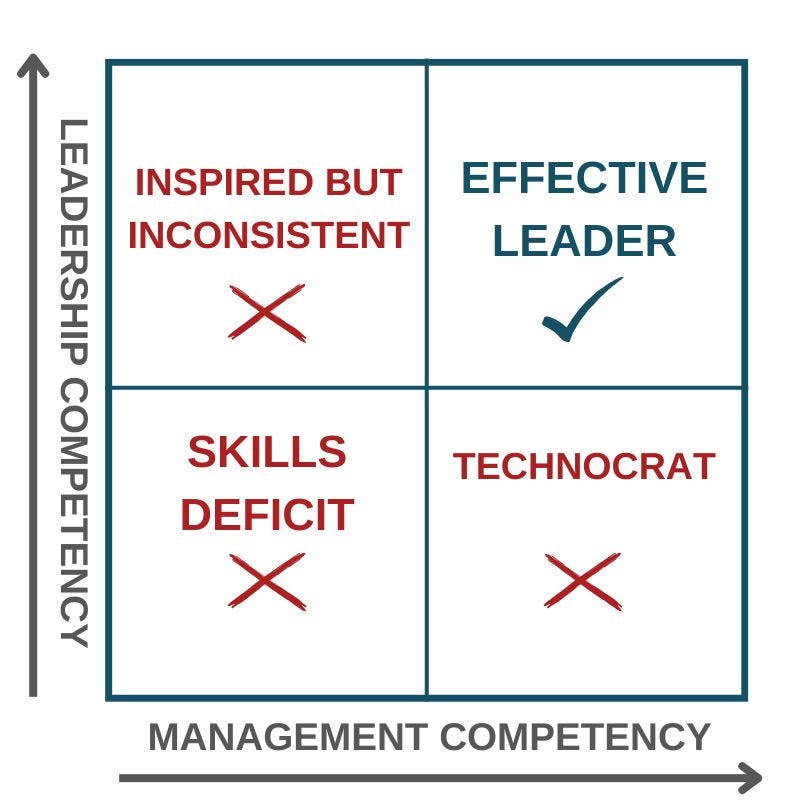
Let’s imagine our usual 2x2 grid.
On the vertical axis, we have leadership competency. On the horizontal axis, we have management competency.
In the bottom left-hand corner is the skills deficit, we find people who possess neither strong leadership skills nor strong management skills. They struggle to create influence, gain authority or inspire confidence because they lack both the vision to lead and the capability to execute effectively.
If you find yourself in that quadrant and want to leave it, then the path forward is clear. Development is required in both areas.
Move across to the bottom right-hand corner and you find people who are highly competent managers but relatively weak leaders.
These are the technocrats.
They are excellent at making sure the train runs on time. They build systems, manage processes and maintain control. They often deliver operational excellence.
What they struggle to do is inspire people.
For so long as people are required to follow them, they will … but the moment people have a choice, they may choose not to. Without leadership, compliance replaces commitment and compliance is the near-enemy of engagement.
Now move up to the top left-hand corner.
Here we find people who are strong leaders but weak managers. This is the home of the Inspired but inconsistent.
These individuals are often highly inspirational. They communicate a compelling vision, energise those around them and make people want to follow them. They can create excitement and momentum. They can even make people feel as though they are ready to run through walls.
The challenge, though, is consistency.
Without strong management disciplines, things become unpredictable. Processes are neglected. Priorities shift. Expectations become nebulous, unclear and even disconcertingly quixotic.
Over time, people may begin to lose trust, not because the leader lacks passion or good intentions, but because the experience of working with them becomes ambiguous and inconsistent.
For visionary leaders, this can be particularly frustrating. They can see possibilities that others cannot see, yet they struggle to bring people with them because they lack the systems and disciplines needed to turn vision into reality.
Which brings us to the top right-hand corner.
This is where we should all aspire to be. This is the Effective Leader.
Here we find the combination of strong leadership and strong management. People are inspired because there is a compelling vision. They are confident because there are effective systems and processes.
They know where they are going, why they are going there and how they are going to get there. This combination creates trust, consistency and results. It is the perfect confluence of vision and execution.
So, don’t think of management as a dirty word. Far from it.
Management is what allows leadership to land consistently, be replicated effectively and scale successfully. Without leadership, organisations can become efficient but directionless. Without management, they can become inspirational but chaotic.
Comments
Nothing yet. Say the first thing.
Sign in to join the conversation.