
This week, we’re continuing our short series on leadership and management with my slight adaptation of one of my favourite leadership models: Hersey and Blanchard’s Situational Leadership.
Why is it one of my favourite models?
Quite simply because it provides a developmental pathway for people.
If you assume that the ultimate goal of leadership is to create individuals who are fully empowered, capable of standing on their own two feet, fulfilled in what they do and all pulling in the same direction, then Situational Leadership provides a practical framework for helping people get there.
The reality is that nobody arrives on day one as ‘the finished article’.
Every new team member joins you with a certain level of competence and confidence, but they do not yet know you, your organisation, your culture or your ways of working. As a result, they need different things from their leader at different stages of their development.
Let’s use our usual 2x2 grid to illustrate the model. On the vertical axis, we have a supportive management style. On the horizontal axis, we have a directive management style.
Rather than viewing the quadrants as fixed positions, think of them as stages on a developmental journey. This is a pathway and people typically begin in the bottom right-hand corner with the first of four stages that I like to think of as Tell, Show, Ask, Empower.
At this first stage -the ‘Tell’ stage- their competence and confidence in the specific role are relatively low. They need structure, guidance and clarity. As a leader, you therefore need to start out being more directive. You are providing clear instructions, setting expectations and telling people what needs to be done.
This is much closer to a form of basic supervision rather than a more sophisticated or empowering style.
As time progresses, though, you provide training, support and mentoring. You help people understand not only what to do, but also how things are done within your organisation.
Gradually, they move into the top right-hand quadrant where they gain more confidence and competence. This is the ‘Show’ stage.
Here, while there is still some direction from you as a leader, there is also much more support. Your role begins to shift from simply ‘telling’ people what to do towards ‘showing’ them how to do it and ‘asking’ them how they are seeing things and helping them to think for themselves.
This is where mentoring becomes increasingly important.
You are still guiding, but you are also helping people build capability and confidence through demonstration, feedback and encouragement.
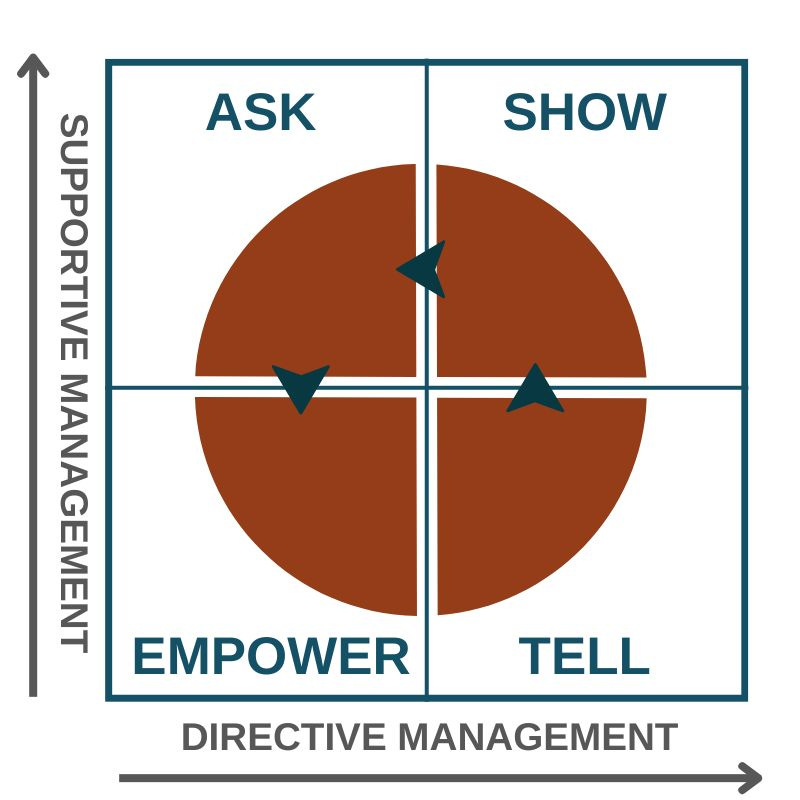
As development continues, people then move into the top left-hand quadrant. Although Hersey & Blanchard say that coaching starts in the top right-hand box, it is in the top left where a genuine coaching style begins to emerge. This is the ‘Ask’ stage.
Rather than providing answers, you start asking questions, which is a ‘pure’ coaching approach. Questions like, “What worked particularly well?”, “What would you do more of?”, “How could you make that even better?” and, “How would you approach that differently next time?”
At this stage, the focus shifts towards ownership, accountability and self-awareness. You are helping people think for themselves and develop their own judgement.
This is where empowerment really begins to take shape.
Finally, we arrive in the bottom left-hand quadrant. This is the stage of delegation and empowerment.
People are highly competent, highly confident and capable of operating autonomously. They no longer require close supervision or constant guidance. They understand the objectives, they understand the culture and they have the capability to make sound decisions independently.
At this point, they become a genuine force multiplier for the organisation.
Instead of waiting to be told what needs to be done, they are already identifying opportunities, solving problems and taking action.
They have moved from being dependent on leadership to becoming leaders of their own work.
For me, that is the real power of Situational Leadership.
It reminds us that leadership is about adapting our approach to meet people where they are and helping them progress to where they are capable of being. Done well, it creates more capable individuals, stronger teams and a more resilient organisation.
We’ll build on that idea next week as we explore different leadership styles in more detail.
Comments
Nothing yet. Say the first thing.
Sign in to join the conversation.