
When I was at art school there was a quiet suspicion of skill. It was often spoken about as though it belonged to another age, an outdated concern that sat uneasily within a progressive culture of contemporary art.
What people usually meant was technique. In an increasingly pluralistic art world, where artists might work with tents, party balloons or discarded objects as readily as paint or clay, it seemed unnecessary to teach traditional methods. If there was no single medium, surely there could be no single craft. There was some truth in this. Contemporary art had rightly expanded what counted as artistic practice. But somewhere along the way we confused technique with skill, and in doing so lost sight of something more fundamental. Skill is not simply knowing how to handle paint or carve stone. It is the disciplined cultivation of attention.
Perhaps this explains why life drawing remained such an awkward subject within many art schools. Students who had no intention of painting or sculpting the figure questioned why they should spend hours drawing from observation. It seems a reasonable question until we ask another. What if life drawing is not really about drawing the figure at all? What if it is about learning to see?
Learning to see has become the mantra of my own life. From the moment I wake and open my eyes, I am engaged in that practice. Even meditation, although it may involve closing my eyes, is another way of seeing. There is an outward seeing that asks, What is this? There is an inward seeing that asks, Why does it matter?
But there is also another question that is too often overlooked.
How is it? Everything we know arrives through this “how”. We touch, taste, smell, listen, move, resist, adapt and respond. We come to understand the world not simply through abstract thought but through our bodies.
Drawing is one of the great disciplines of this embodied attention.
When we draw another person we are not merely describing a body. We are translating an encounter into marks. Each mark is a judgement about proportion, weight, balance, rhythm, pressure, light, shadow, distance and movement. It asks for equivalents not only to sight, but to touch, sound and even memory. Drawing is, at heart, an act of metaphor. Each mark quietly says, “This stands for this.”
The same is true of copying. Copying great paintings has long been dismissed as mechanical imitation, but good copying is anything but mechanical. It is an attempt to borrow another artist’s eyes.
To copy well is to notice the decisions that are otherwise invisible: the hesitation before a brushstroke, the adjustment of an edge, the layering of colour, the pace at which one surface meets another.
You begin to understand not simply what the painting looks like but how it thinks. The choreography of its making becomes visible.
Copying is therefore not the opposite of originality. It is one of its foundations.
Originality is often misunderstood as novelty, as though making something new requires abandoning everything that came before. But originality always has a lineage. Every painting enters into a conversation with other paintings, whether it acknowledges them or not. Originality is not the rejection of tradition. It is tradition continuing to speak in a new voice.
Perhaps this is why craft has quietly returned to contemporary art.
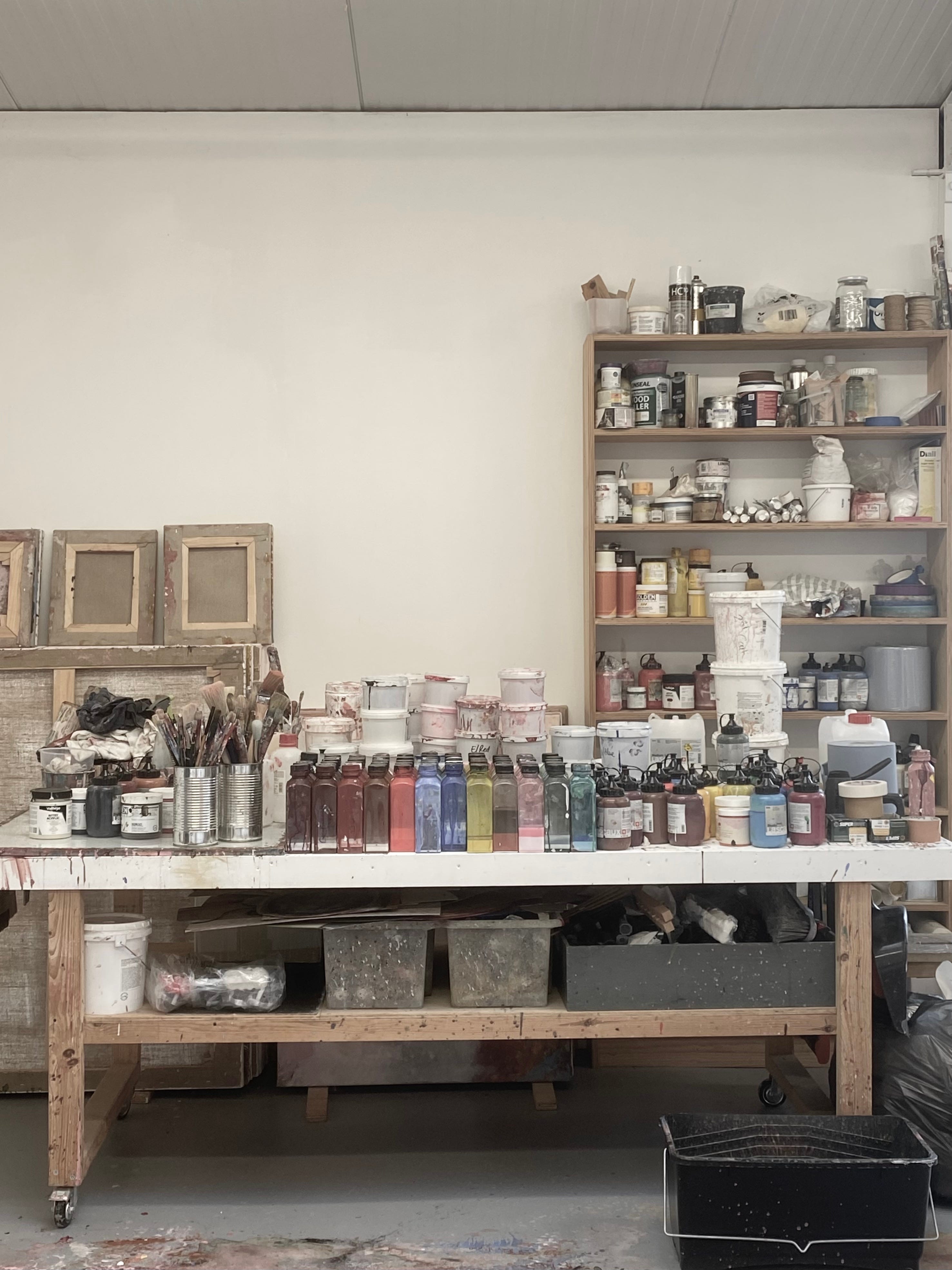
The renewed attention given to ceramics, weaving, textiles and other material practices has reminded us that knowledge lives in the hands as much as in the intellect. Some of the most exciting work being made today emerges from traditions that were once dismissed as merely decorative or functional. Painters, however, have sometimes forgotten that painting has its own craft. I am often surprised by how little many painters know about the material conditions of their work: pigments, binders, grounds, primers, drying times, absorbency, solvents and the behaviour of different surfaces. It is perfectly possible to make paintings without this knowledge. Many people do, but something is often missing, the work begins to resemble an image rather than a painting.
I remember a tutor once telling me, “Respect your turpentine.” It sounded almost absurd at the time. Years later I understand exactly what he meant. He wasn’t talking about solvents, he was talking about relationship. To paint well requires intimacy with your materials. Not mastery in the sense of control, but familiarity born from years of attention. Over time you come to recognise the subtle differences between pigments, mediums and surfaces almost instinctively. Even with my eyes closed I can tell the difference between Viridian and Sap Green by the weight of the tube in my hand and the feel of the paint beneath the brush. Different thinners move differently across the surface. Different grounds receive paint differently. Change the material and you change the painting.
There is no single way to paint. There never has been.
But there are crafts that can be learned, sensitivities that can be cultivated and habits of attention that deepen our relationship with making. Craft matters because it is where thought becomes embodied. It is where feeling acquires form. An accomplished painting is not simply well made. It carries weight and lightness, certainty and hesitation, clarity and ambiguity. It invites us into a relationship rather than announcing itself to us. Who hasn’t walked into another artist’s studio and been moved simply by the smell of paint hanging in the air like incense? Before we see the paintings we encounter a way of life.
So perhaps the rejection of skill in art education contained both an insight and a mistake.
Its insight was that artists need freedom. No tradition should become a prison. Every generation must remain open to new materials, new ideas and new forms of practice. But freedom without craft becomes strangely weightless.
Technique alone is not enough, but neither is theory. Skill is something larger. It is the patient cultivation of perception. The traditions of drawing, painting and making are not valuable because they prescribe what artists should create. They matter because they shape the quality of our attention. They teach us to notice more, to feel more deeply and to enter into richer relationships with the world. In the end, we do not simply make art through our skills. We see through them.
Matthew Burrows
If these are questions that interest you, I’d love you to join me for Studio Conversations. Each programme is a small community of artists exploring not simply how to make stronger work, but how to build a deeper, more attentive relationship with their practice. The conversations are generous, thoughtful and rooted in the belief that art is, above all, an act of listening.
Across five weekly sessions we’ll discuss:
subject, theme, and motif
influence and provenance
process and resistance
artistic identity and context
meaning, continuity, and sustaining practice
The sessions will be a space for reflection, exchange, critical thinking, and serious engagement with the realities of making work over the long term.
The next cohort begins Monday 16th November 2026.
5 weekly Zoom sessions
90 minutes each
recordings and notes included
discussion space between sessions
More information and registration here:
No posts
Comments
Nothing yet. Say the first thing.
Sign in to join the conversation.