

It’s an insult to call someone a “cynic.” In modern dictionaries, the cynic believes everyone is self-interested. But the word’s connotation conveys something more than that, a bitterness. The cynic sucks. They’re negative all the time. They make snide remarks. They put down someone’s earnest best efforts. We don’t like the cynic and the cynic doesn’t like us, asshole.
The great irony, of course, is that we Americans have erected a cynical society on cynical foundation, even if we won’t always face up to it.
Consider the premise of democracy, a social contract between individuals who are presumed to be the best advocates for themselves. You have been constitutionally entrusted to know better than a king what’s good for you; off you go to pursue “life, liberty and the pursuit of happiness,” the greatest declaration of self-interest ever committed to paper.
And therein lies the paradox of democracy for the social reformer: If we’ve created a society for everyone to pursue their own best interests, this presents the unpleasant possibility that the cynic who sees self-interest everywhere is the only one accurately describing what’s actually going on.

In his 1993 book “Love & Friendship,” the archconservative Allan Bloom observed that a democracy of atomistic contractual relationships is built on a foundation of perpetual low-grade social anxiety. Any of our relationships could be cut off at any moment if we no longer serve someone else’s purposes:
The psychological effects of this unending alert are devastating. A being concerned only with himself has to spend his time worrying about the intentions of others and trying to hide his own from them, threatening, flattering, lying. In his selfishness, he forgets himself. His soul goes wandering out over the world of men and never returns, while he becomes hypocritical, envious, vain, slavish, measuring himself relative to the success or failure of others. This is the condition of alienation, which Sartre defined as “Hell is — other people.”
When out in the world with our neighbors, friends and lovers, we walk on loose rough gravel, where anyone’s footing could slip at any moment. I remain haunted that the great humanistic economist Albert O. Hirschman spent his career confounded by Mancur Olson’s work on the irrationality of collective action,1 wherein being a free rider and letting others do the work of fixing society becomes likelier the bigger the problems get.
The guilty thrill of reading a cynic is like the sting of scalding hot water in the shower when it’s sending caked-on mud and dirt down the drain.
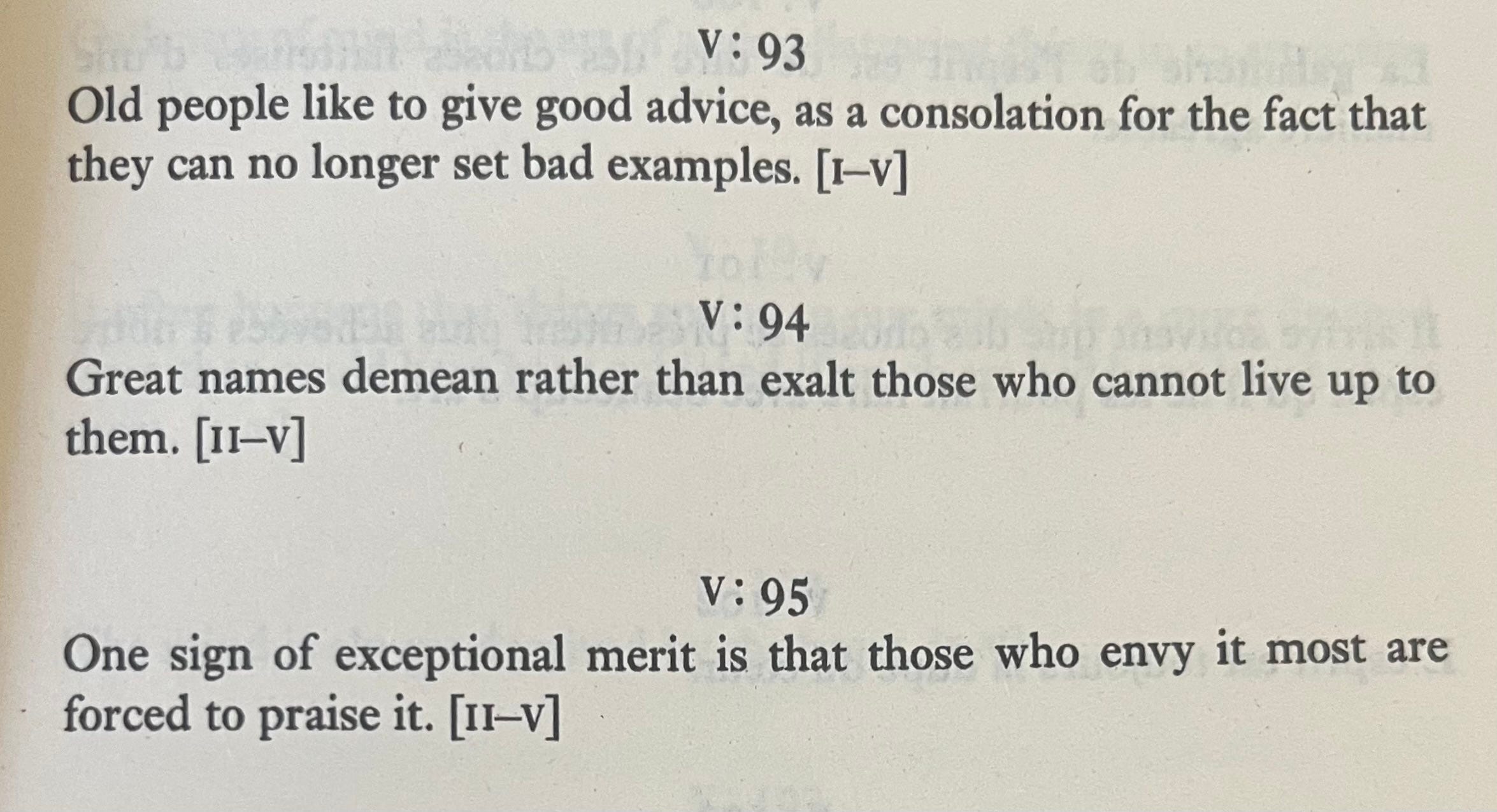
The acerbic maxims of the French noble François de La Rochefoucauld (1613-1680) have exactly this power-washing pleasure. For La Rochefoucauld, self-interest made the world go ‘round. Whatever appeared to be virtue was, for him, exactly that: the appearance of virtue, a false storefront for a reputation-laundering operation busy at work in the back.
I especially loved this couplet of La Rochefoucauld’s maxims:
We often pride ourselves on our passions, even the most criminal ones; but envy is a timid, shamefaced passion, which we never dare to acknowledge.
Jealousy is, in a way, just and reasonable, because its aim is merely to retain something that belongs to us, or that we think belongs to us; whereas envy is a frenzy that cannot endure the fact that other people possess anything.
But can there be some greater end for the cynic than depressing everybody about the suffocating realities of self-interest?
In Jane Austen’s “Pride and Prejudice,” there is the spectacular collision between the story’s two great social perceivers, Elizabeth Bennet and Mr. Darcy. They notice subtle faults and pierce through vanities, including each others’: the Bennet family really is an embarrassing mess, and Darcy really is too scornful to love. For Elizabeth and Darcy to be together too early would be a condescension. It takes Elizabeth’s refusal of Darcy’s desperate offer of marriage — a rejection of self-interest in not marrying one of the most eligible men in England — to prove she’s not merely another one of Mr. Darcy’s many possessions. But this, too, was an act of pride that would need to be overcome, like Mr. Darcy’s prejudices, in order to submit to the happy ending and its declarations of mutual surrender.
Or take one of the greatest cynics in literature, Gustave Flaubert, who practically suffocated me with his ruthless pinioning of human vanity in “Sentimental Education.”2 (“Flaubert’s colossal poetic instrument, his genius of language, was destined to the excruciating labor, a self-crucifixion, of depicting a scene and personages that nauseated him,” Bloom writes.) There is not much redemption to be found in Flaubert apart from the elegance of the prose and the accuracy of observation for accuracy’s sake.
But toward the end of the great novel “Madame Bovary,” there strangely appears a respectable character amid all the idiocy of men around Emma Bovary’s deathbed. “The apparition of a god would not have caused more commotion,” Flaubert writes of the enigmatic Dr. Larivière’s arrival:
He belonged to that great line of surgeons that sprang from Bichat, that now-vanished generation of philosopher-healers who cherished their art with a fanatical love and practiced it with zeal and sagacity. When Dr. Larivière was angry, the whole hospital quaked. His pupils revered him to the point of trying to imitate him in everything as soon as they set up in practice themselves; consequently, every town for miles around had its replica of his long merino greatcoat and his loose black jacket, the cuffs of which hung down unbuttoned over his firm hands beautiful hands, always ungloved, as though to be the readier to plunge to the relief of suffering. Disdaining all academic honours, titles and decorations, hospitable and generous, like a father to the poor, practicing virtue without believing in it, he might almost have passed for a saint had not his mental acuity caused him to be feared as a demon. Sharper than a lancet, his eyes looked straight into your soul, piercing through all pretence and reticence to dissect the lie beneath. So he went his way, in all the easy majesty that comes of the consciousness of great talent, wealth and forty years of hard work and irreproachable living.
For Bloom, it was the quality of “practicing virtue without believing in it” that set Dr. Larivière apart from all of Flaubert’s other fools and madmen: a sort of artist’s statement about the importance of stripping away bullshit. (See last week’s newsletter.3)
“Larivière does not fit into the plot of Madame Bovary” — he’s too late to save poor Emma from the arsenic — “but he is not to be ignored as a human possibility,” Bloom writes. If there is someone who would heal the world, the first requirement would be to see its injuries clearly.
“The Logic of Collective Action: Public Goods and the Theory of Groups,” Mancur Olson Jr., 1965.
No posts
Comments
Nothing yet. Say the first thing.
Sign in to join the conversation.