
In this time of tech hyperbole, it’s trite to call something a “platform,” but a good city really is a platform. The building blocks of the city —the sidewalks, the intersections, the fire escapes, the physical and social fabric— should be flexible enough to knit and unknit itself to meet different moments. For the last month, major corporations, the government, your bodega guy, were all busy transforming whatever patch of concrete they could get their hands on for one thing: To watch the New York Knicks play basketball. The Knicks’ championship run animated an urban metamorphosis on a scale I’ve never seen. In my lifetime, nothing that wasn’t a disaster has occupied the city so totally for weeks at a time. In past years, I have parked myself at Wing Bar on Smith Street for Knicks playoff runs (frankly, I’m still getting used to that being a yearly occurrence), and this year, the surrounding intersection became a laboratory for watch-party-urbanism. Wing Bar turned their TVs streetward to give people outside a view, causing scenes like the one below. This street was no longer for walkin.
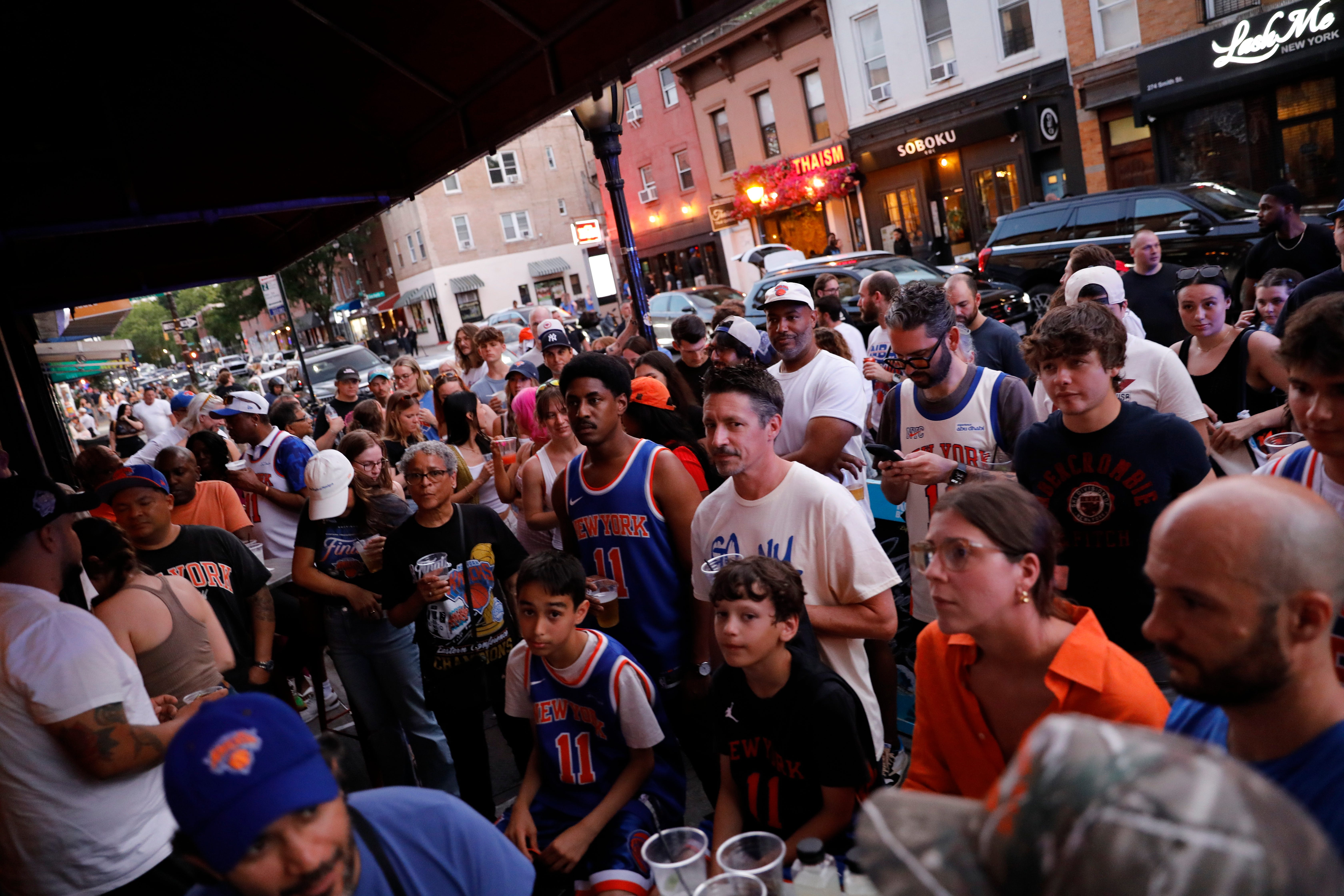
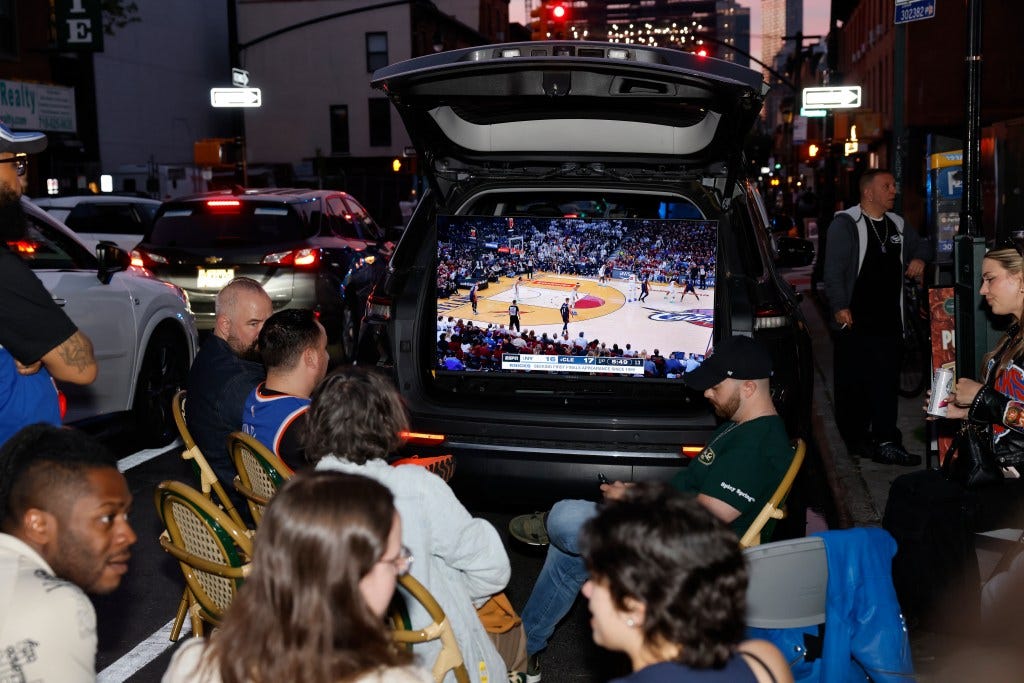
At some point during the conference semi-finals, a guy who had an arrangement with a neighboring pizzeria pulled up in an SUV with a TV in the back to create a watch party in the parking lane. For the first game of the finals, it was chairs requisitioned from the pizza shop; by game 2, the community had supplemented it with beach chairs and camping stools.
After game 3, the Knicks’ only loss of the series, the heavily Italian-American contingent in charge of this whole thing blasted My Way by Frank Sinatra as disappointed fans streamed out of the nearby bars. I caught a man twirling his partner around to Frank’s defiant croon and instantly felt a little better.
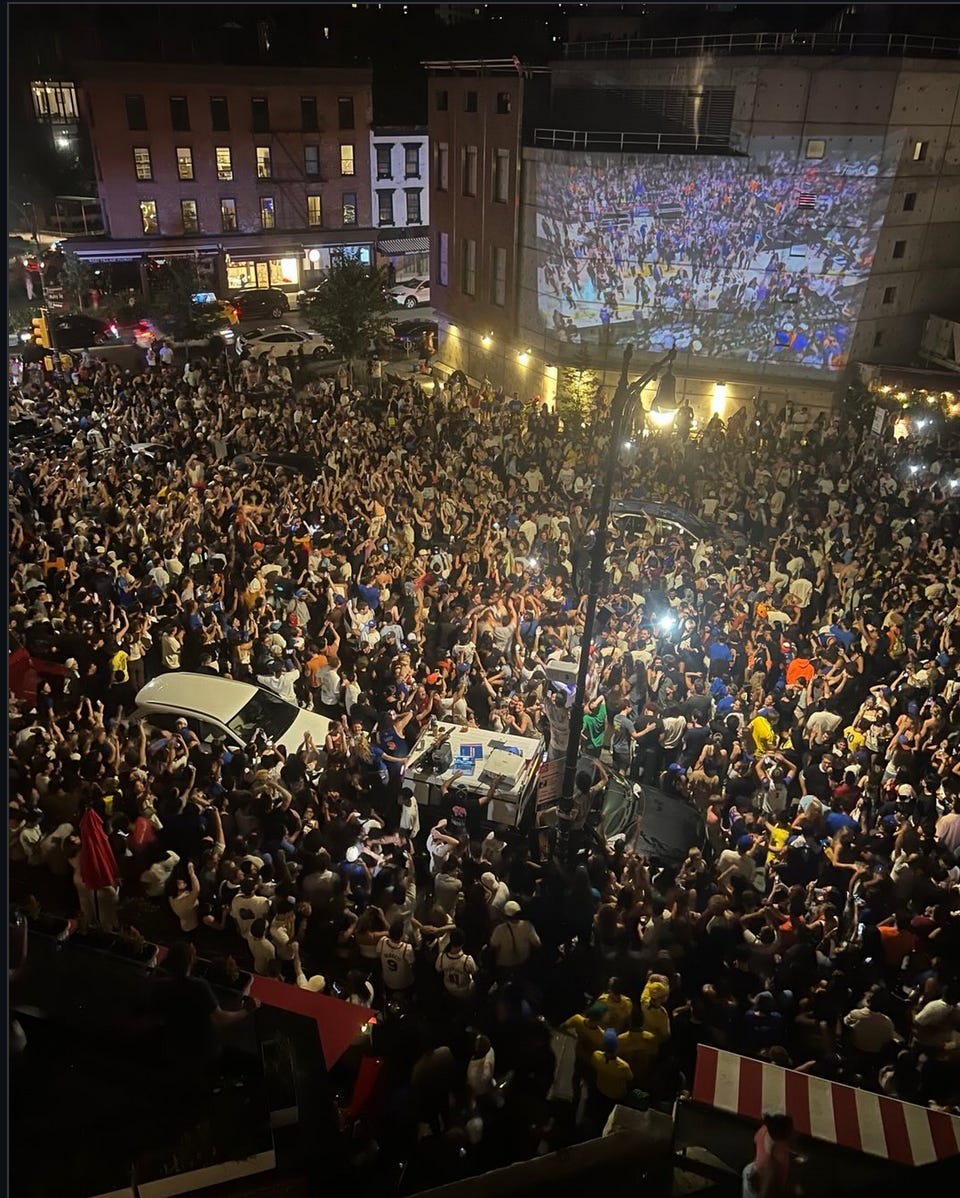
Down the block, Vinny Taliercio, the owner of Smith Union Market, which is definitely not an illegal gambling den, dragged a TV outside his corner store. Several of my friends insist Vinny is a real one and that Smith Union Market may have been a great place to get beer in high school. Old timers formed a ring of camping chairs on the curb facing his store. For game 5, the clincher, someone had set up a projector and aimed it at a blank wall around the corner, possibly taking a cue from a similar setup from the West Village, which had gone viral the game before. The two bro’s who decided to project it from their fire escape are now heroes to many.
Thousands of police officers monitored all of this, but frankly, the Knicks made New York feel ungovernable, mostly for better and sometimes for worse. Theorists who idealize public space frame it as a foundational part of democracy, a place where people of different statuses come together to exchange ideas and learn about each other. A person’s ability to use, without explicit permission, public space is an indication of how free a society is. In cities increasingly controlled by corporations, Henri Lefebvre calls for us to “rescue the citizen as the main element and protagonist of the city that he himself had built,” and use the streets to build collective life. The irony is that politics or democratic ideals didn’t spark this outpouring of grassroots ownership; it was men throwing a ball into a hoop on a team owned by ubercapitalist Jim Dolan.
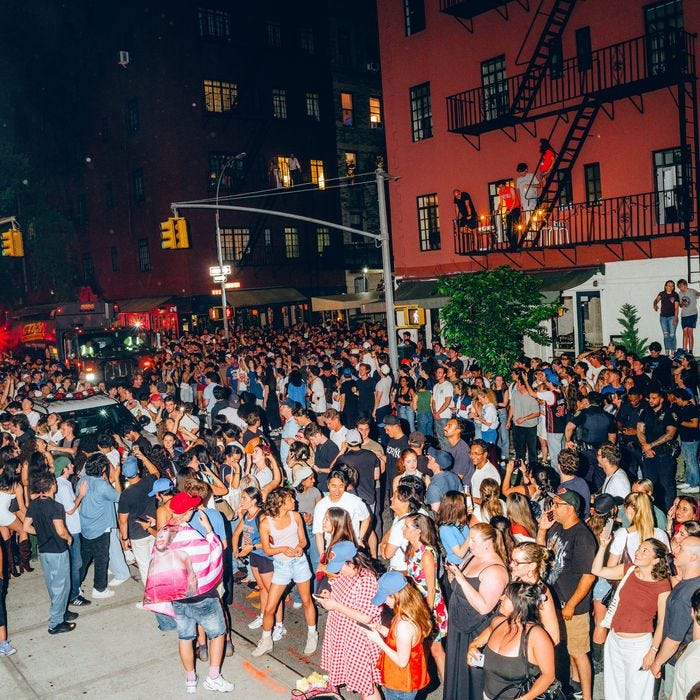
Dolan’s Madison Square Garden Corp, the company that owns the eponymous arena and the Knicks team, engaged in its own watch-party urbanism. MSG’s version of dragging the TV outside was by flexing its access to marquee real estate. The Knicks organized watch parties at Radio City and in the semi-private plaza adjacent to the arena. The arena itself became a watch party during away games, offering fans their only opportunity to get in the building and watch a Knicks game (albeit on the Jumbotron) without a ticket that cost three thousand dollars. Around these Manhattan events, there was a disturbing amount of social-media-fueled bonehead behavior. Streamers donned Spurs jerseys and attempted to run the gauntlet of Knicks fans in Midtown, and phone-wielding teens attempted to rip the jerseys off them. People got beaten up, vehicles were smashed, and set on fire. After Dolan soured the vibes by inviting President Trump to game 3 of the finals, the NYPD announced that the security perimeter in place for the President’s visit would remain throughout the rest of the series. “MAYOR MAMDANI AND POLICE COMMISSIONER TISCH ARE NEW YORK CITY’S BIGGEST PARTY POOPERS” — MSG announced in a press release. Dolan hurried to WFAN to give a radio interview and accuse Mayor Zohran Mamdani of not being a real Knicks fan for canceling the watch parties, and criticized Jessica Tisch for not being able to control the public.
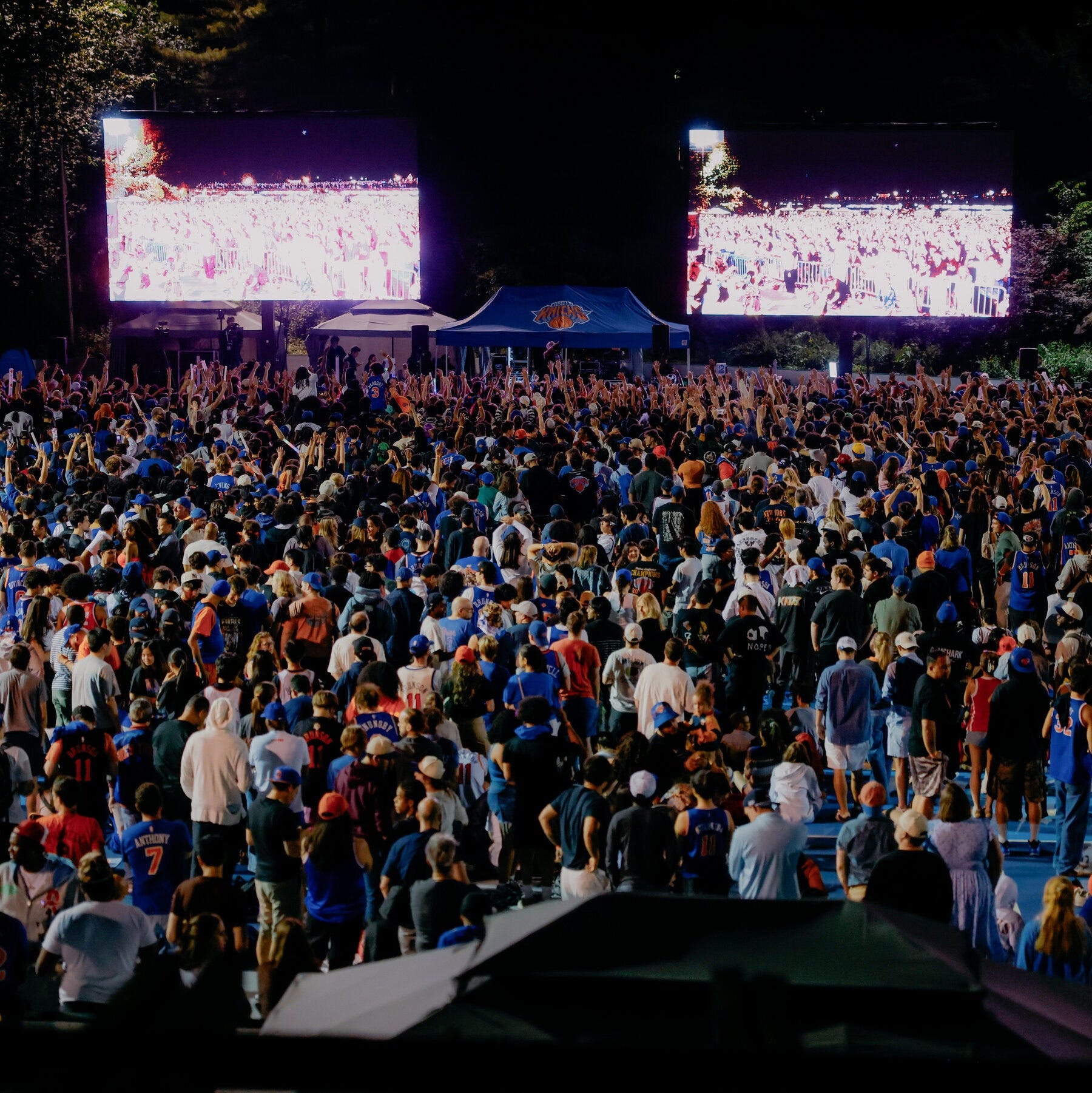
Why Dolan, a fan of enhanced security to say the least, would pick a fight with one of the most media-savvy and popular politicians in his city is beyond me. Mamdani simply tweeted the permit application MSG had submitted for the Game 4 watch party, a permit the city had approved, undercutting Dolan’s story. The bureaucrat in me was tickled that permitting drama was at the top of every local news cycle. Simultaneously, the Mayor announced that the city would stream the game for free on 150 LinkNYC Kiosks around the city, in addition to the free Central Park watch party already planned — flexing a bit of municipal muscle to beam the game to even more people.
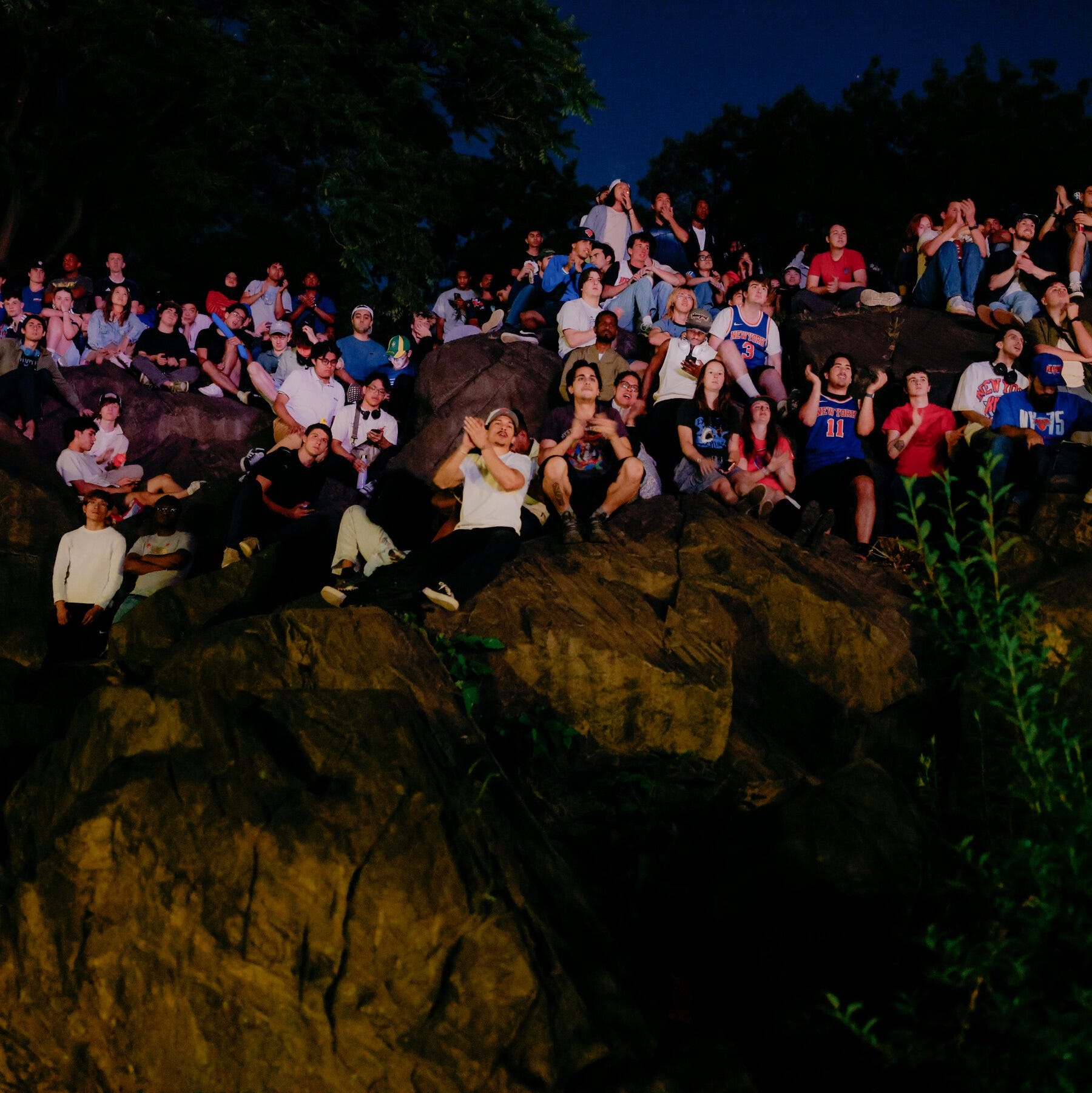
The rowdiness going on in Midtown ranged from distasteful to disgusting, but what I saw with my own eyes around Brooklyn was incredibly wholesome. The parking space watch party was eventually shut down before game 5 by the cops after excessive noise complaints (A pointless gesture, I don’t think there was any less noise). A popular viewing party at Cafe Habana in Fort Greene was told by the authorities to turn off its projector after the crowd outside grew so large that it spilled into the bus lane and oncoming traffic of Fulton Street. But in five late nights out, I saw no violence and no destruction. Sure, there was a little climbing and yelling, but of the joyous, not the mischievous kind. “This is kind of like reverse 9/11.” Someone tweeted, and while it might be a distasteful analogy, there is something to it. Disasters unite places because we all fear death and understand destruction. Positive sources of unity are much rarer, especially in this tribal era. The Knicks might be one of the last for NYC.
I don’t fully buy Mamdani as a Knicks fan; he doesn’t have much public history with the team, unlike his true love, the English soccer team Arsenal, but in an interview with the Ringer’s Katie Baker, Mamdani put the whole thing quite well.
“It’s the TV in the trunk of the car… It’s watching it on LinkNYC. It’s pulling up to the station and the train conductor singing about the team…I can’t wait for New Yorkers to rediscover their own city. Because there is a temptation to live life in the city the way you’ve been living it for years. You go to the same places. You don’t leave the same set of neighborhoods that you’ve grown up in. And now, in this moment? It’s a chance to see the city anew.”
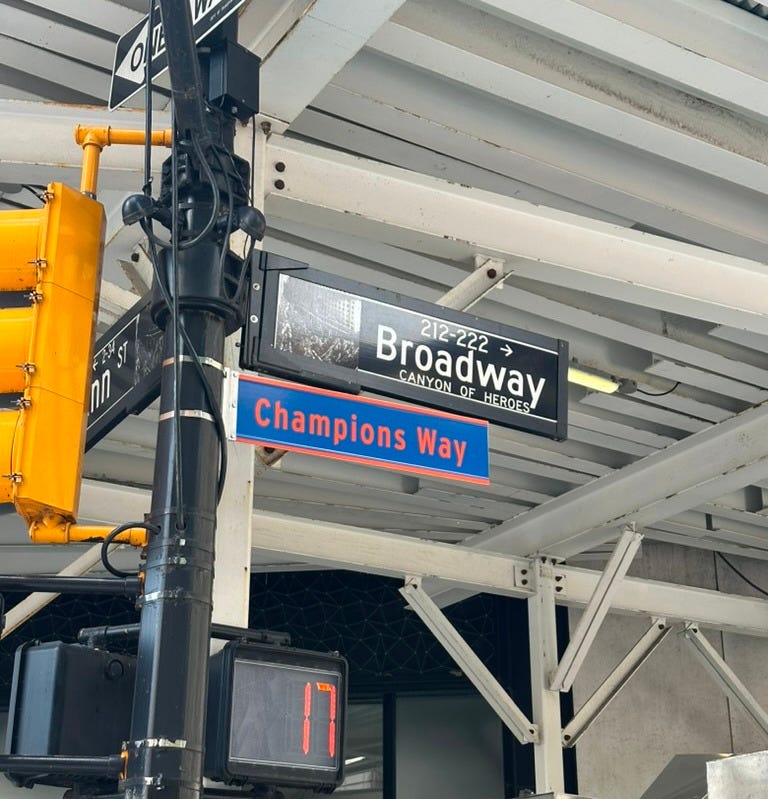
A “chance to see the city anew,” a chance to see a brick wall as a theater and strangers as fellow fans. Let’s remember this even now that the run is over. I tried out my best Norman Mailer impression last year, but allow me to quickly say what this means personally. My mother’s family are all secular Jews, and I always felt like my Knicks fandom was the best expression of my Jewishness, a constant reminder of suffering, but also of the community built by perseverance. “Ahh ahhhh ahhhh, I was born a loooooser” sings Derrick Harriot. You root for something bad so long that you begin to identify with the losing more than the potential of winning. You are forever waiting, but you also find love and happiness in moments other fan bases would consider a blip — Fat Raymond Felton dishing, Toney Douglass scoring a million threes one game in 2011, Clyde Frazier rhyming from the broadcast booth while the team loses, arguing with your college roomate that Jeremey Lin is actually good and is definitly not a flash in the pan—moments that don’t lead to anything but that you nevertheless imbue with meaning. When the buzzer rang for the last time in game 5, it was like Jalen Brunson had come along and finally made it all add up to something. All the crap, Lebron shunning us, Cleanthony Early getting shot outside a strip club, and a million other moments were just wandering in the desert before we were taken to the mountaintop.
After the win, I emerged red-eyed onto Smith Street and engaged in a lot of hugging and jumping around. I probably said “I love you” to 15 people. We maneuvered onto the Brooklyn Bridge to see the skyline lit up in orange and blue and hype up some passing cyclists. I thought I’d make it into midtown to party all night, but I was drained. I leaned against the bridge’s railing and looked up at its gothic arches, before heading home and, like millions of others, falling asleep the first time a winner.
No posts
Comments
Nothing yet. Say the first thing.
Sign in to join the conversation.