
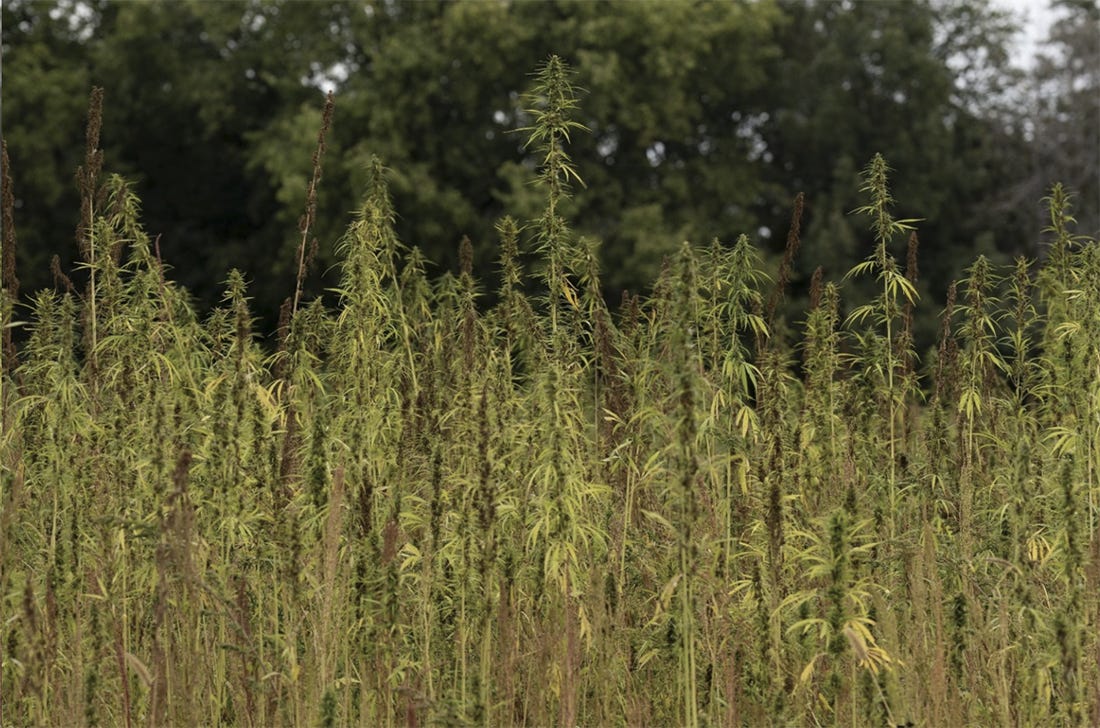
The most productive carbon-capturing crop on earth is not a tree. It grows to full height in four months. It sequesters more carbon per hectare than any other industrially grown plant. And when mixed with lime and water, it becomes a wall — one that keeps storing that carbon for the lifetime of the building.
Hemp has been used as a building material for centuries. The Romans bound it with lime. French builders used it in bridge abutments in the sixth century. British heritage conservators have been quietly reaching for it for decades, because it breathes the way old stone buildings breathe — managing moisture rather than trapping it, regulating temperature without mechanical assistance, and aging without degrading.
What is new is our willingness to take it seriously again.
Hempcrete — the colloquial name for a composite of hemp hurd (the woody core of the stalk), lime binder, and water — is not a structural material. It doesn’t carry loads. But it does almost everything else a wall is supposed to do, and it does it while sequestering carbon rather than emitting it. A hempcrete wall continues to mineralize over time as the lime carbonates, locking atmospheric CO₂ into the wall itself. The older it gets, the more carbon it has stored.
In 2024, hempcrete was added to the International Residential Code — the basis for building law in 48 states. That is not a small thing. The IRC sets the floor for what is permissible to build across most of the country. Every state that adopts the updated code opens the door to builders, contractors, and homeowners who want to use this material without navigating a costly variance process.
The barriers that remain are real. Hemp cultivation in the United States was restricted for decades under federal drug policy, and the agricultural infrastructure to support large-scale hempcrete production is still catching up. Lime sourcing, mix ratios, and installation methods are not yet standardized the way conventional insulation is. The trades knowledge is thin. And code adoption is state-by-state — permissive in some places, uncertain in others.
But the material itself is not experimental. Hempcrete homes in France and the UK have been standing for thirty years with documented performance. The thermal mass is measurable. The hygroscopic behavior is measurable. The embodied carbon is measurable — and it is negative, which almost nothing else in the building material catalog can claim.
At Mattaforma, we think about materials not as products but as relationships — between the land they come from, the labor that processes them, the buildings they become, and the atmosphere they affect. Hempcrete is a particularly clear case of that relationship made visible. The plant pulls carbon from the air. The lime fixes it. The building holds it. The wall, over decades, becomes a slow archive of the atmosphere at the moment of construction.
No posts
Comments
Nothing yet. Say the first thing.
Sign in to join the conversation.