
If you enjoy observations like this from 150+ countries, you can subscribe here.
In Rabat, in Tangier, and along the Atlantic coast where the day doesn’t really end but gradually stretches into the evening, there is a pattern that only becomes visible once you stop trying to define it too quickly. At first it registers as energy, a general sense that something is happening everywhere you look, people moving, talking, gathering, the background never really emptying out. But after a few days, that impression starts to settle into something more precise. It becomes clear that this isn’t activity in the usual sense, not something tied to events or driven by plans, not structured around reasons that need to be explained or justified. It is simply where life unfolds, without needing to announce itself.
The beach is full, but not in the way beaches are full in places where people arrive with a clear intention, settle into a fixed spot, and leave again once that intention has been fulfilled. Here, the beach behaves more like an extension of the city itself, a surface where people arrive, drift, pause, reconnect, and remain part of something that continues around them. People walk without urgency, they stop without explanation, they meet others without planning it in advance, they sit down and stand up again without any visible transition between phases. Children move between groups that are not their own, teenagers begin games that gather participants without introduction, and adults slide into conversations that do not seem to require a clear beginning or a defined end. The longer you watch, the less it feels like a place people visit and the more it feels like a place people remain part of, even as they move through it.
The same structure becomes even more apparent along the corniche in the evening, when the light begins to soften and the temperature drops slightly, because instead of emptying out, the space fills even more.
Children run in loose groups, sometimes far ahead, sometimes circling back, always within a shared field of awareness that doesn’t rely on strict supervision. Parents are present, but not directing every movement, and other adults are nearby, observing without formal responsibility, creating a kind of distributed attention that holds everything together without needing to be organized.
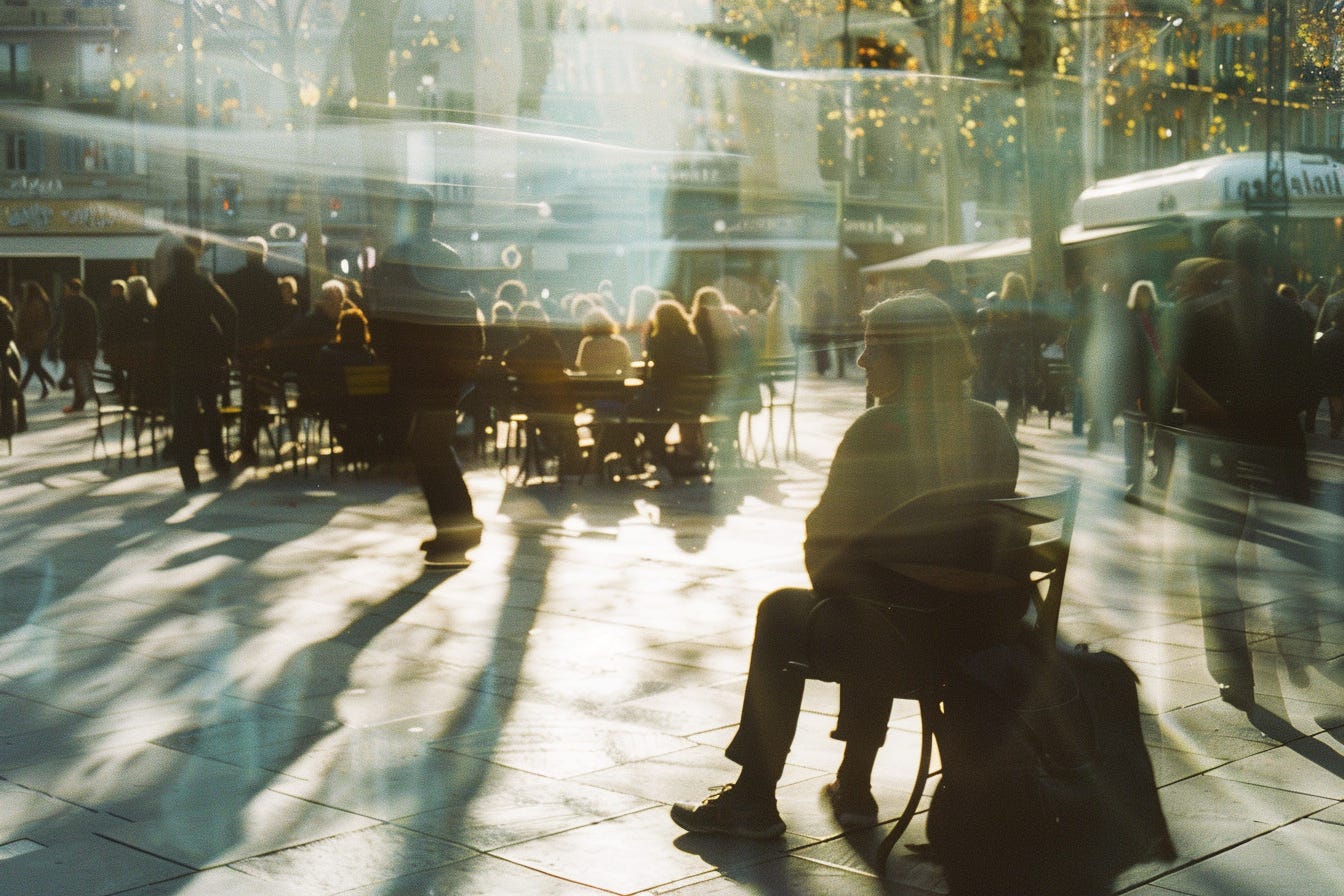
People sit wherever space allows, on low walls, steps, edges of sidewalks, and conversations stretch without any visible pressure to move on. Someone buys tea, someone else brings something small to eat, and these small transactions blend into longer stretches of time that are not being measured or managed. The noise becomes part of the environment, not something that interrupts it, and after a while you stop focusing on individual moments and start recognizing the structure that produces them.
That is the point where comparison begins to emerge almost automatically. In Germany, the day feels more defined, more segmented, shaped by clearer edges that separate one activity from the next. People leave the house with a purpose, complete that purpose, and return. Time outside is often connected to something specific, a meeting, a walk, a reservation, an activity that has been planned in advance, and even social time tends to follow a certain arc, beginning, unfolding, and ending within a structure that has been agreed upon. Children play, but their play is usually contained within spaces designed for it, playgrounds, sports clubs, scheduled activities with defined start and end points, and even when they are outside, there is often a framework around it that explains why they are there and how long it will last. Outside exists, but it is not the default layer of life; it is one option among many.
What becomes clearer the longer you observe both environments is that the difference is not about how often people go outside, but about how much of life is allowed to take place there without needing to be organized first.
In Morocco, the boundary between private and public life feels more open, almost permeable, in a way that allows the street to function not only as a connection between destinations but as a place where time can accumulate. You do not need a reason to remain there, and that absence of justification changes how space is used. In more structured environments, presence tends to require a reason, a plan, a purpose that explains why you are there and what you are doing. Time becomes something you allocate rather than something you let expand.
That shift changes how interaction happens at a fundamental level. When life unfolds in shared space, interaction does not need to be initiated deliberately. It emerges from proximity, from repetition, from the simple fact that people are there at the same time. Children find each other without coordination, adults run into each other without planning it, conversations begin without a trigger and dissolve without a formal conclusion. The environment itself produces connection. When life moves inward, interaction becomes something you arrange. You decide who you see, when you see them, where it happens, and how long it lasts. The result is efficient and often comfortable, but it is also contained, shaped by intention rather than generated by the surroundings.
You can feel the shift immediately when crossing into a place like Ceuta, where the infrastructure is similar and the density is comparable, but the way people occupy space changes noticeably. Movement becomes more directed, more purposeful, less intertwined. People are present, but they are less entangled with each other, and children, while visible, are more confined to specific areas. The street becomes a passage again, a space you move through rather than a space you inhabit, and once you notice that shift, it becomes difficult to ignore.
At that point, the question of what creates this difference begins to surface, and the answers are never singular.
Weather plays a role, because warm evenings extend the day and make it easier to stay outside without effort, but that explanation does not fully account for what is happening. There are warm places where life still retreats indoors early, and colder places where shared space remains active in ways that feel surprisingly resilient. Wealth also plays a role, because the more private space you can afford, the less you depend on shared space, and over time, that independence reshapes habits. When your home provides comfort, entertainment, and privacy, the outside becomes optional, and optional behaviors tend to fade if they are not reinforced.
What seems to matter more than any single factor is whether shared space still functions as a primary layer of daily life or whether it has become secondary. In places where it remains essential, it stays active, absorbing time, interaction, and presence without requiring coordination. In places where systems have reduced that dependency, life becomes more self-contained, and public space becomes something you use rather than something you inhabit.
Nothing about that shift feels immediately problematic, because it works. It creates efficiency, predictability, and comfort. But it produces a different experience of being in a place, one where much of what happens remains hidden from view. When you walk through a city where life is mostly internalized, you see activity, but you only see part of it. The public layer becomes thinner, more functional, less expressive. In places where life remains external, activity becomes visible, and you see not only what people are doing, but how they are spending time without doing anything in particular. Presence itself becomes part of the environment.
Children reflect this difference more clearly than anything else, because in environments where shared space is active, they integrate into it naturally, moving through it, learning to read it, interacting within it without needing constant direction. Their world expands through exposure rather than through structured experiences. In more contained environments, childhood becomes more segmented, movement is guided, interactions are organized, and much of what they experience is mediated through systems designed to optimize safety and efficiency. Both approaches create stability, but they shape a different kind of presence.
What you begin to realize, walking through these places, is that the feeling of a city has less to do with its design than with how much life remains visible within it.
The same street can feel entirely different depending on whether it is used as a passage or as a place where people stay, and in Morocco, people stay. They remain without needing to move on, without compressing the moment into something defined, and within that slight expansion of time, interaction becomes easier, more fluid, less deliberate.
You feel it most strongly in the evening, when other places begin to close down and these cities continue, when the temperature drops, the light softens, and instead of retreating, people come out. The day does not end; it shifts, and with that shift, the city becomes more itself.
After a while, the question stops being analytical and becomes personal, because you begin to notice where you feel more at ease, in environments where life is structured and contained, or in environments where it remains visible and shared. And that question stays with you, because in the end, choosing a place is not only about what exists there, but about where life actually happens once you are inside it.
If you want to receive future field reports
and notes from 150+ countries, you can subscribe below.
No posts
Comments
Nothing yet. Say the first thing.
Sign in to join the conversation.