
If you enjoy observations like this from 150+ countries, you can subscribe here.
I grew up on a short street.
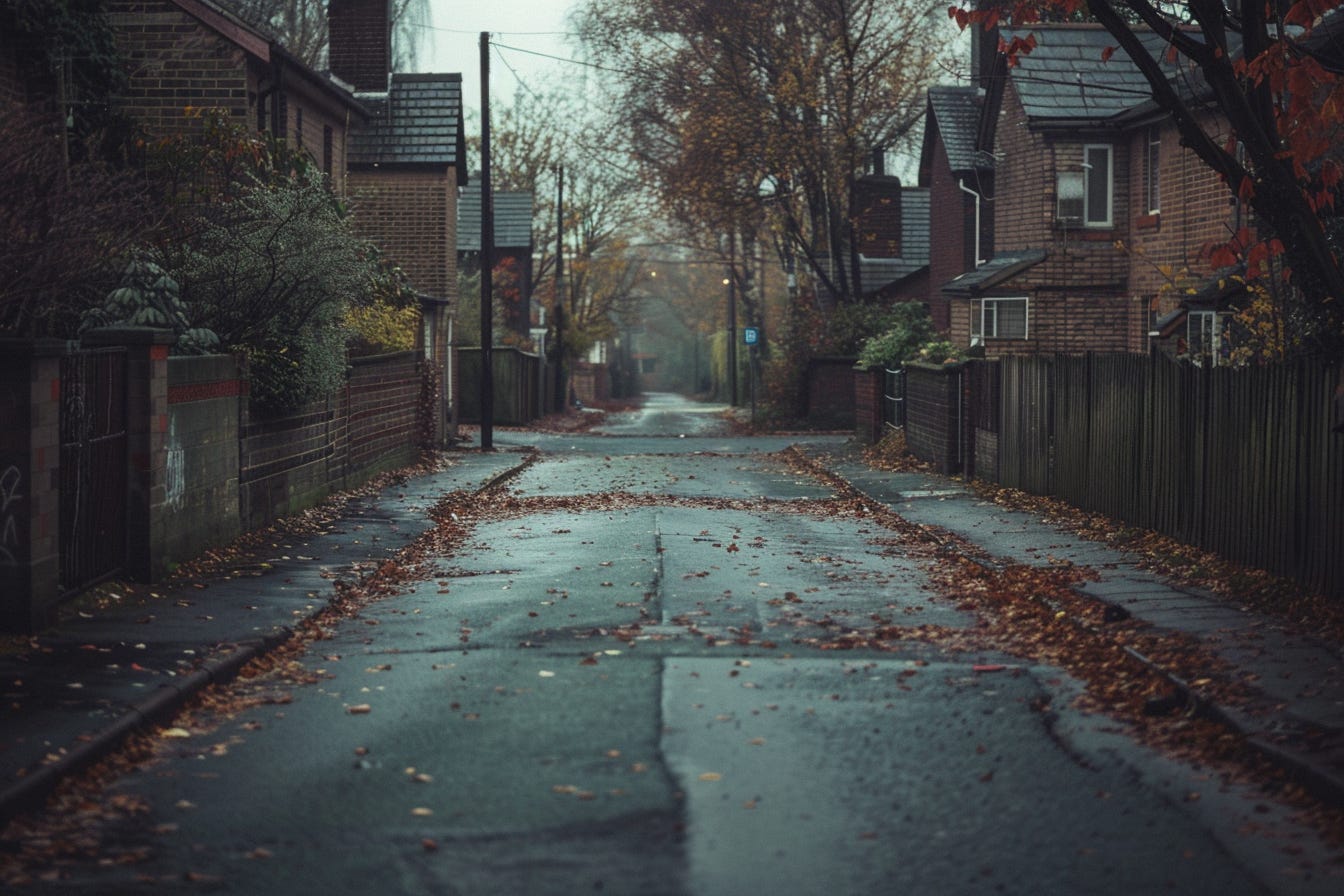
It wasn’t special in any obvious way. Maybe one hundred and fifty meters long, branching off from a normal road in a quiet neighborhood near Munich, nothing that would stand out if you drove past it without looking closely. At the end of that street, there was a small bridge over a narrow stream, barely two or three meters wide, more something you stepped through than something you crossed. Beyond it, a thin strip of forest, and behind that, open fields that stretched far enough to feel like distance when you were a child.
Some of those fields were used for strawberries. Others for crops. If you kept going, maybe three hundred meters further, there were two lakes, one where people swam, one used more quietly, surrounded by trees, less visible, almost hidden unless you knew it was there.
All of it belonged together.
And inside that space, there were always children.
Five in one house, two in another, one here, one there, all roughly the same age, close enough that nobody had to call anyone in advance. You stepped outside and someone was already there, or someone appeared a few minutes later, or you walked ten meters and found the next one. The street wasn’t something you crossed carefully. It was something you used.
We played football directly on the asphalt, moved goals made from jackets or stones, stopped when a car came and continued immediately after. We went into each other’s gardens without asking, not because there were no rules, but because the rules were shared and understood. One house had a small pool, another had space to build things, another had a mother who decided one afternoon that we would all try working with clay, and suddenly that became the activity for the day.
Nothing had to be planned.
You stepped outside, and the day assembled itself.
Sometimes that meant staying on the street, sometimes it meant crossing the bridge and walking into the water, standing in it because it was shallow enough to feel safe, sometimes it meant disappearing into the trees to work on something that looked like a treehouse but was mostly an unstable construction that collapsed every few weeks and got rebuilt again. On other days, we rode our bikes out toward the fields, picked strawberries when they were in season, or continued all the way to the lake, where time stretched even further because there was no clear reason to leave.
There was no real transition between one thing and the next.
It just flowed.
The day ended when it got dark. Not at a fixed hour, not because someone had decided in advance, but because visibility disappeared and one mother after another leaned out of a window and called a name. You heard your name eventually, or you followed the others as they left, and that was enough structure for it to work.
Looking back, what made it function wasn’t just freedom.
It was the way everything connected.
You could move without interruption. The street led into the gardens, the gardens into the bridge, the bridge into the forest, the forest into the fields, and the fields into the lake, and at no point did you have to stop and re-enter under different conditions. There were no clear breaks that forced you to reset. You stayed inside the same world the entire time.
Time worked the same way. You didn’t divide the day into segments. You didn’t move from one activity block to another. You stayed outside, and whatever happened filled the hours until something else replaced it. There was no sense of starting and finishing something properly, just a sequence of moments that blended into each other without needing definition.
And there were always other people.
You didn’t need to arrange anything. You didn’t need to check who was available. You didn’t need permission to join or leave. There was enough overlap for everything to keep moving on its own.
That combination made it easy.
It sustained itself.
When I look at how children grow up today, what stands out first is not behavior, but absence.
You walk through similar neighborhoods in the afternoon, and the streets are empty. The same kind of houses, the same layout, the same potential for something to happen - but nothing is happening. No football goals made from jackets, no bikes lying on the side, no small groups moving from one place to another. The space is there, but it isn’t being used in the same way.
Children are still active, but they appear in different places.
You see them at scheduled training sessions, at clubs, at playgrounds designed for them, often accompanied, often with a clear start and end. You see them being brought somewhere and picked up again. You see movement, but it happens between defined points, not across an open environment.
The day looks fuller.
But it also looks more contained.
What used to happen naturally now depends on coordination. Someone has to decide, someone has to confirm, someone has to make it happen. If nothing is arranged, nothing unfolds on its own.
You can feel the difference immediately.
When you needed to plan less, you did more without noticing it. When everything requires a small decision, activity becomes something you initiate rather than something you fall into.
Over time, that changes how time is experienced.
Instead of stretching, it becomes segmented. Instead of carrying itself, it needs to be managed. Even free time starts to feel like something that exists between other commitments rather than something that defines the day.
The same thing happens with space.
Instead of moving through one connected environment, you move between zones. Home, school, playground, sports club. Each with its own rules, its own expectations, its own time frame. You leave one, you enter another, and each step requires a shift.
Nothing overlaps in the same way anymore.
And because of that, less emerges on its own.
None of this feels extreme when you look at individual pieces. Each change makes sense. Safety matters. Structure makes life easier to organize. Schedules reduce uncertainty. Private space offers comfort. Technology fills gaps that would otherwise feel empty.
But taken together, they reshape the entire environment in which childhood takes place.
What disappears is not movement.
It is everything that used to happen without needing to be arranged first.
In the environment I grew up in, you didn’t need to create interaction. It was already there. There was enough time, enough shared space, and enough overlapping presence for things to happen without effort.
Now, interaction depends on intention.
And intention is slower.
It requires a decision. It requires timing. It requires alignment. And because of that, there is less of it, even if no one explicitly reduces it.
The difference is not huge when you look at a single afternoon.
But it compounds.
If you need to plan interaction, you have less of it. If you divide time into smaller pieces, you experience each of them differently. If space is fragmented, you move through it instead of living inside it.
At some point, the environment stops producing moments on its own.
It waits for them to be created.
One of the most striking parts, looking back, is how little we needed to make it work. There were no tools, no devices, no external stimulation required to fill the day. The environment itself provided enough variation, enough friction, enough possibility to keep everything in motion.
We didn’t think about whether the day was “well spent.” We were simply inside it. That is the part that is hardest to recreate once the structure changes.
You can schedule activities, you can provide options, you can design environments that are safe and efficient and well-organized. But the underlying flow that allows a day to unfold without intervention is difficult to rebuild once it has been broken into pieces.
And that shift doesn’t feel like a loss when it happens. It feels like improvement. More control, more safety, more structure, more options. Until you compare it to something that worked differently.
Not perfectly, not something that needs to be idealized, but something that held together without being managed.
The street I grew up on still exists.
The bridge is still there, the stream still flows, the fields are still behind it, and the lake is still where it used to be.
But if you stand there today in the afternoon, you will notice something immediately.
Not what changed.
What’s missing.
If you want to receive future field reports
and notes from 150+ countries, you can subscribe below.
No posts
Comments
Nothing yet. Say the first thing.
Sign in to join the conversation.