
Synchronised strikes on Aramco facilities by Iran’s proxy militias in Iraq and the Houthi blockade of the Bab al-Mandab chokepoint demonstrate that the Islamic Revolutionary Guard Corps (IRGC) generals who are the new autocrats in Tehran have decided to escalate their shadow war against Saudi Arabia by panicking the oil market.
The Houthis violated their 2022 truce with the kingdom by hitting two Saudi-flagged tankers in the Red Sea and launched drone and missile attacks on the East-West pipeline terminus port of Yanbu. This conduit accounted for 90 percent of seaborne Saudi oil exports – 4.6 million barrels per day in July alone – since the Strait of Hormuz closed in late March.
The Houthis also attacked the 400,000-bpd Aramco refinery in Jizan in an attempt to disrupt downstream civilian energy infrastructure in a Saudi border province on the Yemen frontier, a war crime against Riyadh.
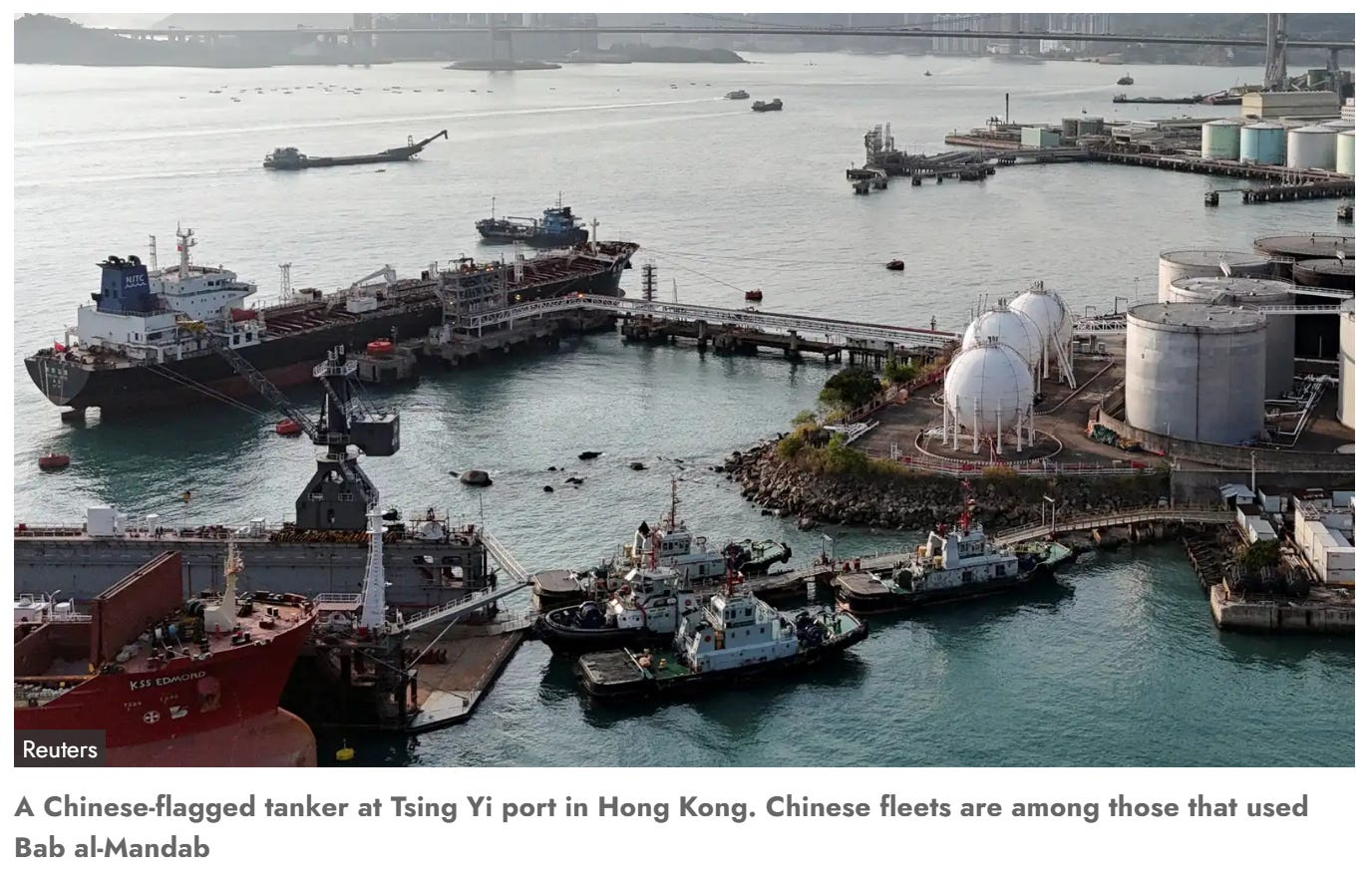
Since Saudi exports from Yanbu were a lifeline for Indian, Japanese, South Korean and Chinese refiners, whose tanker fleets used Bab al-Mandab, the Houthi blockade and missile attacks triggered immediate panic in the global wet-barrel or physical crude markets.
Spot Brent surged to $100 a barrel as Asian refiners scrambled to deal with the supply shock. Saudi Arabia responded to the IRGC’s twin escalation with air strikes on the Houthis’ Red Sea port of Hodeida. The Saudi air force then joined US warplanes in combat sorties to bomb Iraqi militia bases in an attempt to restore deterrence.
Saudi Arabia has put the IRGC on notice that the largest air force in the GCC will now be deployed to retaliate against aggression. The kingdom has signalled that it is no longer just a logistics facilitator but a co-belligerent in the US war against Iran. Riyadh is also seeking to forge a 43-country naval coalition to break the Houthi blockade.
The world economy could easily slip into recession or even suffer a 1970s-style stagflation nightmare if Asian refiners are denied access to Saudi oil exports for a protracted period.
The option to re-route tanker shipments from Yanbu via the northern Red Sea route to the Suez Canal is costly and a logistical problem for Aramco. The canal cannot accommodate very large crude carriers with capacity to carry 2 million barrels per trip.
Aramco will thus be forced to use double the number of Suezmax tankers, which have a capacity of only 1 million barrels. The Suez route is thus more expensive and the sailing and delivery time for a refiner in Japan has just risen by 27 days.
Pipe dreams
In any case, insurance and tanker freight costs have more than quadrupled since the Hormuz closure. The only reason Brent is not $125 or higher is because Chinese President Xi Jinping has bailed out the global economy with an unexpected cut of 5 million bpd in Chinese imports via drawing down his country’s colossal 1.3 billion barrels in strategic reserves.
Aramco can also tap Egypt’s SuMed pipeline that terminates near Alexandria, though this conduit has capacity of only 2.5 million bpd. Using the Israeli Eilat-to-Ashkelon pipeline, ironically financed by the shah of Iran in the 1970s before he lost his Peacock Throne, is not viable due to geopolitical and logistical constraints. Saudi Arabia does not recognise Israel and no diplomatic thaw is imminent while war rages in the Levant.
In any case, the Israeli pipeline has capacity of only 600,000 bpd, which is now being used to transport Kazakh crude to the European Union. A recent drone attack on the Egyptian port of Damietta makes it clear that the IRGC junta will do its best to sabotage any shipping re-route options Aramco selects to bypass the blockade.
The impact of the Houthi attacks on Saudi Arabia’s energy geopolitics and traditional role as the “swing producer” of Opec is devastating. The kingdom can no longer threaten Opec quota violators with turning on the world’s largest spare capacity of 2-3 million bpd.
There is little respite in prospect via US-Iran negotiations. The war “pause” lasted a mere two days, while the 60-day ceasefire negotiated in the Islamabad memorandum of understanding failed to sustain for even a month.
US President Donald Trump is eager for a quick exit from this Iran quagmire as his approval rating has sunk to only 34 percent. As crucial midterm elections approach, gasoline is at $4.50 a gallon at the US pump and diesel way above $5. The IRGC praetorians’ calculus lies in military escalation, an oil panic and global economic distress.
The Saudi economy is collateral damage amid the IRGC’s twin acts of aggression. In the first place, the IMF projection of a budget deficit of 3.7 percent of GDP and the finance ministry’s forecast of 3.3 percent are now unrealistic. Goldman Sachs economists argue the kingdom’s 2026 budget gap will be 6.6 percent, higher than 2025’s 5.8 percent.
Secondly, the growth shock due to the Hormuz closure and Houthi attacks has been traumatic. GDP contracted by 4.8 percent in the second quarter and the oil sector shrank by a horrific 25 percent. Third, the kingdom will be forced to borrow a record $20 billion in 2026 at a time when the yield on 10-year US notes has spiked to 4.75 percent.
Energy inflation could well force the US Federal Reserve into a new rate-hike cycle even as credit spreads for GCC sovereign debt widen. This is a trifecta of macro horrors.
No posts
Comments
Nothing yet. Say the first thing.
Sign in to join the conversation.