
Ciao.
Today we play with slime.
A team of Japanese researchers got there first, and they discovered that the slime is remarkably intelligent, despite having no brain. What they learned from it can save anyone running a team or an organization hours of unnecessary planning.
Enjoy.
Last edition’s top clicked link: the app for reducing foreign accents in Zoom calls.
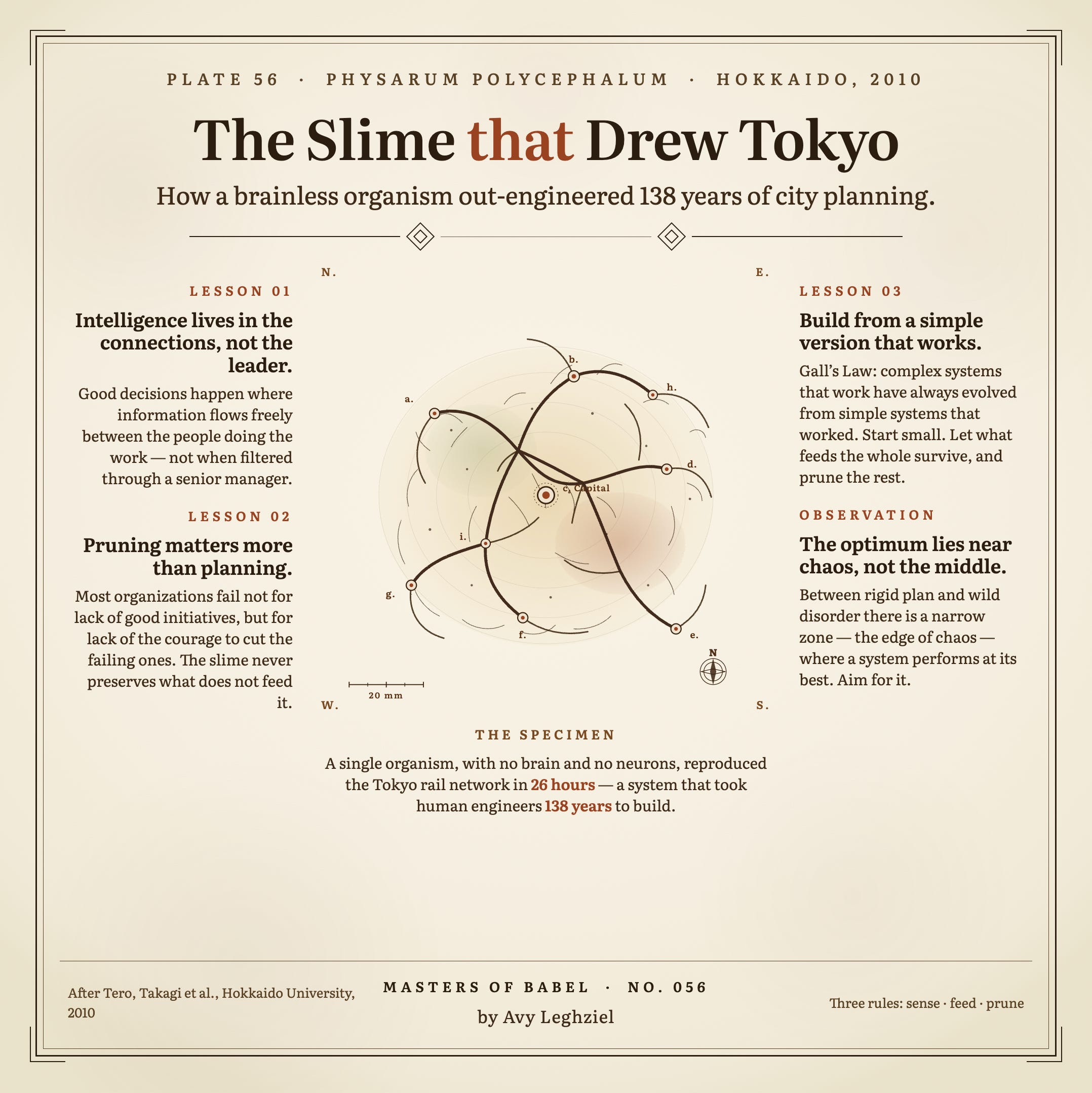
In 2010, a research team at Hokkaido University published a study using Physarum polycephalum, a single-celled slime mold with no brain, no neurons, and no central nervous system. Some of you might expect me to make a joke about beauty influencers, but I am above that.
The researchers placed the slime on a wet surface and arranged oat flakes in positions corresponding to major cities around Tokyo. To represent geographical obstacles such as mountains and water, they exposed certain areas to light, which the slime mold avoids. They then observed how the organism developed over the following 26 hours.
The slime mold initially expanded across the entire surface, forming a dense web of plasmodial tubes. Over time, it thinned out the network, retaining only the connections that linked the food sources efficiently.
The final network closely resembled the Tokyo rail system in both structure and performance metrics: the total length of the tubes was comparable to the total length of Tokyo’s tracks. Neither cheaper nor more expensive. The average distance between any two “cities” (oat flakes) in the slime’s network was similar to that in the real system. Traveling from one point to another required, on average, the same number of steps. For reference, it took about 138 years and hundreds of engineers to develop the real Tokyo rail system. The slime did it in 26 hours.
The slime mold did not plan the network. It produced it through three mechanisms operating in parallel:
Each segment of the organism followed the same logic: reinforce pathways carrying more nutrients, withdraw from pathways carrying fewer. The slime followed simple rules.
Every tube was simultaneously sensing what was happening around it (where the food is, how much protoplasm is flowing through it) and responding to it (getting wider or thinner) in the same moment. The slime followed fast feedback loops.
Pathways that stopped performing were eliminated. The organism had no mechanism for preserving underperforming connections. The slime was consistent in its pruning.
The conclusion drawn by the research team was that systems that are managed by a central leader and follow a detailed plan are not necessarily better than systems with no central manager and with a set of simple rules. The opposite is true: decentralized systems can work better, just like the slime did.
It’s a fascinating phenomenon. We are so used to complex organizations with lots of managers and processes that we don’t even ask ourselves if there’s a better alternative. It made me think:
Do humans have a natural ability to build efficient systems as well, just like the slime in the experiment? Did we lose the ability when we learned to overcomplicate?
How do we distinguish between problems that require simple natural solutions and problems that require complex processes?
Is there an optimal point at which a simple solution is perfectly sophisticated? A point below which it’s too simplistic and beyond which it becomes too complex to be effective?
I happily went down those rabbit holes. Here’s what I learned:
Humans are actually really good at producing self-organizing systems. No one plans how language works or who should show up at a traditional market. It just happens. The problem is that at work we assume we need a planning phase. Once an organization commits to a course of action, it frequently keeps going even when the plan is clearly failing. The slime mold has no equivalent mechanism: it never ignores feedback.
New complex solutions are a direct highway to failure. John Gall studied how bureaucracies, healthcare institutions, and organizations fail in ways that seemed predictable across very different settings. He articulated what’s now called “Gall’s Law”: complex systems that work have invariably evolved from simple systems that worked, and complex systems designed from scratch do not work and cannot even be made to work by tweaking them. Anyone who has ever dealt with new government regulations knows this is true.
The optimal spot between complex plans and utter chaos is not in the middle: it’s closer to chaos. The idea of “edge of chaos” (Kauffman, The Origins of Order, 1993) identifies a narrow zone between rigidity and disorder that allows a system to work at its best. Wikipedia is the best example: there’s no editorial team and no formal hierarchy but there are a few simple rules that work well for everyone. It looks like Encyclopædia Britannica on the surface, but underneath it works like Reddit: every user contributing separately. The result is neither bureaucracy nor wild west.
Let me show you. Three practical ideas:
The intelligence of an organization resides in its connections, not in its leadership layer. Good decisions are made when information flows freely between the people doing the work, not when it has to be filtered through a senior manager. Authority-driven bottlenecks, complicated knowledge platforms and mega-coordination meetings are a waste of time.
Pruning is more important than planning. Most organizations underperform not because they lack good initiatives but because they don’t have the courage to cut the failing ones.
Systems should evolve from simple working versions. Per Gall’s Law, complex systems built from scratch will fail. The implication for organizational design is that processes, structures, and workflows should begin with minimal viable versions and be modified based on what works.
I never thought I would reach this level of insight by discussing slime. That’ll probably make my kids proud.
How a Slime Mold Designed the Tokyo Railway System. Short video explaining the slime experiment.
Coordination Headwind: How Organizations Are Like Slime Molds. The former Head of Corporate Strategy at Stripe explains what he learned from slime mold dynamics about organizational design.
Lenny Rachitsky interviews Alex Komoroske. The gardener vs. the builder. We prefer the gardener.
How Do Smart People Make Smart Decisions? The case for simple heuristics over complex analytical models.
When algorithms work because they are simpler than humans. What can we learn from the field of machine learning about decision-making?
Also, I am splitting this newsletter in two. Wednesdays are for exploring the forces shaping executive work, Fridays are for experimenting with new technologies, methods and ideas. See you on Friday.
Avy
P.S. - I am mostly active on LinkedIn and Substack. The first one for work, the second one for my soul. Let’s connect!

Comments
Nothing yet. Say the first thing.
Sign in to join the conversation.