
This week I’m thinking about “deep play,” a phrase that keeps coming up in interviews with the musician Steven Hall, aka Nirosta Steel, whose groovy and ghostly double album My Skyscraper is the only thing I want to listen to lately, and who told the newsletter Tone Glow last month:
There’s this anthropological term called “deep play.” Arthur [Russell] and I would talk about this. Birds learn how to fall and fly at the same time. It’s the idea of playing and learning at the same time, and that’s the state I’m looking for. I want there to be no distinction between rehearsal, performance, and studio recording. There should be no difference—they should all be one. It’s as if you’re walking continuously from one to the next, and it’s all one party from beginning to end.
My Skyscraper sounds like a party that first got underway in a loft in New York’s East Village sometime in the late 1970s—which is exactly what happened. Hall was a teenager in Delaware when a group of New York poets, including Allen Ginsberg, visited his high school and drew him toward the city, where he befriended many of the residents of the now-famous Poets’ Building on 12th Street—including the cellist and composer Arthur Russell, who became Hall’s close friend and long-running musical collaborator, and whose ghost hovers over many of these songs. (Russell died of AIDS-related illnesses in 1992.)
Hall was born in Scotland in 1957. After his father died, when Hall was 11 or 12, his mother placed a personals ad in the International Herald Tribune looking for a husband; Hall and his two siblings helped her evaluate suitors and said she should choose the one from America, which is how Hall ended up going to high school in Delaware. After moving to New York a few years later, he studied poetry at Columbia with Kenneth Koch, made music with Russell, and later followed a boyfriend to Hong Kong, beginning a long involvement with East Asia. He subsequently lived in Thailand and Taiwan for stretches; his first album as Nirosta Steel is a live concert he played in Taipei in 1999, which he self-released in 2014.
Last year, one of the founders of the tiny independent label Ulyssa heard that album through a friend, and reached out to Hall—now 69 years old, living in Champaign, Illinois, with his lawyer husband, and until recently driving an Uber for extra cash—to see if he had any more material. Hall sent him hours’ worth of recordings spanning 40 years, and from this trove Ulyssa assembled My Skyscraper, which—to Hall’s surprise and the label’s—became an instant critical darling and indie-music phenomenon. In the weeks since its release in June, Hall has been profiled by the Guardian, recorded his first-ever podcast appearance, and started planning a world tour, with stops already announced in New York, Chicago, and London.

But back to the idea of “deep play” Hall describes above—of “walking continuously” from rehearsal to performance to recording, with no distinction between these different phases—well, doesn’t that sound marvelous? I have to admit that I often feel jealous of musicians, whose work seems so much more conducive to this kind of free-flowing, improvisational approach than writing, which feels like such a grind by comparison (at least to me).
But then I remembered something the writer Sheila Heti told me over email in 2016, when I was gathering material for my second Daily Rituals book. Heti wrote:
More and more as I get older, I want my writing and my life to interweave. I don’t want my books or writing itself to be something separate from what I would do anyway, or to be about something apart from what I am thinking anyway—my writing should be no different from my thoughts going through the day. I don’t know if I have come to this because I can’t seem to separate out a privileged space for writing, in which I imagine other worlds, or if it’s the reverse, but it’s important for writing and life to be fairly seamless; to be the same thing. So that I can come to the computer at any time—night or day, for ten minutes or two hours, and begin writing from where I am—from what I am thinking about. I want writing and living to be one thing, so that writing is just me living, but on the page—an extension of the living I was doing before I sat down to write.
Which further reminds me of something the poet Bernadette Mayer in a 2020 interview:
If you practice writing constantly, you can start to speak in poetry form and so whenever you feel like writing something, all you have to do is immediately write what you’re thinking. John Ashbery says that poetry is like a stream that’s always running and whenever he wants to, he can dip into it and take a little ladleful and have a poem. If I hadn’t devoted my life to poetry, then I’d have to sit down and struggle with the page. That seems torturous to me.
More and more, this is what I want to figure out how to do in my writing, too: to get the stream running, and anytime I want, dip into it and take a little ladleful; how wonderful would that be? I’m still trying to figure out how that might work—still trying to find the right stream, or the right ladle, or both—but at least now while I do so I have the perfect soundtrack.
From the archive:
Quick reminder: New issues of this newsletter are free for all—but paid subscribers also get Worm Zoom, the group chat, the book club, the full archive of 190+ back issues, and my sincere gratitude for your support, thank you!
Our virtual coworking club reconvenes in less than three weeks! The Labor Day holiday made the dates slightly wonky, so please mark your calendars: We will meet Monday, August 31 – Friday, September 4, at 6–8am Pacific / 9–11am Eastern time each morning.
For those who haven’t taken part before: This is a great, low-pressure way to steal some focus with a community of fellow writers and artists. Come for the full two hours or drop in for however much time you have available—it’s amazing how even this very light form of accountability can galvanize a stretch of new creative work.
And after the Friday session, we’ll have our Worm Salon—an opportunity to chat about what we’ve all been working on and set our creative intentions for the remainder of the month.
Find all the details and join us here:
Thanks for reading! If you want to know how poets, artists, and musicians paid the bills while making idiosyncratic experimental bodies of work that sometimes didn’t get recognized until decades later, check out my third book, Making Art and Making a Living, which delves into the myriad ways they have done it, in New York and elsewhere, since time immemorial—it’s available from Amazon, Barnes & Noble, Bookshop, Powell’s, and, of course, your local bookstore.
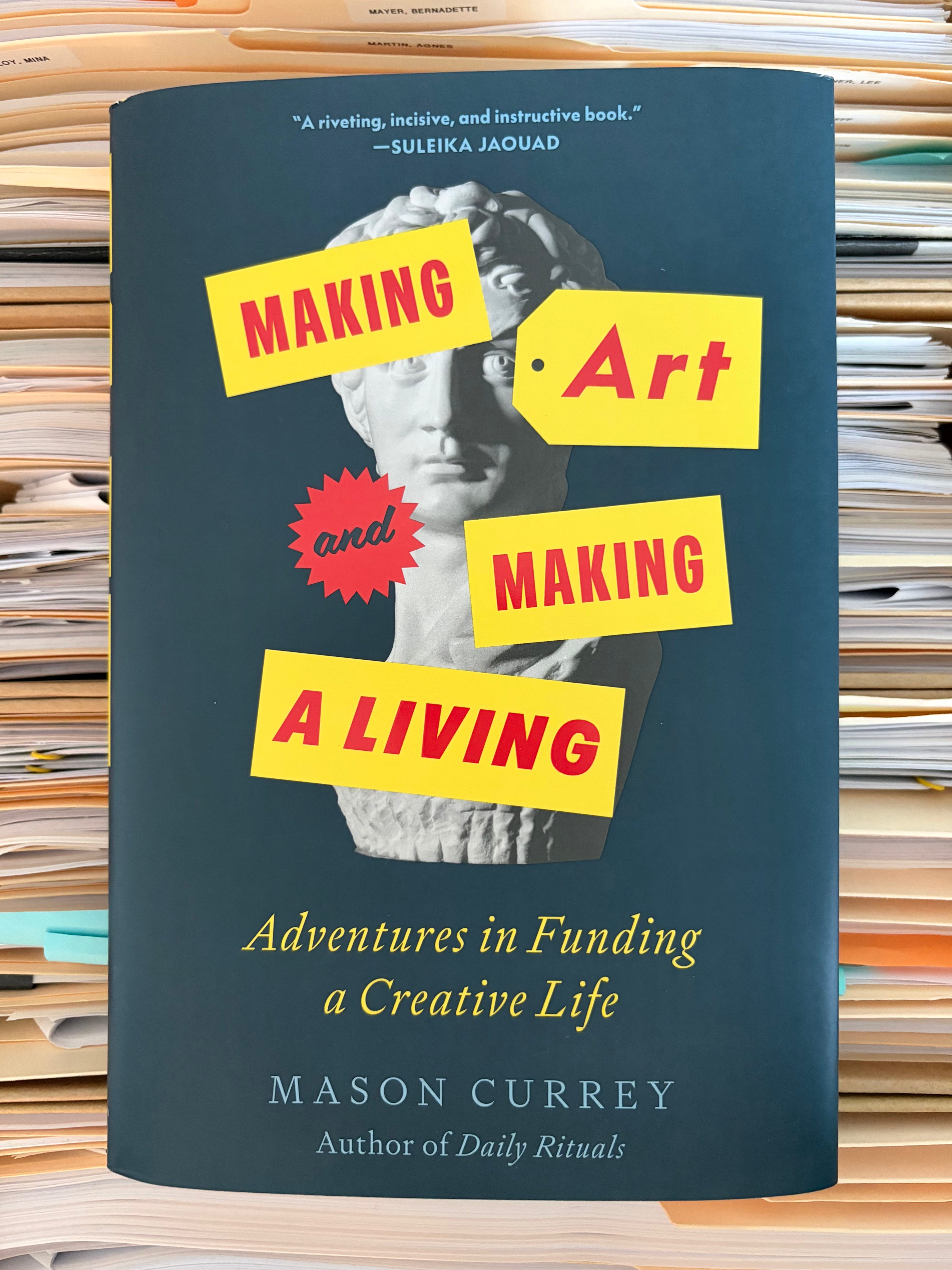
SELECTED PRAISE:
“A wonderfully readable, anecdote-filled tour of the inventive and sometimes eyebrow-raising ways artists through history have sought to transcend the everyday while also paying the bills. Mason Currey never tells the reader what to do—creativity is too personal for that—but there’s vast inspiration, and consolation, in these pages.”
—Oliver Burkeman, New York Times bestselling author of Four Thousand Weeks
“A delicious peek at the rich husbands, family money, business schemes, and desk jobs that really filled famous artists’ bank accounts, this book is a balm for anyone who has ever fretted that they are not a ‘real’ artist because they don’t pay their bills with their art.”
—Ann Friedman, co-author of Big Friendship: How We Keep Each Other Close
“I didn’t think Mason Currey could top Daily Rituals—but with his thorough research and his lively rendering of great artists and their lives, he’s proved me wrong. Making Art and Making a Living is a riveting, incisive, and instructive book that illuminates the material conditions that creators across the ages have lived through, which reveals the depth of their commitment to the artistic vocation. . . . Come for the lessons in enduring for the sake of one’s art. Stay for the strange and delightful anecdotes, the confessional letters, and the gossipy journal entries that feel like the best kind of eavesdropping.”
—Suleika Jaouad, New York Times bestselling author of Between Two Kingdoms and The Book of Alchemy
Comments
Nothing yet. Say the first thing.
Sign in to join the conversation.