
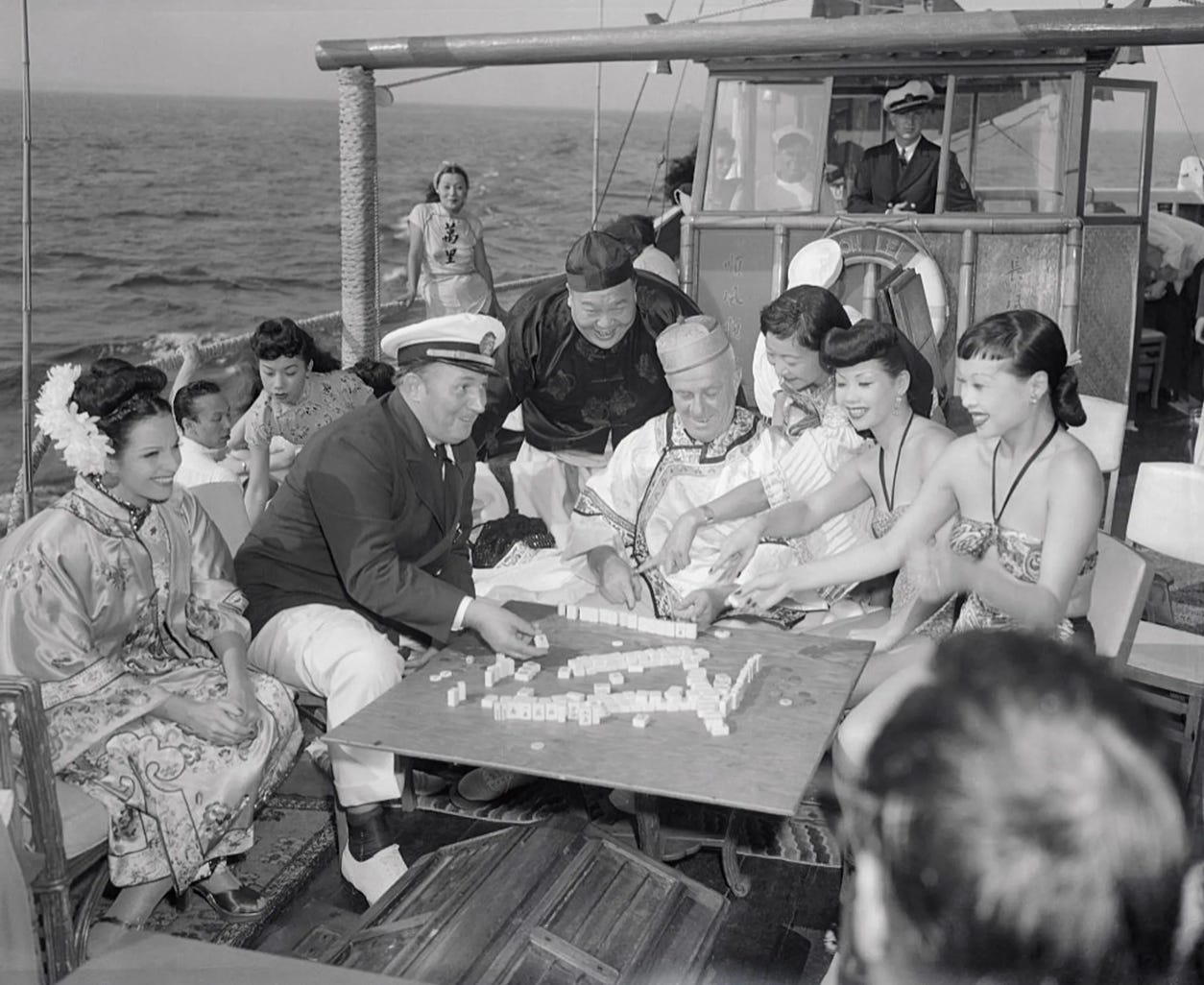
Robert L. Ripley (seated, in captain’s hat) and various guests enjoy a game of “mah-jongg” aboard the Mon Lei, a junk (type of Chinese sailing ship) he brought across the Pacific from Kowloon, on a cruise on the Long Island Sound in Aug. 1946. Ripley was known for his show "Believe it or Not!" which featured "unusual" facts from around the world. Bettmann Archive—Getty Images.
Mary McCarthy
Mahjong is one of the latest fad games to take over American dining room tables, but its roots here stretch back more than 100 years. The game originated in China during the 1800s before making its way across the Pacific in the early twentieth century. In 1920, New York City’s Abercrombie & Fitch began importing mahjong sets from China, helping spark a nationwide fascination with the game. The demand was so great that the retailer reportedly dispatched buyers to China to purchase thousands of additional sets as Americans rushed to learn this exciting new pastime.
American players gradually adapted the game, and in 1937 the National Mah Jongg League was founded in New York City by a group of Jewish women led by Dorothy Meyerson who standardized the game. The organization established a standardized annual card of winning hands that remains the foundation of American mahjong today. Over the decades, the game became especially beloved within Jewish American communities, where weekly games grew into cherished family traditions and social gatherings.
I started playing this summer when a very good friend of mine invited me to play at her shop, and have been surprised at how quickly I got sucked into the kinda-fun, kinda-stressful quicksand of glitzy matching tiles, mats, matches and merch. Last night I fell asleep when I was playing a game on my phone, which fell onto my face. I went to a neighboring town’s game and got completely overwhelmed because over 40 people were playing at once and the sounds of the tiles clacking at once almost drove me into overstimulation overdrive— I just wasn’t ready for that advanced level of play. I’m still a rookie, and not sure I will ever wear an MLB jersey— people who can consume multiple cocktails while playing are clearly experienced and brave; no way am I risking spilling booze on a $500 set of tiles while I’m still learning to tell them apart.
Since I started playing this summer, occasionally the 152 tiles shuffle my way and I’ve managed to score a mahjong or two. My algorithm on social media has been affected, and of course I see funny mahj content. Recently I saw an interesting Chinese “cultural appropriation” post and thought, oh shit, am I going to be like cancelled for playing this?
In her book Mahjong: A Chinese Game and the Making of Modern American Culture, Annaleise Heinz says:
Chinese Americans speak out against some of the really clear appropriation of the game that happens at various points. They also look for opportunities to make money in a really discriminatory economy in which Chinese American college graduates in English and art and engineering could not get jobs outside of curio shops and restaurants and laundry work, the same stereotyped and segregated economic sectors. And for a brief period of time, teaching people how to play mah-jongg actually provided a more lucrative opportunity, in part because they are seen as authentic teachers. The meaning of the game for Chinese Americans is linked to specific ways that generations can connect to each other across really significant generational (and geographic) divides in the 1920s and ‘30s. Mah-jongg becomes one of many ways that Chinese Americans build a transnational nationalism.
The craze quickly spread beyond New York. Philadelphia embraced mahjong during the Roaring Twenties, with department stores such as Wanamaker’s selling imported sets and hosting demonstrations that introduced the game to curious shoppers. Before long, bridge clubs, neighborhood gatherings, and living rooms across the country were filled with the familiar sound of clacking together. The spelling of the word “mahjong” was eventually shortened; its original translation from Chinese means “clattering sparrows” after the sound the tiles make when shuffled.
Coincidentally, it also represents the clattering of my nerves when it’s my turn and I can’t commit to a hand. Luckily, learning the game at the same time as a group of other women tends to lend itself to a sort of survival-group mentality where we tend to support one another in the learning journey. There seem to be about eleventy hundred little rules and nuances, tips, tricks and strategies and even more subtle “house rules,” so having people around who can help you remember things, even when you forget them repeatedly, is essential. I’m not a big “get dressed in cute outfits” or “matching cocktails and tile sets” chick; my skills have come more from playing on the “Mahjong 4 Friends” (more like when you don’t have many) to fall asleep at night—trying to keep getting clocked in the face by my phone to a minimum—but learning the game this summer has been really fun and I’m grateful to my friend for bringing my me into the tile mix. I look forward to Mahjong Mondays.
No posts
Comments
Nothing yet. Say the first thing.
Sign in to join the conversation.