
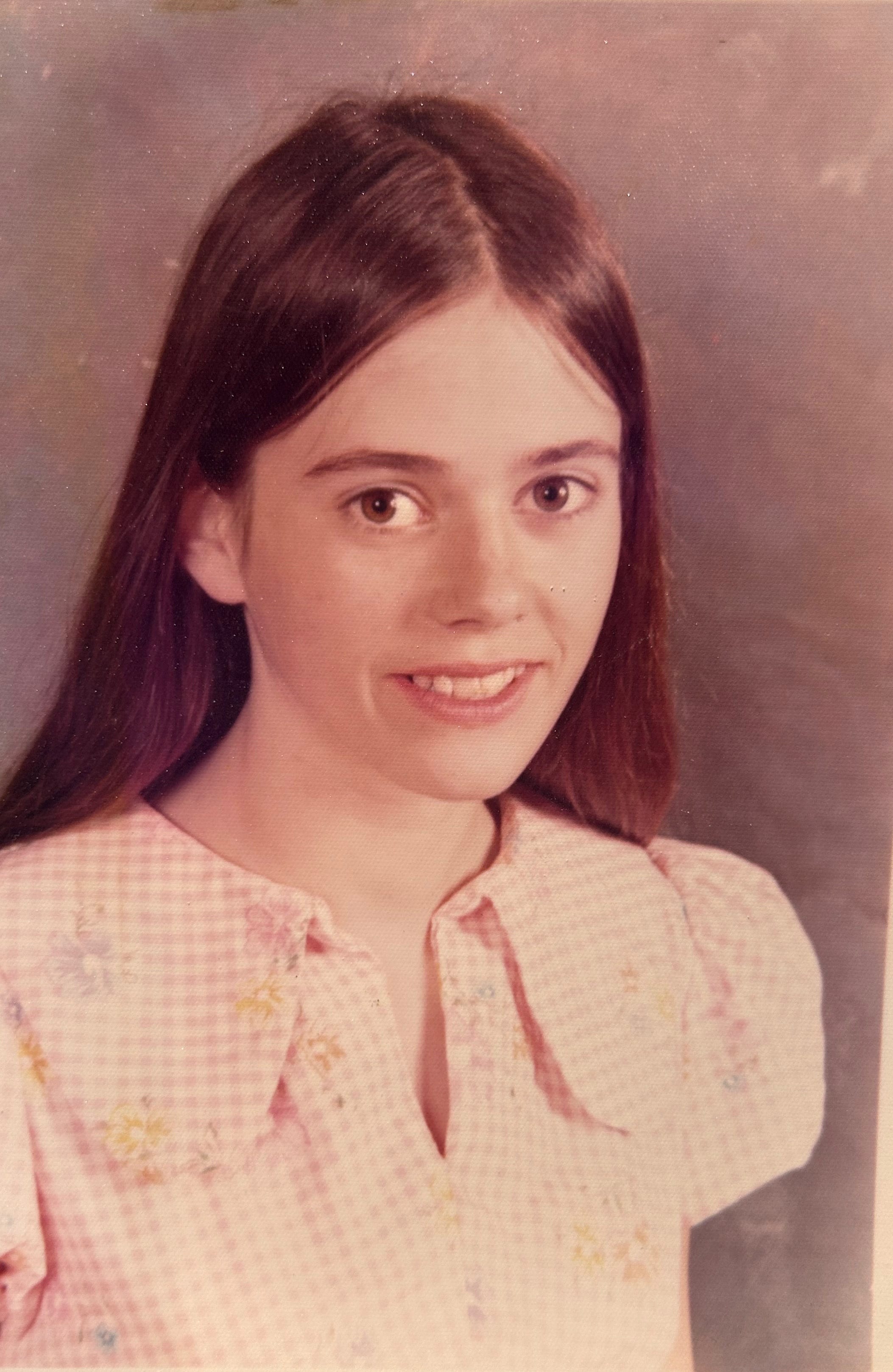
Today I was rummaging through some old boxes at my mom’s house when I found a photograph tucked away between a stack of birthday cards and a bundle of faded letters. I was fourteen in the picture, with long brown hair, big brown eyes, a hand-sewn top, and a smile that looked much braver than I probably felt. In the same box was a letter I had written to my mother, folded neatly after all these years as though it had simply been waiting for me to come back and read it.
The letter began by informing my mother that her husband was not a very nice man.
I was furious with my father because he wouldn’t let me go to a local restaurant called The Peaks with my friends. To him, it was a place where teenagers gathered to smoke cigarettes and drink coffee. To me, it was where everyone went after school to have fries, drink a Coke, laugh too loudly and feel, for an hour or two, like we belonged somewhere.
If you grew up in the seventies, you’ll probably remember places like that. Restaurants weren’t smoke-free then, and teenagers mingled with adults over burgers, pie, and endless cups of coffee. My father looked at Peaks and saw temptation. I looked at it and saw my friends. We weren’t looking at the same restaurant.
Reading the letter now made me laugh because fourteen-year-old Mary Ann was convinced this was one of the great injustices of her life. I had informed my mother that I no longer loved my father, that I would be leaving home in a few days, and that I would try to phone her when I could. Apparently, I felt it was important to give everyone advance notice that I would be running away.
I also built quite the legal case, explaining that everyone else was allowed to go, that I didn’t even like coffee, that I only wanted a Coke, that I would never smoke, and that my friends would think I was a “suck hole” if I wasn’t allowed to join them. At fourteen, in the 70s, that seemed like social ruin.
Reading those words now, I smiled at how completely I believed every one of them. Then I came to the sentence that made me stop.
“If he could only prove to me that he respected my hopes, my dreams and my feelings, I would love him again.”
I read it twice.
For all the teenage drama wrapped around that letter, I don’t think it was really about Peaks at all. It was about trust. I wanted my father to believe me. I wanted him to understand that I wasn’t asking for permission to become someone else. I simply wanted him to believe that I was exactly the girl he had raised—a girl who would drink a Coke with her friends, come home when she said she would, and give him no reason to worry.
What I couldn’t see then, but can see so clearly now, is that my father wasn’t making his decision because of who I was. He was making it because of what he feared. That’s what parents do. They imagine the worst long before anything has happened, and they make decisions their children often mistake for a lack of trust.
There was another detail I had completely forgotten until today.
My father had met my mother at Peaks.
She was a waitress there, and he was a young high school teacher. They married when she was eighteen, and by the time she was twenty-two they already had four children. I don’t know why that thought struck me so deeply. Maybe it was because fourteen is only four years away from eighteen. Suddenly the restaurant became something more than the place where I wanted to spend an evening with my friends. It had been part of my parents’ story long before it ever became part of mine. I can’t help wondering if my father wasn’t remembering a very different Peaks than the one I thought I knew.
As I sat there holding that old letter, it occurred to me that we were probably both right. At fourteen, being trusted mattered more than almost anything. Being included mattered. Feeling that your parents believed in your judgment mattered. Those feelings weren’t silly simply because I was young. They were real, and they were enormous.
At the same time, my father was doing exactly what he believed a good father should do. He wasn’t trying to make my world smaller. He was trying to keep it safe.
When I read that letter today, I didn’t feel embarrassed by the girl who wrote it. I felt protective of her. She was trying so hard to explain herself. She wanted to be trusted, to be taken seriously, and to have someone acknowledge that her feelings mattered. Isn’t that what most fourteen-year-olds want? If I’m honest, I think it’s still what most of us want.
I looked at the photograph for a long time before putting everything back into the box.
That girl had no idea what life would bring her. She didn’t know about marriage or children or heartbreak. She didn’t know about loss, forgiveness, or the strange realization that one day your parents stop being simply your parents and become people whose fears, hopes, and mistakes you can finally understand.
Looking at that letter now, I didn’t wish he had let me go. I wished I could tell him I finally understood.
I folded the letter carefully, slipped it back into its envelope, and placed it beside the photograph.
Then I closed the box.
I hope, wherever this finds you, that you can look back on your younger self with a little more compassion than judgment.
Until next time,
Mary Ann
Comments
Nothing yet. Say the first thing.
Sign in to join the conversation.