
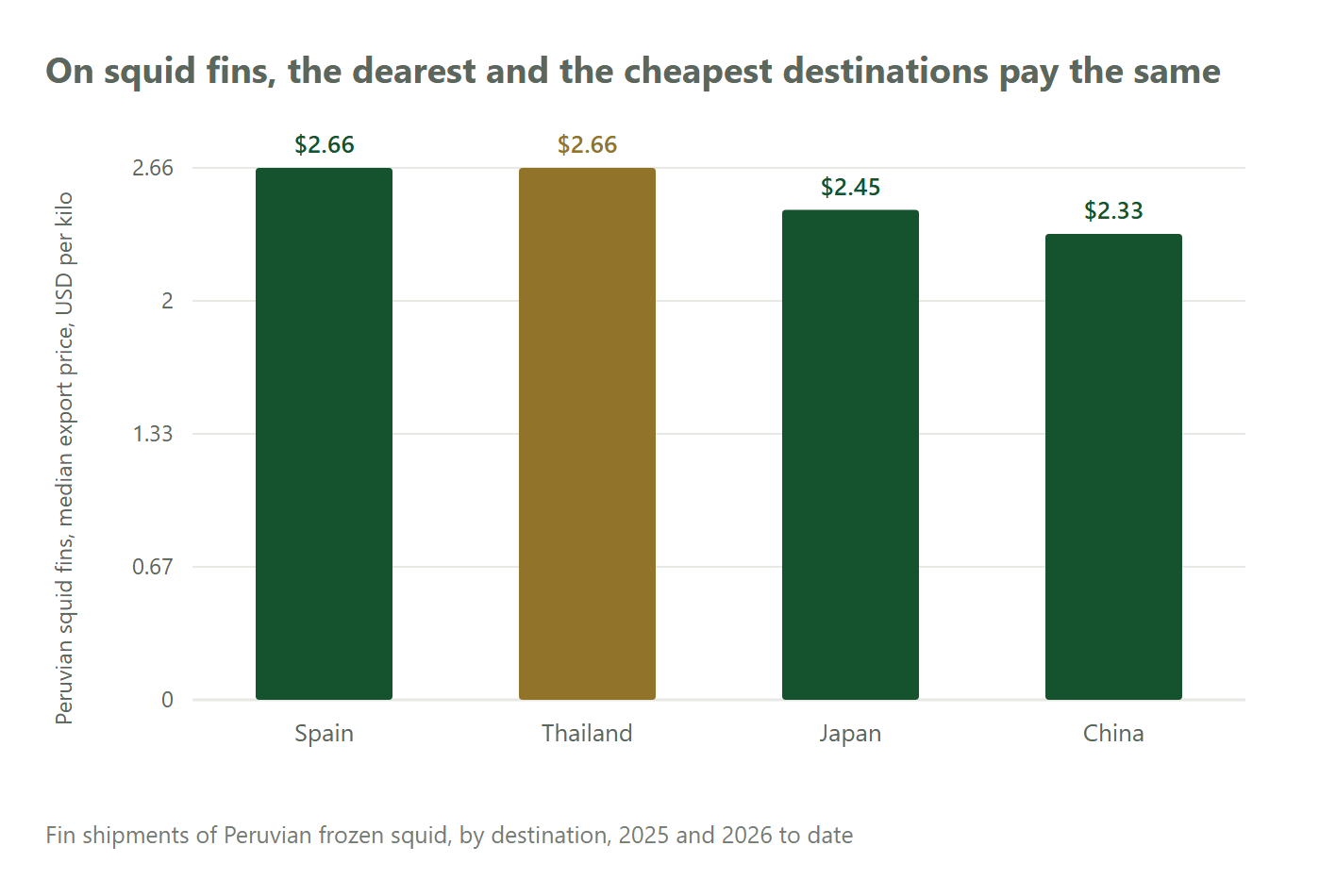
Spain and Thailand pay $2.66 a kilo for Peruvian fins. Both of them, to the cent, across every shipment since January 2025. Each figure here is a midpoint, with as many kilos leaving above it as below, so an identity like that survives a lot of noise before it shows up.
It is odd because those two are the extremes of this trade. Averaged across everything they buy, Spain pays $3.52 a kilo and Thailand $1.60, with China, the largest destination by a distance, between them at $2.35. Read as a quality signal, those averages say Spain buys the good material, Thailand buys what is left, and a plant shipping to Bangkok is selling itself short.
A single cut priced identically in both markets rules that reading out. If the destination were setting the price, two markets that far apart would not meet on the same cent for the same product. Whatever decides the number is upstream of the shipping address.
Getting to that comparison takes two steps of cleaning, and the first one is the customs code. Frozen squid is 93% of the value declared under it, and scallops travel under the same code with a different price and a different buyer, so they come out before anything is measured.
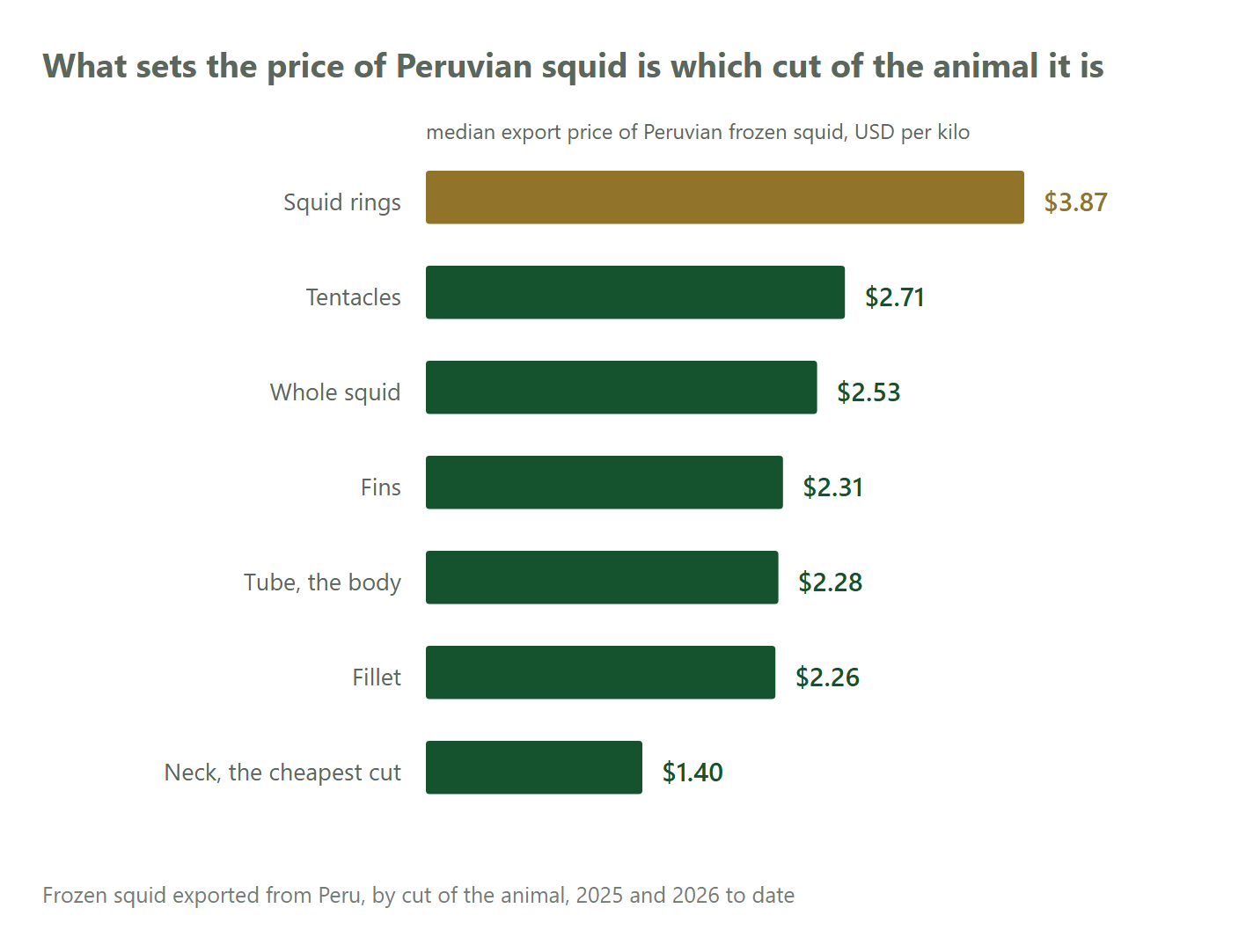
The second step is the animal. Squid leaves Peru as fillet, fins, tentacles, tube, rings, necks and whole, and those are a price ladder rather than a list. Rings run at $3.87 a kilo and tentacles at $2.71, whole at $2.53, fins at $2.31, tube at $2.28 and fillet at $2.26. Necks are $1.40, the cheapest thing in the record.
Now the baskets. Of the 62.5 million kilos Thailand bought, 52.7 million are neck, which is to say Thailand is not a squid market in general but a neck market in particular. Spain sits at the other end of the same ladder, taking 17.1 million kilos of rings, 31.7 million of tentacles and 21.8 million of fillet.
Two shopping lists that far apart produce the country averages on their own, without anyone paying a premium or a discount for anything. The $1.92 that separates Spain from Thailand is the distance between a ring and a neck, priced in the same market, in the same months, out of the same plants.
Fins are where the identity is cleanest, because both destinations move enough of them to compare without the arithmetic wobbling. Tentacles come close behind at $2.83 against $2.68. Fillet does not cooperate: there the distance is real at fifty three cents, and the likeliest reading is size band rather than destination, since the grade travels inside the shipment description and not in a column that can be grouped. So the defensible claim is that most of the destination gap is composition, and not that every cent of it is.
The reason each market buys the end of the ladder it buys sits outside the record entirely. Thailand runs one of the largest seafood reprocessing industries in the world, and a reprocessor buys an input rather than a product, while Spain buys much closer to the shelf, where a ring arrives already a ring. That reading fits everything measured here and is proved by none of it.
What the country average does do, reliably, is show up in the commercial conversation. It is what gets quoted back when a price feels high, and what a plant reaches for when it wants to argue that a market pays well. Both uses describe a basket and call it a price, which is a habit worth breaking before the season starts rather than during it.
Fixing the cut, the size band and the month turns the destination into a different kind of question, one about what a market wants to receive rather than what it is willing to pay. A plant that makes only fillet never appears in a search for rings, however sharp its price looks against an average that was never about it.
Sin posts
Comments
Nothing yet. Say the first thing.
Sign in to join the conversation.