
A supplier list has a shelf life, and the shipping record puts a number on it.
Most buyers never see it happen. The list was good when it was built, the names were real, and nothing announces the day one of them stops shipping.
Take the companies that shipped alpaca knitwear out of Peru two years ago. There were 182 of them.
Follow the same registrations forward to today. 101 have stopped appearing altogether.
Seventy five are present in every year. Twelve are genuinely new.
Now put the volume next to that. Alpaca garments out of Peru are flat across the same period, with the latest half year slightly ahead of where the count started.
Those two facts together are the whole read. The output did not leave. The places to buy it did.
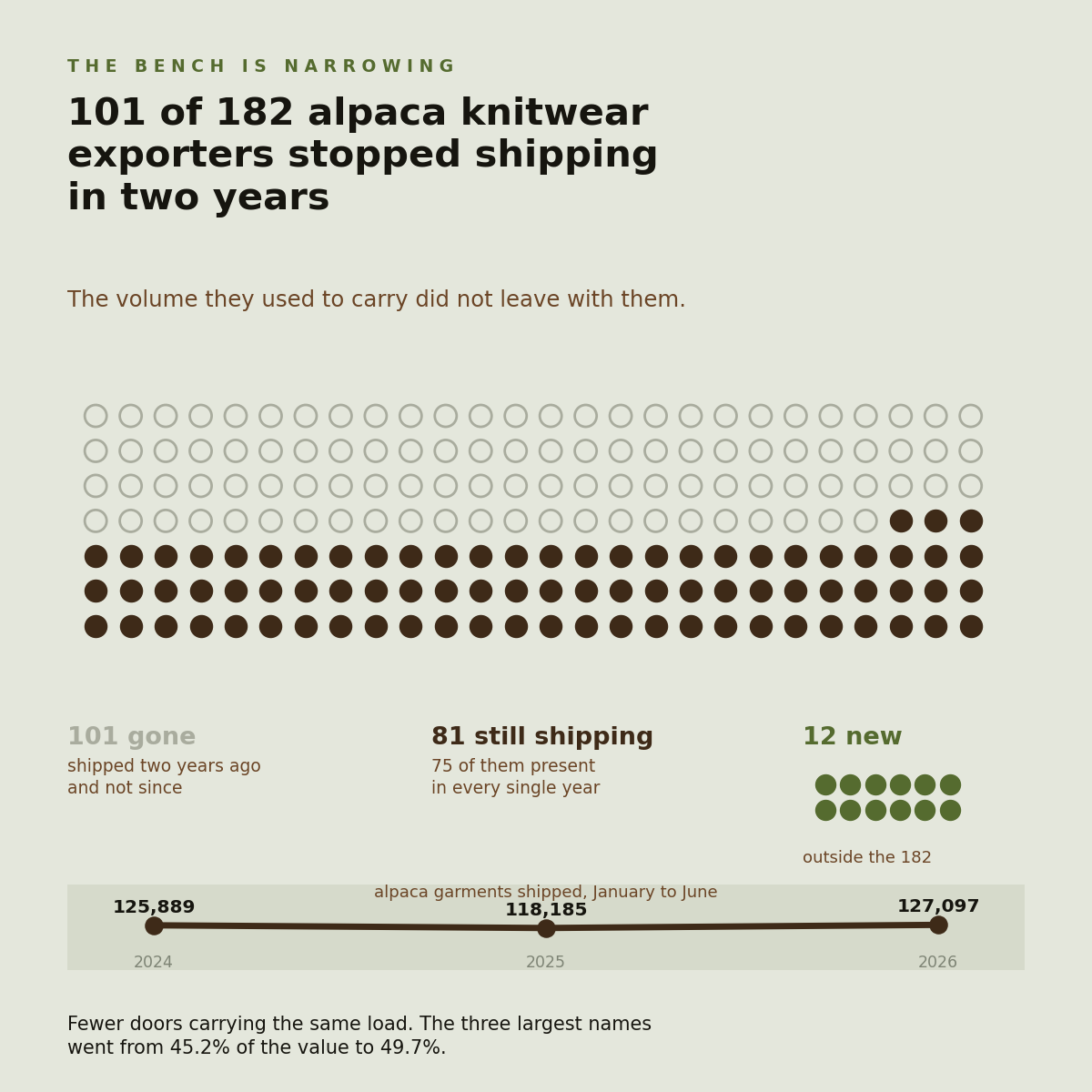
The concentration confirms it from the other direction. The largest three alpaca companies held 45.2% of the value at the start and 49.7% now.
Half the trade sits with three names, and the share is climbing.
It is worth checking whether this is just the market as a whole contracting, because Peruvian knitwear did contract. The full product code went from 443 active companies to 362 over the same period, and the garment volume fell with them.
But that is the difference. In the wider market, companies and volume left together. In alpaca, the companies left and the volume stayed.
One is a market shrinking and the other is a market consolidating, and they call for opposite responses from a buyer.
Call it the Narrowing Bench. The output is intact and the roster carrying it is shorter every year.
The replacement flow barely exists. Twelve entrants in a year, against 101 exits over two, is roughly eight departures for every arrival.
The practical consequence arrives with a lag, which is what makes it easy to miss. A buyer working from a list built two years ago is working from a list that has lost more than half its names.
They will discover this one unanswered email at a time, while the headline volume reports that nothing has happened.
A limit that matters. A company disappearing from the record is not necessarily a company that closed.
It may have merged, changed its registration, moved its volume under a group, or stopped exporting directly and started selling through someone who does. What the number proves is that a name that used to ship no longer ships under that name.
Which is enough to act on. If the number of doors is falling while the volume behind them holds, the cost of finding a company goes up every year.
There is a plausible mechanism behind it, though I cannot prove it from the record alone. Fiber supply, working capital and the cost of holding a classed inventory all favour the larger operator in a bad year.
Whatever the cause, the effect compounds in the same direction. Every year the list is shorter, the remaining names are larger, and larger names quote larger minimums.
There is one more effect worth naming, and it lands on the buyer rather than on the market. A shorter roster means a company that would have quoted eagerly two years ago now has more work than bench, and chooses its clients.
So the same email that used to open a conversation now competes with several others for the same floor. The list did not only get shorter. The names left on it got harder to reach.
Which makes the cheapest time to build the relationship always earlier than it feels.
Sin posts
Comments
Nothing yet. Say the first thing.
Sign in to join the conversation.