
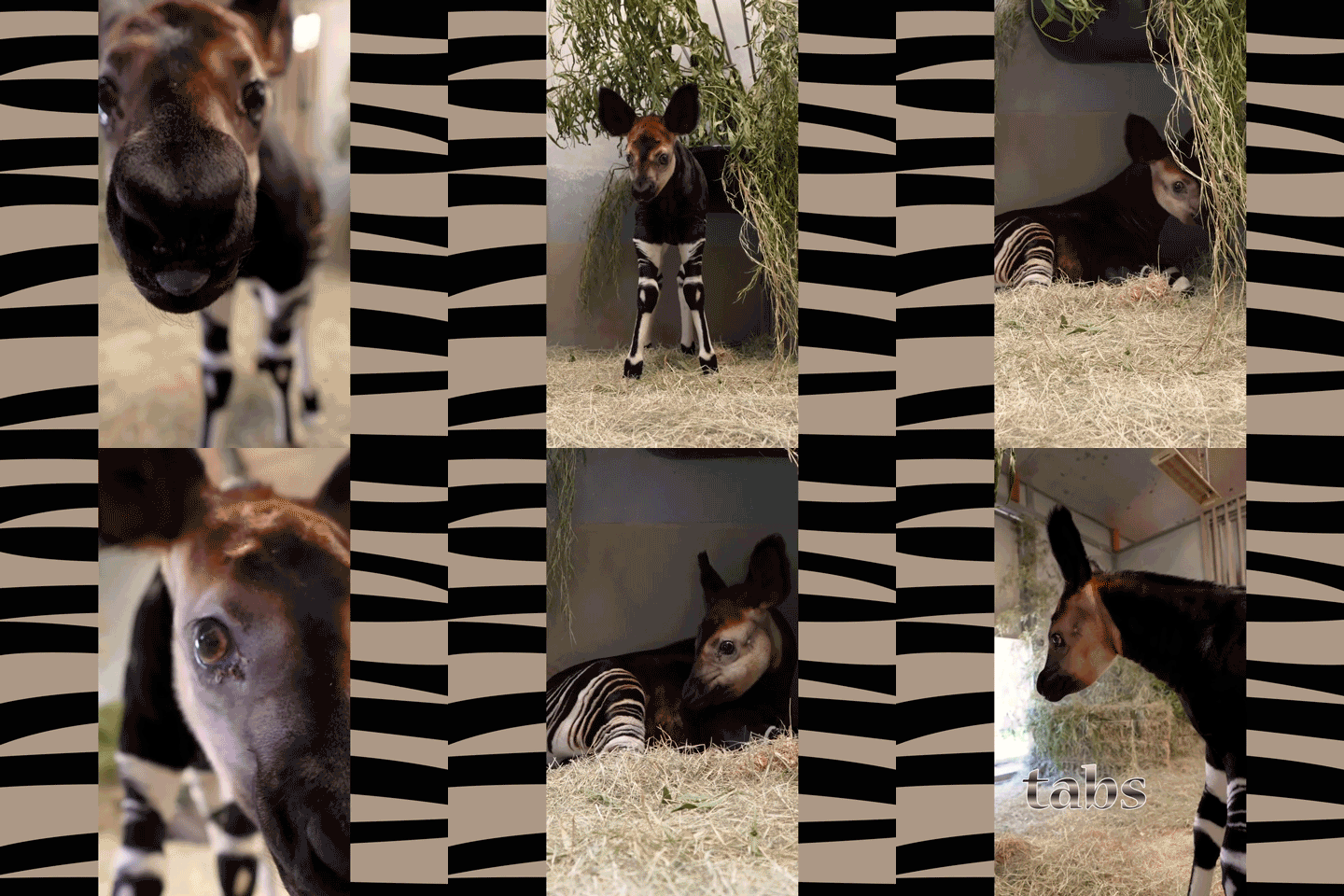
Monzoto is an okapi calf born at San Diego’s Safari Park in early May to dad Upepo and mom Mahameli. His name means “star” in Lingala, the Bantu language spoken in Central Africa. Monzoto, like all okapi calves, instinctually likes to hide away: baby okapis spend their first few months under cover, allowing mothers to leave them for a bit while they search for food. But as time goes on, the youngster is feeling a bit bolder, growing more confident and adventurous, and starting to venture out into the park’s African Woods habitat, joining his mom. I mean, check out those fabulous markings—I’d be showing those off too if I were him.
Okapis are also called “forest giraffes” or “zebra giraffes,” and indeed they are related to giraffes, being the only other extant genus of the Giraffidae family. The animals in both genera have relatively long necks for ruminants (although obviously giraffes’ are much longer), both have long, agile, dark-colored tongues, and both have skin-covered horns called ossicones—present in both male and female giraffes, but only in male okapis. The two share a common ancestor that diverged from other ruminants over 20 million years ago. Studies to determine when okapi and giraffes split from each other place their common ancestor somewhere between 11.5 and 18 million years ago. While giraffes and okapi are now only found in Africa, the Giraffidae family once contained a number of diverse species, with numerous extinct genera found in fossils throughout Eurasia. With its physical similarity to earlier members within its evolutionary tree, the okapi is considered a living fossil.
Okapis are about 8 feet long and weigh about 640 pounds on average, with females being a bit taller than males. In the wild, they are elusive and solitary, coming together only to mate. Gestation last on average about 440 days (!), whereafter a single calf will be born (although in rare instances, twins can occur). Calves can stand within 30 minutes of birth. To protect against predation, they are kept in hidden nests in densely forested areas, nursing infrequently on milk that is high in protein and low in fat. Calves do not poop until they are a month or two old, an adaptation thought to help avoid predator detection when they are at their most vulnerable. Juveniles start eating solid food at about three months and are fully weaned by about six months. They are independent at about one year old.
As ruminants, okapis browse forest vegetation, eating understory foliage of small trees, shrubs, and herbaceous plants adapted to their dim, humid forest environments. They will dine one grasses, ferns, fruit and fungi as they find them, using their long, flexible tongues to selective browse for the plants that they like. They are primarily diurnal, although they may be active during a few hours of darkness. Both males and females establish home territories using urine marking and scent, rubbing their necks against trees. Males are tolerant of females foraging within their ranges, but will defend against other males. While males are constantly migratory, shifting their turf, females are stationary within their established ranges.
Okapis are only found in the northeast of the Democratic Republic of Congo, preferring lush, high-canopy rainforests. They are fully protected under Congolese law and nature reserves within the country support significant populations of the animal. However, logging, human settlement and illegal bushmeat hunting continue to stress okapi populations. The violence and ongoing poaching in this area of political instability makes protecting this IUCN-listed Endangered species more difficult. One particularly vicious attack at occurred the Okapi Wildlife Reserve in 2012 when a gang of armed poachers killed six staff members and all 14 okapis at their breeding center. During this incident, most of the center’s staff were able to escape into the forest. The center continues to function today, and the reserve provides refuge to a number of endemic and threatened species, including about 5000 okapii, and is home to two indigenous tribes.
Captive breeding populations of okapi, like the one in San Diego, help bolster wild populations, and zoos in North America and Europe participate in managed breeding programs. San Diego has included okapis since 1956 and have welcomed over 60 okapi births since their first in 1962.
The source for today’s gif is here.
Save Giraffes Now: Evolution of Giraffes
Huffpost: “Tragic Losses in the Heart of Darkness,” by Jeff Flocken, 8/29/12
Comments
Nothing yet. Say the first thing.
Sign in to join the conversation.