
This essay was first published at Customer Decisioning Guild on 15/08/2026 and cross-posted here.
To improve a customer decision, we must be able to describe one.
Over the last many months, I have met executives who are well versed with Level 0 and Level 1 understanding of the customer decisioning and would like to understand more. I am writing this five parts series - The Customer Decisioning Primer for Executives, for such leaders. This is written in a way that it can be references time to time. Today is the Part 1.
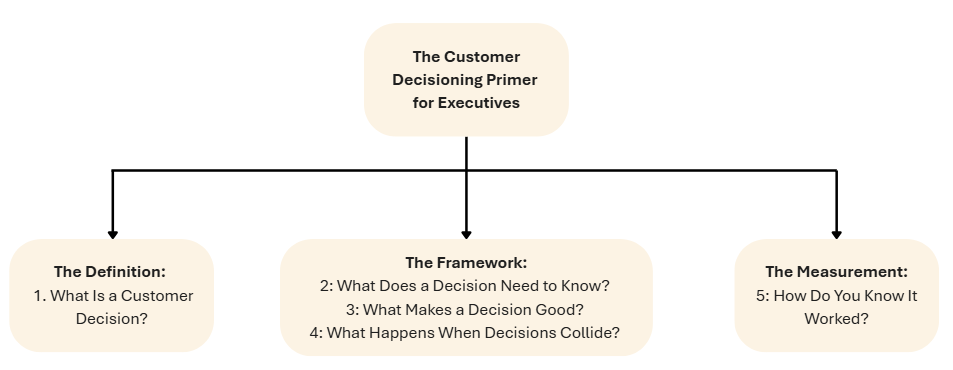
This series will be written in three parts:
Part 1 is about the definition (this one): what is a customer decision, and how to tell one apart from other things that people often mistake with.
Parts 2 to 4 build the framework, covering what a decision must know, what makes it good, and what happens when decisions collide.
Part 5 is about the measurement, and what how what you measure implies for what you should be buying.
A new executive has joined a large bank. She is heading to her first steering steering committee meeting. She asks an innocent question - “when a customer logs into the app tomorrow morning, what do we say to them?”
The team present is a senior team - a head of digital, program directors, a lead architect, a data science manager, a marketing leader, and a vendor manager. The digital head knows the banner in the app. The marketing manager knows the segments in flight. The data scientist knows the propensity scores that are refreshed overnight. The architect knows the systems that can serve content into the app. Between them they hold a piece of the overall puzzle required.
However, nobody holds the answer. It took couple of days, if not weeks to get one.
Keep this scene, because the rest of the essay refers back to it. The data existed. The platform was installed and running. The people in the room were good at their jobs.
Nobody could describe the thing being asked for, so nobody could be accountable for producing it.
Here's our definition.
A customer decision is choosing what to do for one customer, at one moment, from what’s allowed, for a stated reason.
This definition has four key components.
A customer. A specific person, identified. Not a segment.
A moment. A point in time with context attached, started either by the customer or by the organisation.
A set of actions. Everything you could legitimately do right now: offers, service messages, content, and doing nothing.
An objective. The thing you’re maximising when you choose between those actions.
Let’s run a scenario.
Customer: Priya, thirty-four, banking with you for six years, two products, no service complaints, mortgage-eligible on current income.
Moment: she opens the app at 7:41 on Tuesday morning, thirty-eight minutes after abandoning a home loan application on your website at the income verification step.
Eligible actions: resume the loan application; offer a callback from a lending specialist; the credit card upsell in flight this week; a service message that her existing card expires in eleven days; a satisfaction survey; nothing at all.
Objective: here the exercise stops being comfortable. If the objective is application conversion, resume the loan. If it’s service quality, tell her about the expiring card, because otherwise she finds out at a checkout. If it’s the quarterly card acquisition target, run the upsell. If it’s lifetime value, the callback probably wins, since a lending specialist on the phone converts a stalled mortgage far better than a banner does, and the mortgage is worth more than everything else on the list combined.
Same customer. Same moment. Same six options. Four defensible answers, all of them mutually exclusive, because she gets one screen.
The definition also serves as a diagnostic. Take any piece of customer activity in your organisation and try to fill in all four components. Whatever’s missing tells you what you built instead.
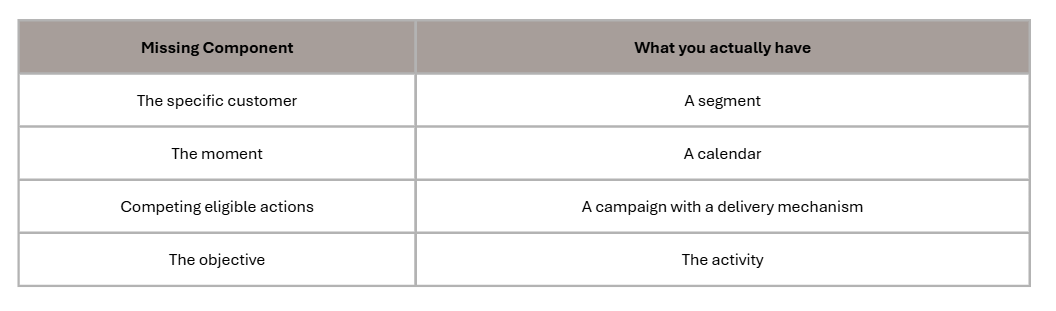
With no objective stated, go back to Priya. What fires is the credit card upselling, because it was the campaign in flight. She is thirty-eight minutes into a stalled mortgage application, and you are showing her a credit card.
The second idea to carry forward is about what’s fixed and what’s free to vary. It explains why an organisation can be excellent at one kind of work and structurally incapable of the other.
Message-first. You start with something to say: a marketing campaign, a product launch, a retention push, a quarterly target. You work outward from it to find the audience who should receive it. The message is fixed. The audience is the variable. You succeed by finding the right people for something you’d already decided to send.
Customer-first. You start with a customer and a moment. You work from there to choose the single action most worth taking. The customer and the moment are fixed. The action is the variable. You succeed by choosing well among options you didn’t pre-select.
The practical consequence is lopsided investment. Most enterprises have industrialised delivery to a high standard: templates, approvals, deliverability, suppression, calendar governance. What they have under-built is the choosing. That gap shows up most sharply when the customer creates the moment, because then there’s no planning cycle to fall back on and no time to convene one. The bank in that steering committee could send four million emails on Thursday. It couldn’t answer what to say to one person who showed up on Tuesday.
Marketing owns the messages and offers. Product owns the propositions and their economics. Risk owns eligibility. Analytics owns the models. Technology owns the systems. Channel teams own the surfaces. Finance owns the number everyone chases.
Every ingredient has an owner. The decision has none.
This isn’t a complaint about silos. It’s what happens whenever a capability sits between functions instead of inside one. Watch for the symptom: a next-best-action programme that stalls in governance rather than in build, in the meeting where two directors want the same moment, and nothing settles it beyond seniority. Those programmes rarely die. They get negotiated into a fixed priority list of offers, refreshed quarterly, which everyone calls decisioning and nobody would defend as such.
I have written before that most customer decisioning projects fail for organisational rather than technical reasons. This is the reason upstream of the others. You can’t assign ownership of something you haven’t defined, so define the decision first.
This is the third idea.
Your organisation already makes these decisions. Every login, call and abandoned form is a moment where one action got chosen over the others. With no decision layer the choice still happens: by whoever configured the default, by whichever campaign is in flight, by the tile that has occupied that slot since the app was redesigned three years ago.
Call these default decisions. Choices made once, some time ago, by someone who didn’t know this customer and wasn’t thinking about this moment.
They are decisioning frozen in the past, which reframes the executive question. You have already started making customer decisions. What’s open is whether you make them deliberately, against a stated objective, and can change them when the evidence changes.
That’s a question about control rather than software, and a board follows it more easily.
A customer decision. Choosing what to do for one customer, at one moment, from what's allowed, for a stated reason.
The four components. Customer, moment, eligible actions, objective. If you can’t name all four, you’re describing something else.
Message-first and customer-first. Campaigns fix the message and vary the audience. Decisions fix the customer and the moment, then vary the action.
The ownership question. Every ingredient of a decision has an owner. The decision itself doesn’t.
Default decisions. The choices your systems make by inertia, which count as decisions whether or not anyone treats them that way.
Five questions - scored 0-3 each. Fifteen points in Part 1, sixty across the primer. Take it here and keep your number. It is anonymous.
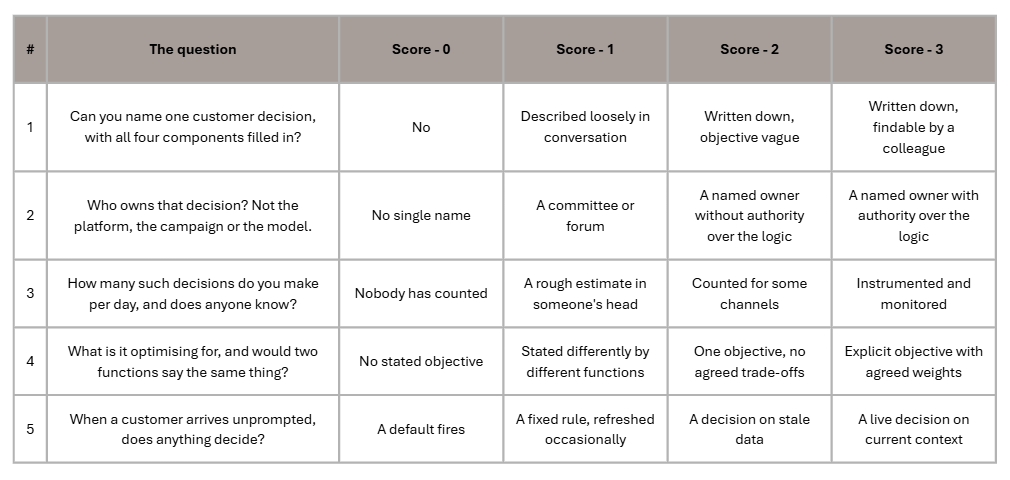
If you score:
0–3, not yet defined. The decision hasn’t been described yet, so nothing downstream can rest on it.
4–7, described but not owned. You can name a decision. Nobody is accountable for it, and seniority still settles ties.
8–11, owned and partly instrumented. A real capability exists in places. The gaps are usually measurement and the objective.
12–15, operating as a decision. Part 1 isn’t your constraint. Parts 2 to 4 will show you where the ceiling actually is.
I am collecting the distribution, and will cover this in detail in Part 5 (or beyond) where the overall numbers sit.
Part 2 double clicks on what a decision needs to know. Most organisations spent most of their money here and the least progress has been made, because the industry has been sold a destination, the myth of complete customer view, while a decision needs something narrower and faster.
If you enjoyed reading this, please join the Customer Decisioning Guild. It is a small, practitioner-led community. You can join at customerdecisioningguild.com.
No posts
Comments
Nothing yet. Say the first thing.
Sign in to join the conversation.