
In Part II, we crunched the numbers to evaluate multi-stage fund strategies and the key drivers of returns. We compare a multi-stage fund returns with no concentration limits and standard 10% concentration limit. In addition, we discuss probabilities of generating returns for each strategy.
Assumptions
· Fund with no concentration limit is a $100 million fund.
· Our research indicates that most funds run a 10% concentration limit for their portfolio, this means a $26 million investment would require a $260 million fund.
· Both funds aim for 10% ownership and exercise their pro-rata after leading the Seed round.
· Exit is at a $2.6 billion valuation; the probability of achieving this exit is 0.1%.
Deployment and Return Analysis
As expected, funds with higher concentration limit generate higher fund-level returns. A closer look at deployment and returns at each stage gives us an interesting insight.
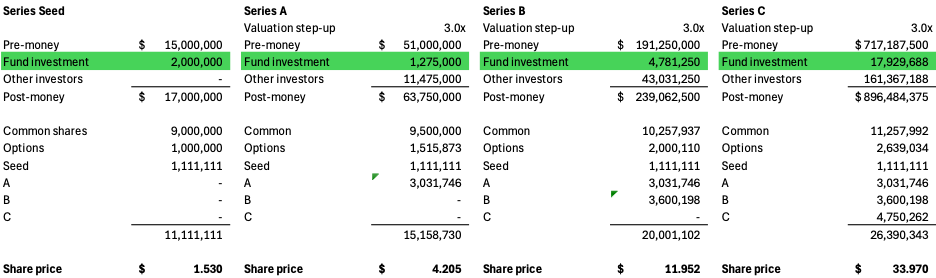
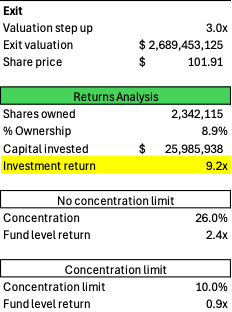

While both strategies increase their check sizes as the companies’ scale, fund-level returns are consistently 2.6x higher in every round for the No Concentration Limit strategy. Conceptually, strategies differ in philosophy: aggressive vs. play-safe.
ROI Probabilities
The probability of any single company achieving a valuation above $2 billion is approximately 0.1%. Just like the lottery — more companies in a portfolio increases the probability of investing in one. But unlike a lottery, this probability is dynamic, increasing as a company demonstrates momentum and traction; Follow-on investing is more akin to purchasing a ticket after several numbers have already been drawn.
The probability of having at least one company valued over $2 billion in a portfolio of 30 seed companies is under 3%; having at least two is 0.04%. Furthermore, 70–80% of companies fail to break out past Series A.
With probabilities like these, a good question arises: Are fund managers professional lottery players? Some obviously are; others are not. Consistent returns generated by managers would imply skill. In our minds, the key to generating consistent returns is:
· Having a thesis/view on where the world is going, and
· Understanding when to move chips towards the center.
A typical “spray and pray” model should, at best, deliver consistent market returns. However, venture is a game of upsized — not market — returns. For LPs seeking market returns, our advice is to invest in the S&P 500, a much safer bet. For market-beating returns, our recommendation is to invest in managers with the skill to identify breakout companies and execute a successful concentrated investment strategy.
Comments
Nothing yet. Say the first thing.
Sign in to join the conversation.