
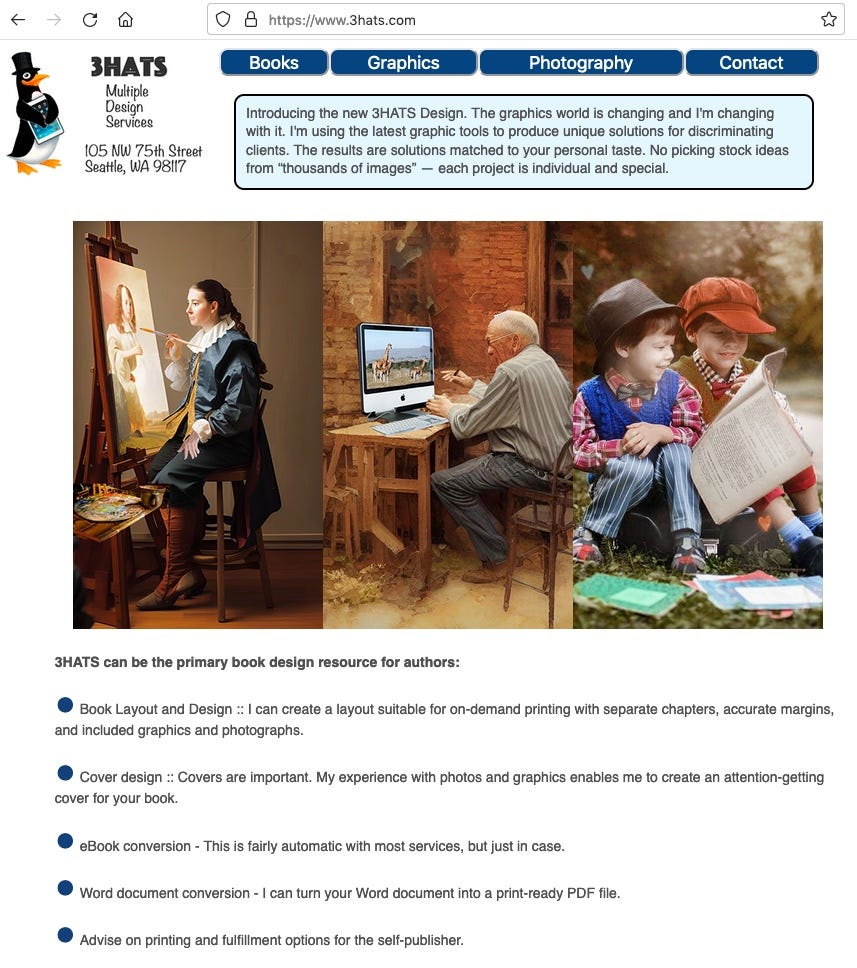
I closed my web service, 3hats.com, last September to pursue computer-assisted design projects. The Internet has become the realm of the tech titans who managed to eliminate the small web designers (me). They did this by offering what I used to get paid to do for nothing—or next to it—so that they can collect information about how people use the Internet. This "data" is sold to advertisers who are spending millions on Internet spot ads. They are everywhere. They have ruined the Internet experience for almost everyone. I didn't want to swim in this polluted pond of rampant privacy invasion.
My creative outlet for years was photography. The accessibility of sophisticated, compact phone cameras now enables the capture of images that rival what I achieved with expensive and bulky equipment. I can't tell you how many times I was out trying to get a nice landscape or bird shot with my big Canon DSLR, only to be interrupted by some excited amateur showing me the picture they just got with their iPhone. Most of the time, their pictures were impressive. If they want a print, they can make one on their desktop inkjet printer.
Time to change with the times
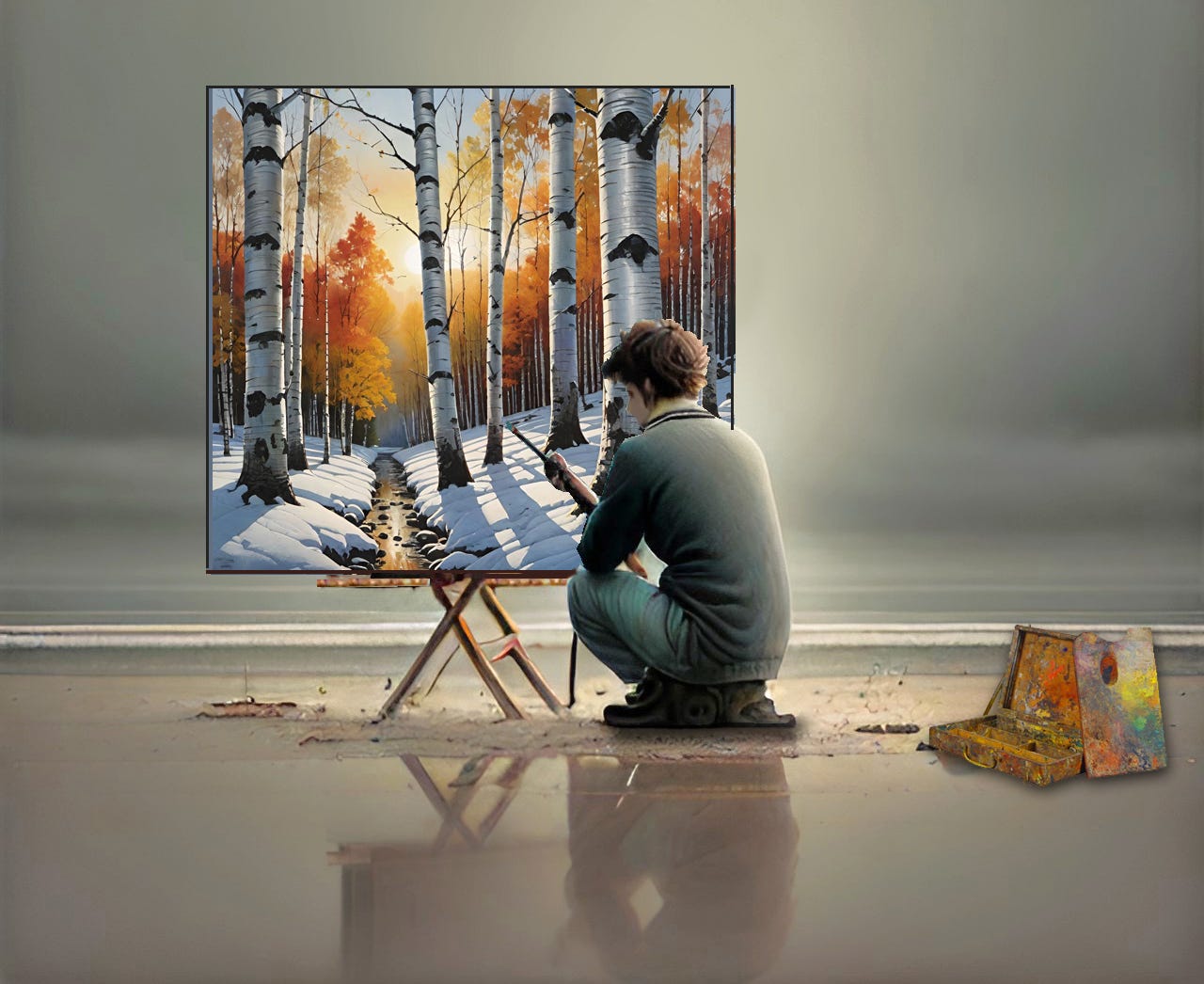
People are just not buying original art and prints. One complaint is "I don't have any wall space." This is true for many people in major cities. The condo and apartment dwellers are multiplying with the push for urban density. The cost of making a print and framing one has increased dramatically. It costs me almost a thousand dollars to re-ink my Epson ink-jet printer. Frame shops are succumbing to a new economic reality as well. Just the cost of having a 24 x 30 inch art print framed is about the same as the price of a 34-inch TV. With a framed art print on your wall, you have one unchanging picture. With the TV, you have hundreds of channels of movies, reality shows, gossip, travel shows, etc. Why would anyone want an expensive piece of static art? Unless the picture is a personal photo or a talented family member's watercolor painting, it's not likely to be framed and hung on a wall.
The galleries that are still in business are inundated with applicants. What about online galleries? They are mostly selling hope. There are 110,000 artists registered with Saatchi Art, the gallery where I have some work for sale online. I am totally buried in that multitude of hopefuls. I've never sold anything there. I am not making art prints on spec anymore. I'm going back to design and graphics for commercial projects using the new AI apps and other useful computer-aided design tools; time to recognize that change is necessary.
I started down the AI graphic rabbit hole just to see what this new tech could do. I've always been curious about new technology, which is why I left the music business years ago to pursue computers. What I found with AI was an astonishing example of programming expertise. I can't even imagine how to create something that uses a math algorithm to compose an image by following text instructions. But it's just a tool. It doesn't dream, it doesn't feel, it doesn't enjoy a stunning sunset, although it can fake the look of one. It also does not steal finished images off the internet—that's not how it works. People who spout that mantra are misinformed, but nevertheless are adamant in their opinion. When I approached the owner of a leading gallery near Seattle about an AI print show, he replied, "I'll never have that crap in my gallery." Good luck with that. I thought I had a book cover design project, but the author decided, on the advice of friends, not to use a computer-generated image but a photograph instead. It will take some time for the art world to accept computer generated art, but it will eventually.
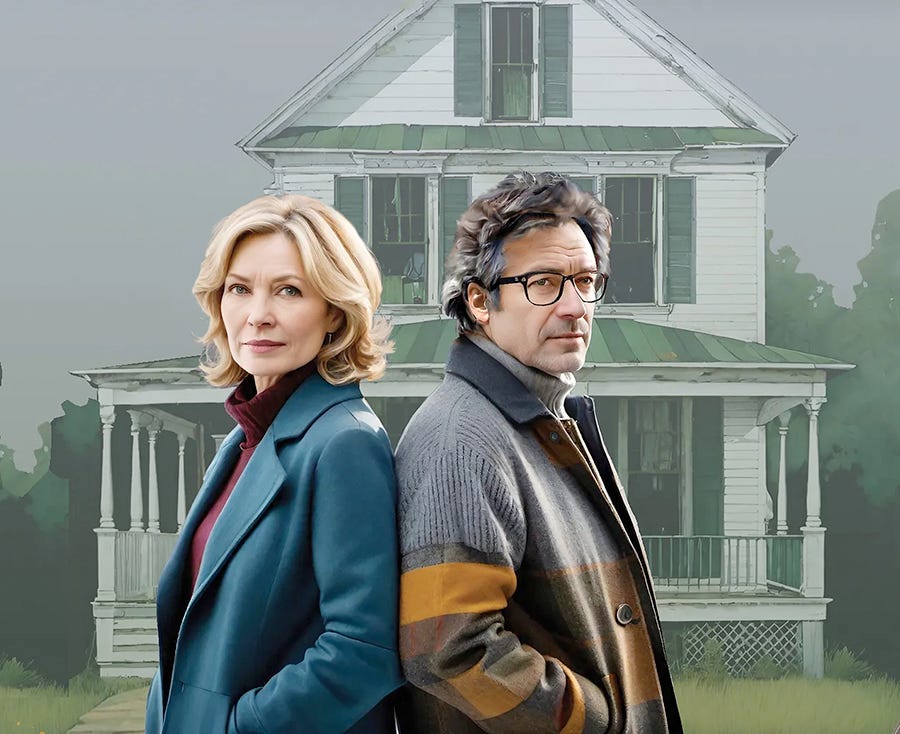
Book cover rejected by author in favor of actual photograph
Computer technology does not create. It is a reflection of human creativity. We should learn how to utilize it creatively—it ain't going away. So, while the possibility of selling original art prints has faded like the setting sun, I am hoping to be able to use this new tool to offer creative services for what it does best—an image of an unusual or specialized situation suitable for: illustrations, book covers, CDs or record jackets, product promotion, and yes, even prints for those devoted enough to still hang art on their wall.
I’m also welcoming the new technology for creating original music.
Music artists are being challenged even more than visual artists by new technology. Now anybody can make a record. According to the monitoring service, Nielsen Music, an average of 120,000 new music audio files were added to music streaming services—across audio and video platforms—per day in Q1 2023. That’s 120,000 per day! Talk about "too many notes." I don't do social mania, so I probably won't ever have a huge following. But creating music is a joy for me, even if my efforts are buried somewhere at the bottom of the 120,000 new music audio files. I'm going the computer route with music like I’m doing with graphics. I’m using Logic Pro and music samples from PG Music to put my music together. I am enjoying producing songs with my computer studio band—what a bunch of talented musicians! I left the music business when I was in my ‘30s. I have new track up on Bandcamp if you want to see what I sound like 40 years later. Click the “Fireflies” icon for a new song.
https://marlingreene.bandcamp.com/
So, this is my take on how technology has rocked the boat for those of us aspiring to create art. For graphic designers, the life-jacket may be an AI app. For musicians, if you make music for yourself—for the joy it brings you—you are in luck. The computer will enable that surprisingly well.
Thanks for listening.
No posts
Comments
Nothing yet. Say the first thing.
Sign in to join the conversation.