
This summer, I found myself in a quiet back room of Ethan Cohen Gallery turning the pages of history. I was a curatorial intern carefully handling a cache of 1970s drawings by Frédéric Bruly Bouabré, each no bigger than a record cover. The first time I saw Bouabré’s work, I felt I had opened a small portal into a vast universe. Here were hundreds of hand-drawn symbols and scenes, inscribed in ballpoint pen and crayon on bits of recycled cardboard. Bouabré, a self-taught artist from Côte d’Ivoire, once said he aimed “to record and transmit information about the known universe”, and in that back room, I could sense the magnitude of his mission. The drawings seemed alive with memory.
As I traced the bold lines of a sun motif or the delicate curve of a Bété syllabary character, I imagined the artist’s presence, a gentle guide murmuring, “observe, and what you see will delight you.” Bouabré observed everything, from a bruise on a fruit to the cosmic vision he once had of seven suns circling a Mother-Sun. In the wake of that 1948 revelation, he took on the name Cheik Nadro, meaning “He Who Does Not Forget.” I felt a kinship across time: Bouabré refused to forget the knowledge of his people, and I, in my own way, was there to make sure his art and story would not be forgotten either.
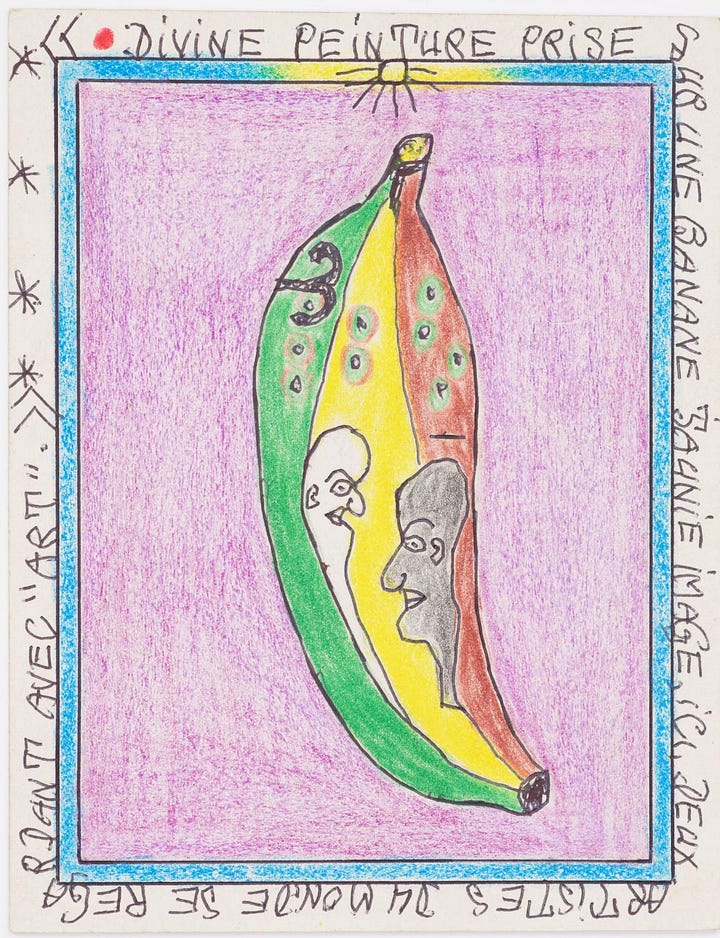
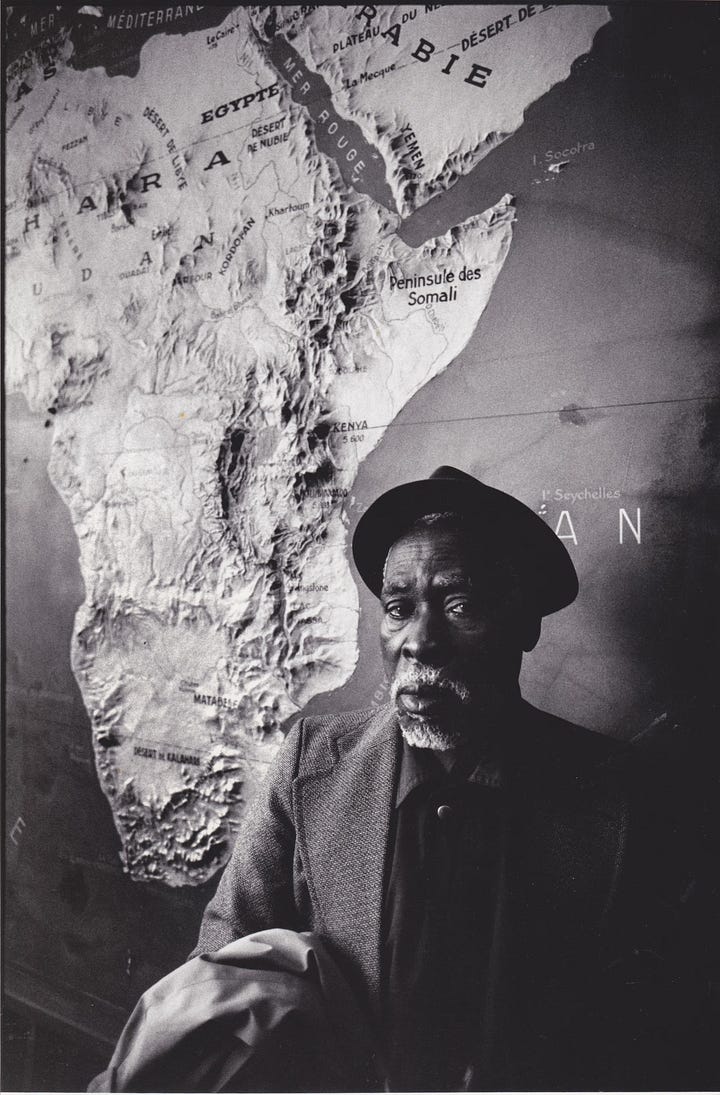
Each morning at the gallery began with the quiet ritual of opening the dossiers that held Bouabré’s drawings. Hundreds of them neatly catalogued. I’d lift the artworks, eyes scanning the French captions he’d written in precise block letters. One card showed a golden disk with radiating lines—a sun, captioned Vision Divine du 11 Mars 1948. It refers to that day the sky opened up for him. Another card depicted a simple village scene: two figures pounding grain. To the uninitiated, these drawings might look childlike, even naïve. But as I learned through my research, nothing about Bouabré’s work is naive. They are spiritual manuscripts crafted from society’s margins, small in scale but monumental in concept. In the 1970s, lacking traditional art materials, Bouabré cut up old record sleeves and packaging to use as his canvas. What others saw as trash, he saw as treasure, fragments of the modern world on which he could map an ancient knowledge. This humble materiality was itself a message: knowledge need not be gilded or elite; it can live on the backs of discarded things, accessible to anyone willing to look.
Day by day, I immersed myself in Bouabré’s world. I helped catalog these works and draft an essay for a forthcoming book on his early years. Each drawing was bordered by a hand-drawn frame, containing an image at the center and a caption at top or bottom. Through repetition, Bouabré built a visual language. Human figures drawn in profile with wide, observant eyes; spiked suns and crescent moons; carefully rendered leaves and stones. Every symbol reappeared like a familiar refrain across the cards, creating a coherent lexicon. It struck me that Bouabré was both an artist and an archivist. He was sketching out an archive of the world, piece by piece, so that nothing would slip through the cracks of memory. Bouabré wasn’t simply recording his culture for posterity; he was envisioning a future where that culture’s knowledge would stand proudly alongside the rest of the world’s.
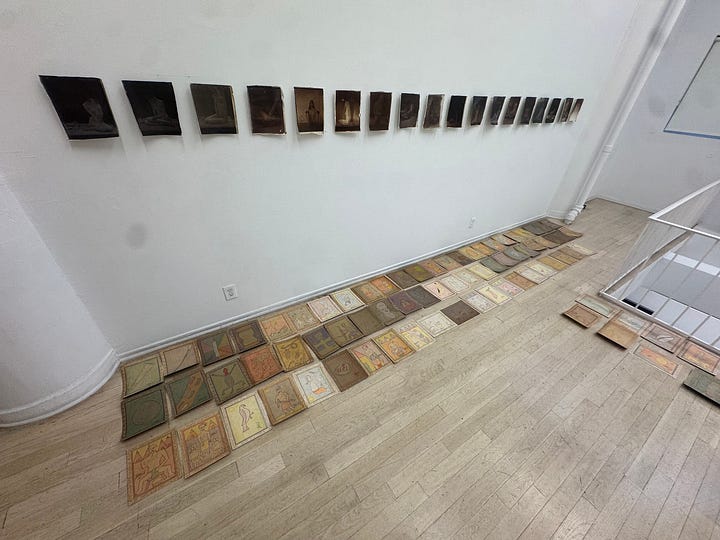

Handling those drawings, I felt the weight of that vision. The edges of some cards were frayed, colored pencil faded by time, but the intent shone through: make the invisible visible. I often whispered Bouabré’s adopted name to myself as a mantra, He Who Does Not Forget. In the quiet of the archive, I realized I was practicing a form of memory work. I was part of the long chain of people (curators, interns, librarians, translators) who dedicate themselves to remembering, to amplifying voices and images that others might overlook. It’s the same impulse that led me, at age 10, to start #1000BlackGirlBooks, gathering stories to make Black girls visible. Now here I was, years later, helping make Bouabré’s vision visible to new generations. There was a sacredness to this labor that I didn’t expect to feel in a commercial gallery. I realized curation can be a form of caretaking, even love.
Working behind the scenes in an art space taught me that cultural preservation is often quiet, meticulous work. Visitors to a gallery see the polished exhibition; frames on the wall, lighting just so, labels with neat text. What they don’t see are the months of research, the late nights editing catalog essays, the careful wrapping and unwrapping of artworks, the endless meetings to decide which story to tell. Much of this labor, often carried out by young women like me, is effectively invisible. In the art world—as in many others—you quickly learn that brilliance alone doesn’t put a show together; there is an army of interns, assistants, and curators (often overworked and under-credited) holding it all up. This summer, I joined that invisible army. My tasks ranged from the romantic (researching Bouabré’s life in-depth, attending artists’ talks) to the mundane (updating inventory lists, proofreading wall text). Somedays I was moving crates or cataloguing paintings in a dusty storage room, my hands literally getting dirty with the grit of gallery work. I joked with a fellow intern that we were like “art-world stagehands,” moving in the shadows while the art took the spotlight. And yet, I found profound meaning in those shadows.
Being a young Black woman in predominantly white art spaces added another layer to this awareness. There were moments this summer when I became achingly conscious of my difference. Like when I was the only Black woman at a private view, or when a visitor assumed I was a docent rather than a researcher. In those moments, I felt a familiar mix of hyper-visibility and invisibility. I’d catch my reflection in the glossy gallery door, a Black girl in business casual, museum badge around my neck. I’d sense a quiet sorrow in my eyes, a weight I carried that others did not. Some of that weight was personal, but much of it was collective: the weight of knowing how many Black creatives and workers before me were overlooked, how many had to fight to prove they belonged in these halls. Yet, that weight was also motivation. If I was often the only one in the room, I made sure to speak up for perspectives that might be missing.
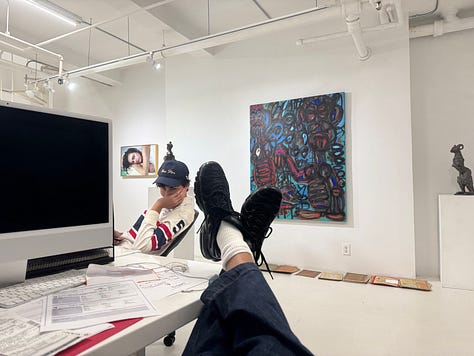
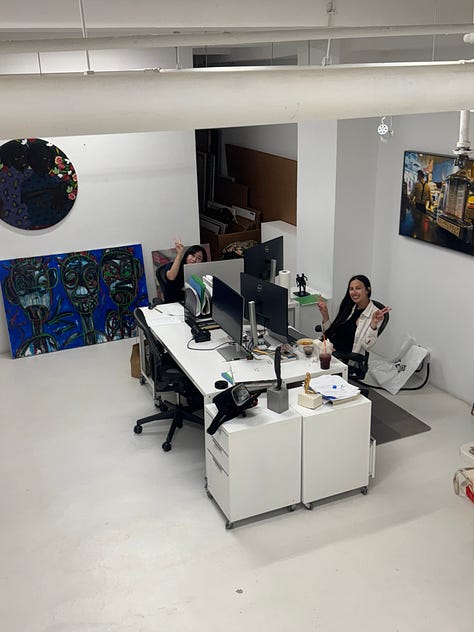
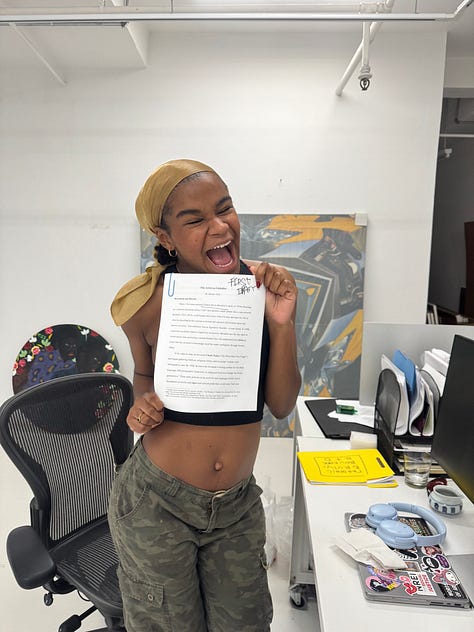
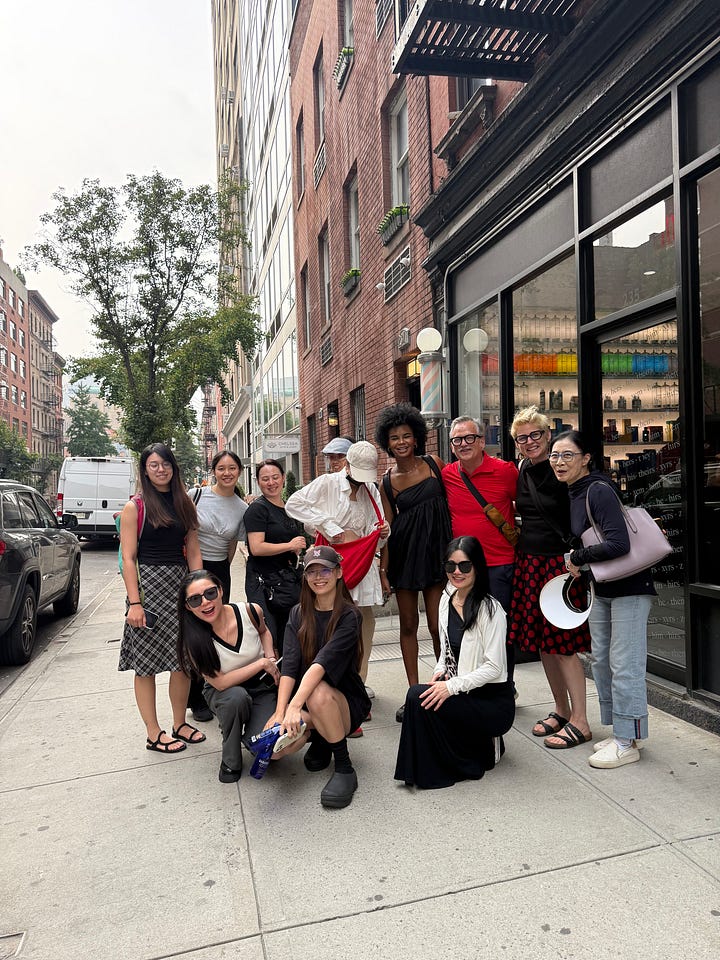

Midway through the summer, my internship took me out of the back rooms and into the open air. On a bright July evening, I traveled up the Hudson to Beacon, NY, where Ethan Cohen Gallery has a second space at the KuBe Art Center. KuBe (short for Kunsthalle Beacon) is a sprawling art hub housed in a repurposed public school. It’s complete with old classrooms turned studios, a gymnasium now echoing with performance art, and an auditorium that hasn’t changed its retro orange seats since the 1970s. I’d heard whispers about “something big” happening that weekend.
It turned out to be an event for Upstate Art Weekend: a conversation between two towering figures of contemporary art, Mickalene Thomas and Derrick Adams. Both are Black artists I’ve admired for years. Mickalene for her resplendent portraits of Black women, and Derrick for his vibrant mixed-media work celebrating Black joy and leisure. They both recently moved to Beacon, and here they were, opening up their new community with a public talk. I arrived early to help set up, but mostly I was trying (and failing) to contain my excitement.
Full post tomorrow at 9 am EST !!
By 6 PM, the KuBe auditorium was packed. I spotted a mix of local art lovers, fellow curators, students, and a few familiar faces from the city’s art scene who’d made the trip. The energy was electric—a kind of anticipatory hum filled the room. I took a seat near the front, my notebook balanced on my knee and phone poised to snap a few photos. Soon, Mickalene Thomas and Derrick Adams walked onstage to warm applause. Seeing them in person, here in this repurposed high school auditorium in Beacon, felt surreal and affirming. Two celebrated Black artists, usually seen in glossy art magazines or headlining shows in Chelsea, were right here in our upstate community center, casual and approachable. They greeted us with an easy camaraderie; you could tell they’re friends as well as colleagues.
Their talk was part of KuBe’s Distinguished Artist Lecture Series, and fittingly, it was distinguished yet down-to-earth. They began by sharing what drew them to Beacon. Mickalene spoke about craving space – not just physical studio space (though Beacon offers plenty of that), but mental space. The idea of an artist retreating to nature to recharge is as old as art itself, but hearing it from Mickalene—someone whose work is so steeped in urban glamour and interior scenes—was powerful.
Throughout the talk, I was struck by how generous Mickalene and Derrick were with their insights. They weren’t speaking in lofty, inaccessible art-speak; they were telling stories. Derrick recounted how, as a kid in Baltimore, his first art-making material was grass – he’d weave blades of grass into little figures (to which Mickalene quipped, “See, you curated your first show in your backyard”). Mickalene spoke about her mother’s love of houseplants and how she’d named each one, treating them like family. “I think that’s why I fill my collages with so many patterned leaves and floral fabrics,” she mused, “because I grew up understanding that plants are part of our living spaces, part of our identities.” There was a tenderness in her voice I hadn’t heard in more formal artist talks. It felt like we were sitting in on an intimate conversation between friends, which, in truth, we were.
She then shared a personal anecdote I knew well but loved hearing again: the first time she saw Carrie Mae Weems’s photography in a museum. “I never felt there was a place for me in museums until that moment,” she said. “Here I am seeing something reflected that was so familiar... I understood the nuance. Everything in that composition, I could relate to.”. Weems’s Kitchen Table Series had given Mickalene permission to belong. “After that,” she continued, “I claimed my space. I said: I have a right to be here, to tell my story. And so do you.” I glanced over at the young woman who’d asked the question; her eyes were shining with tears. Mine were too.
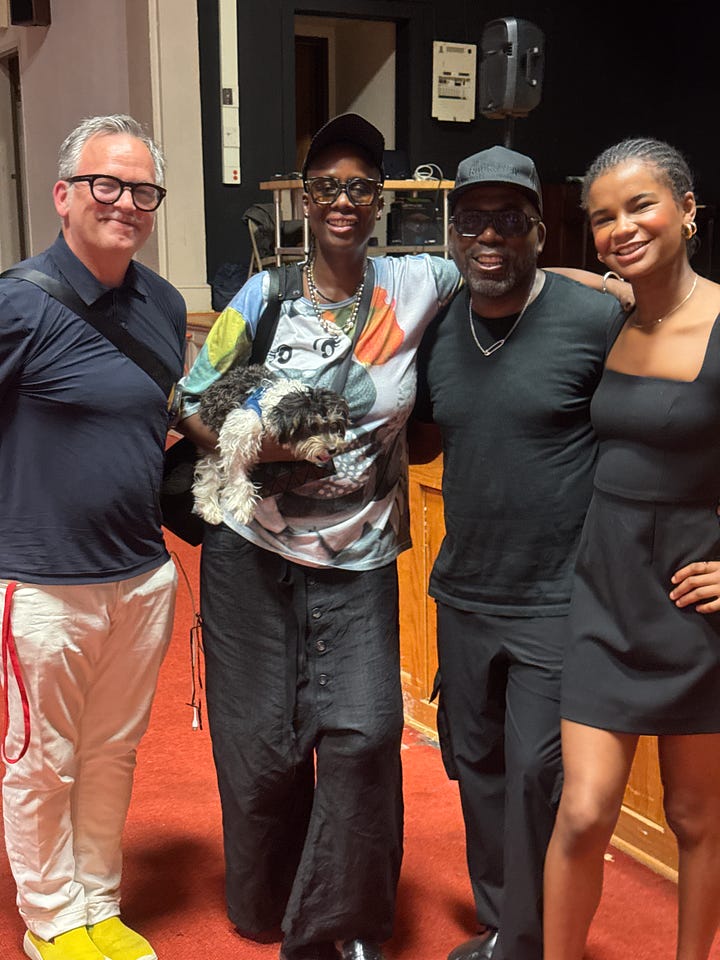
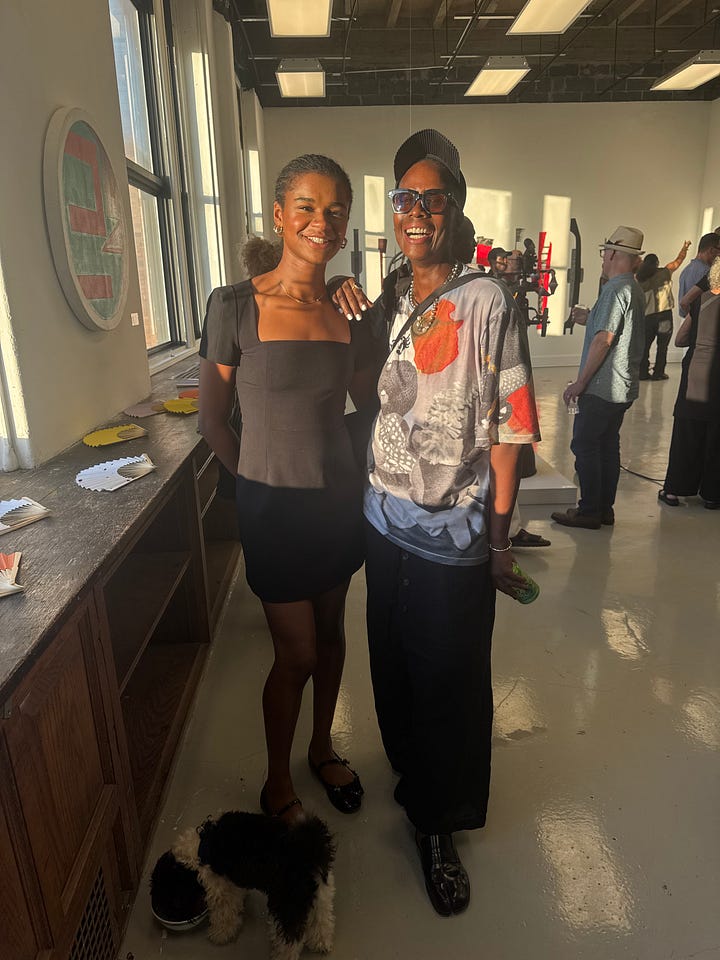
I left the KuBe event feeling refueled by the sense of community in that room. As we spilled out into the summer dusk, people lingered on the lawn. I snapped a mental photo of the illuminated school facade-turned-art-center, thinking of how spaces transform (schools become galleries, old walls host new voices) and how I, too, was transforming this summer.
As August rolled in, my internship neared its end, and I found myself reflecting on how much had shifted in just a couple of months. When I first arrived at Ethan Cohen Gallery, I was eager, a little nervous, and unsure how (or if) my voice would fit in this rarefied art world. Now, I leave with a clearer sense of myself as a thinker, a storyteller, and perhaps one day, a curator. The transformation was subtle but profound. I think back to Bouabré adopting the name He Who Does Not Forget and realize that I, too, have adopted a kind of mantle: She Who Remembers and Reimagines. I carry forward memories of ancestors sewing story-quilts in secret, of Black artists claiming their space on museum walls, of seeds planted in dark soil and I reimagine ways to honor them through my work.
This summer, I witnessed the power of narrative in real time. I saw how a well-placed quote on a wall label can change someone’s perspective, how a conversation on an old school stage can spark new dreams in a young listener, how invisible labor can sow the ground for visible change. I used to think my activism and my art interests were separate, but now I see them as one continuous practice of care. Curation is activism when done with intention. It’s choosing which stories to uplift, which absences to fill, which communities to welcome. I’ve also learned that being a woman in the workplace—especially in arts and cultural labor—means you often have to be your own advocate, your own visionary, sometimes your own gentle rebel.
On my last day, as I turned off the gallery lights, I felt a swell of gratitude. Gratitude for Ethan Cohen and the team who treated me not just as an intern fetching coffee but as a collaborator whose ideas mattered. Gratitude for the artists, living and departed, who filled my summer with meaning: Bouabré with his world of symbols, Thomas and Adams with their visionary seeds, and so many others. Gratitude for the quiet moments, dusting a sculpture, archiving a file, that allowed me to commune with art in solitude. And for the loud moments like opening receptions and panel discussions that reminded me art is also about people coming together.
I know the lessons of this summer will continue to unfold in me like perennial blooms. I leave you with one image that encapsulates it: imagine a young woman (that’s me) standing in a sunlit archive room, holding a tiny drawing of a sunflower that Bouabré made decades ago. In that drawing, each petal is annotated with a word in his invented alphabet, translating the flower’s secret language. I’m smiling, because at that moment I sense Bouabré’s delight, “what I see delights me,” he said of observation. My heart is full of that delight and the hope that I can pass it on. The drawing’s secret language, the ancestors’ secret quilts, the intern’s invisible work—none of it is really secret if we choose to see it, if we choose to value it.
So, as I step forward into whatever comes next, I do so carrying a watering can of lessons, a pocket full of seeds, and the conviction that with care and creativity, we can make even the most constrained spaces bloom. After all, life is transformation, and where we are today is not where we will be tomorrow. I’m excited to continue blooming in this ever-expanding THIRD SPACE, nurturing stories, cultivating connections, and remembering that the smallest acts (like the smallest drawings) can contain universes. Onward.
Until next time,
Marley
🌻 THIRD SPACE is where I gather seeds of thought—art, memory, activism—and see what blooms. If this piece resonated, consider becoming a paid subscriber.
Paid subscribers get access to deeper essays, behind-the-scenes reflections, and invitations to future conversations. Free or paid, I’m grateful you’re here, tending this garden with me.
Comments
Nothing yet. Say the first thing.
Sign in to join the conversation.