
"I am the source of my joy and infinite possibilities."
– Polar Bears' affirmation.
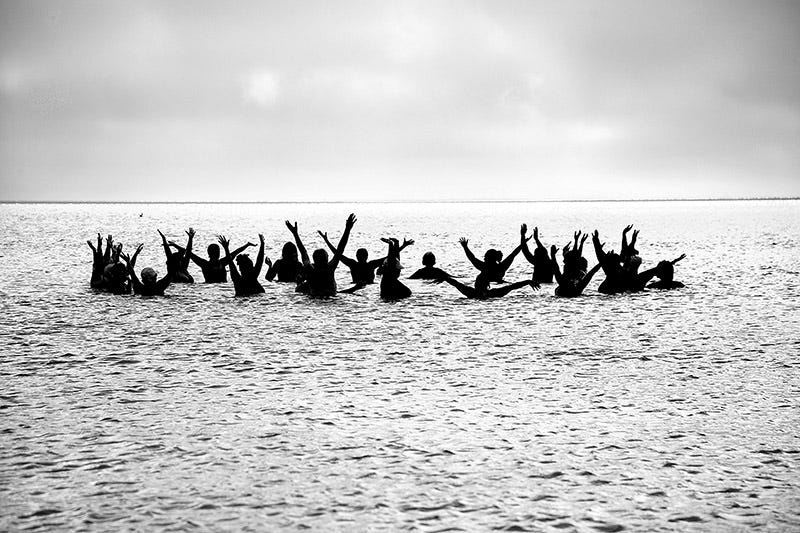
At 7:30 a.m., a circle of elders and children gathers in the gentle surf of Inkwell Beach, their arms lifted toward the sky in an exuberant salute to the new day. Each body moves in unison with the wave, a choreography of joy passed down through generations. In this black-and-white photograph titled "Joy," 22 silhouetted figures form a living mandala in the water. They recite their morning mantra, "I am the source of my joy and infinite possibilities!" voices melding with the ocean breeze.
This affirmation, spoken each sunrise, transcends mere ritual. The image is both document and dream: proof that in this place, Black joy rises like the sun, infinite in its possibilities.
Sixteen summers of my life have begun on this stretch of sand. I remember toddling behind my mother at age four, watching her and her friends wade confidently into the Atlantic. The Inkwell, as Oak Bluffs' town beach is affectionately known, has always been our place of exhalation and belonging. Long before I understood its history, I felt the embrace of its community. The shoreline hummed with the rhythms of funk and gospel from speakers, and neighbors greeted each other with laughter and dance. Even as a child, I sensed that this beach held something sacred.
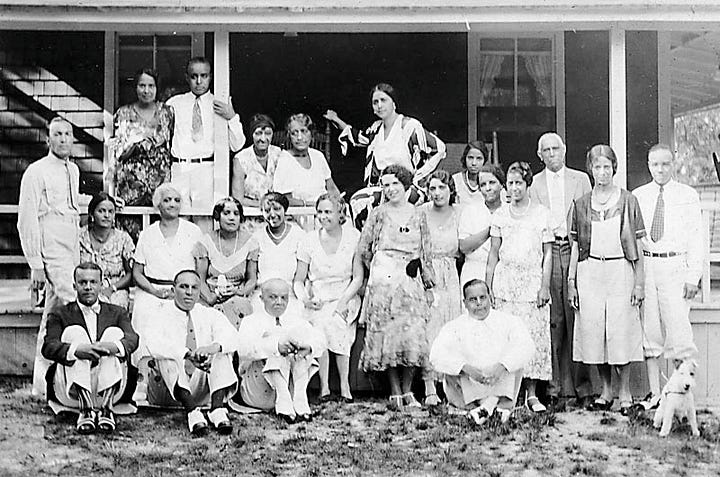
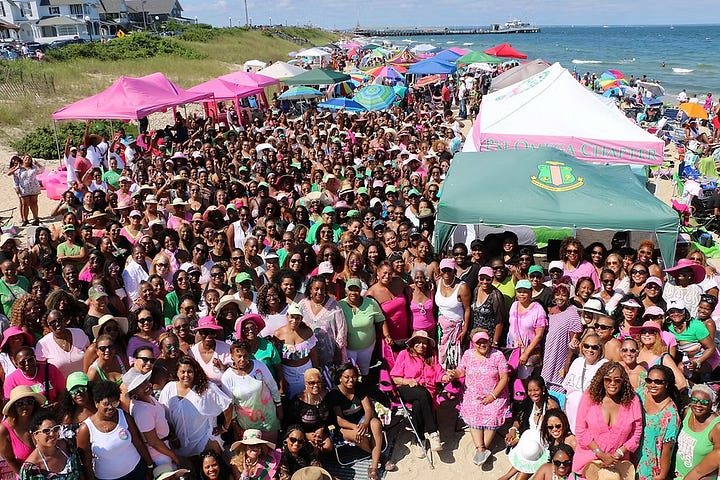
Oak Bluffs, a town on Martha's Vineyard, became a cherished haven for Black families over a century ago, a leisure destination literally born of segregation. Black homeowners built summer cottages here and formed a thriving seasonal community. Oak Bluffs' gingerbread cottages and beaches offered refuge from a world of Jim Crow laws and "sundown towns." This seaside escape, born from exclusion, blossomed into a sanctuary defined by inclusion, rest, and generational memory. HBCU alumni have long returned here each summer, reuniting on these sands to reconnect and celebrate traditions rooted in resilience. Just down the beach from the Polar Bears’ morning circle, the women of Alpha Kappa Alpha gather each year at Pinkwell—a sea of salmon and apple green parasols marking their sisterhood’s joyful claim to the shore. OB earned nicknames like the "Black Hamptons," a signifier of luxury and a self-made safe harbor in a apartheid America.
Inkwell Beach is a slight stretch along Oak Bluffs where Black folks planted umbrellas when no other shore would have us. The beach's nickname, "the Inkwell," has a bittersweet origin. Many say white locals coined it decades ago as a slur, comparing the dark-skinned bathers to ink staining the sea. Yet, over time, Black vacationers reclaimed the Inkwell as a badge of pride. I grew up hearing the name spoken with reverence, unaware until adolescence that it once dripped with contempt. Our community has a way of alchemizing pain into pride, transforming even insults into inside jokes.
However, some legends say the name also nods to the Black literati who frequented Oak Bluffs. During the Harlem Renaissance era, writers like Dorothy West and Langston Hughes strolled this beach, trading lines of verse and plotting stories.
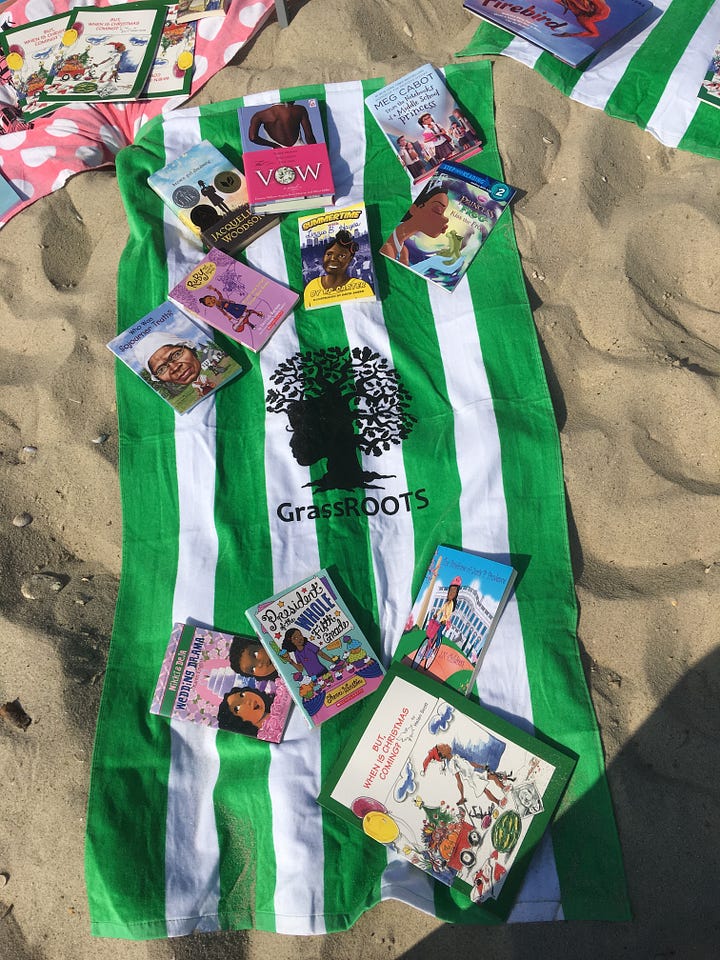
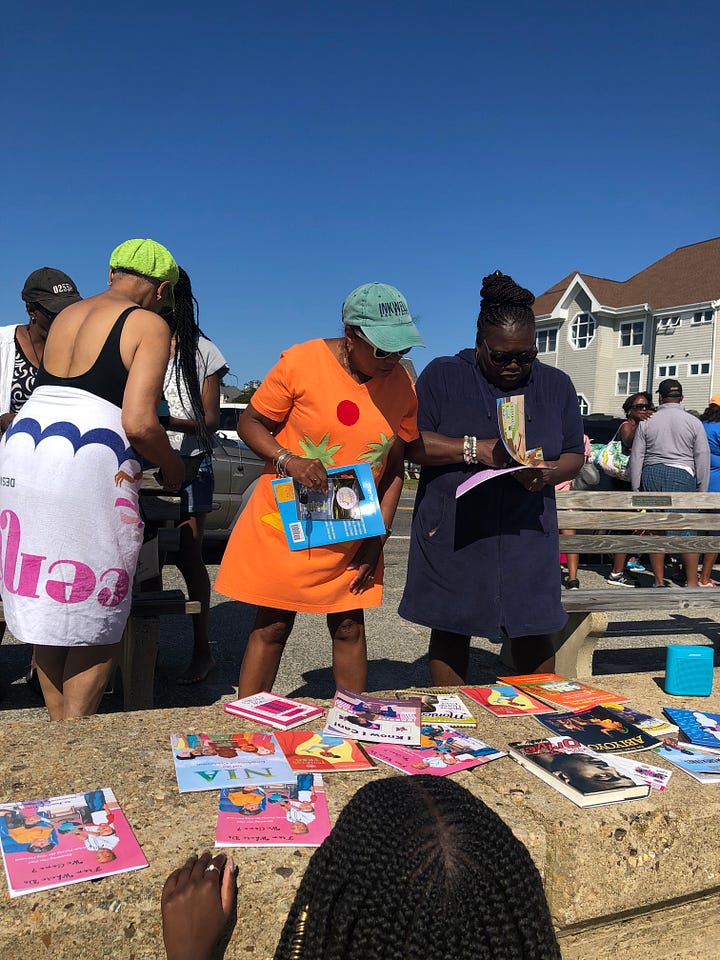
That spirit of literary communion lives on. For several summers, I hosted Books on the Beach, a community giveaway where I laid out hundreds of Black children’s books on picnic blankets by the shore. Families would stop by between swims to browse and take stories home, no questions asked. We transformed the Inkwell into a library and a love letter, each book a ripple in the ongoing tide of Black storytelling.
Each summer at daybreak, the Inkwell plays host to a remarkable ritual. Founded in 1946, the Polar Bears of Martha's Vineyard swim club has been a safe space for Black swimmers and beachgoers for nearly eight decades. What began as a casual morning dip among working-class Black folks (many in service jobs who had only early mornings free) evolved into a resilient community institution. There is no clubhouse, no official charter, just a come-as-you-are gathering at sunrise, bound a shared love of the water and the fierce leadership of Caroline Hunter.
Caroline Hunter is an educator, activist, and chemist. From organizing a Polaroid boycott in protest of the company’s complicity with apartheid, to serving Cambridge Public Schools as an accomplished teacher and assistant principal, and now as an elected member of the Cambridge School Committee, she exemplifies a life of service. She also co-founded the Benjamin Banneker Charter School and received the Rosa Parks Memorial Award at National Education Associations' annual Human and Civil Rights Gala in 2012.
When I spreading paperback treasures across blankets in the sand, Caroline was always there, offering quiet support. She greeted families, lifting the occasion with her presence. This March, I saw her again when I spoke at Cambridge Rindge and Latin School and told her how much her presence at my Books on the Beach events meant to me.
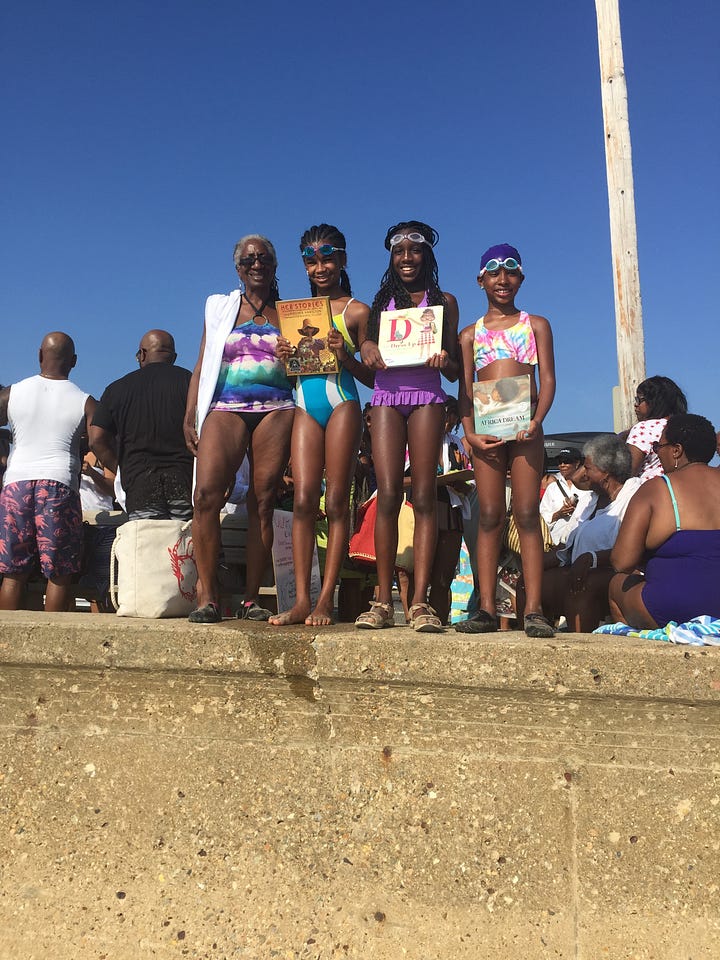
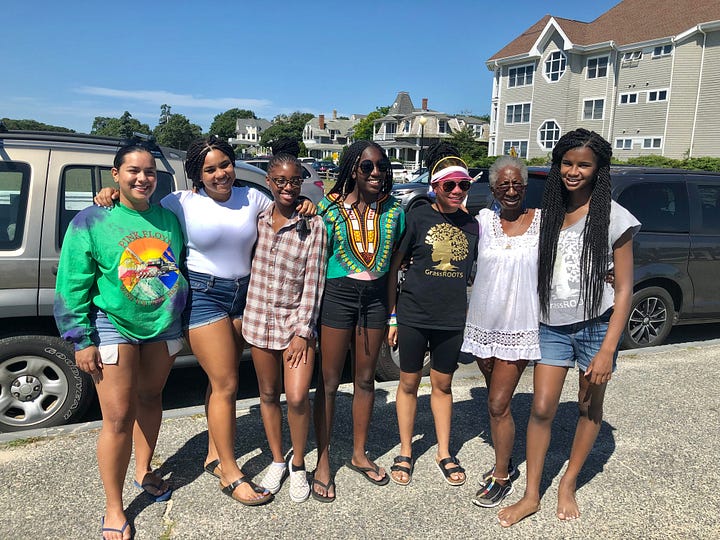
I nervously joined my first Polar Bear circle at 15. I arrived in the half-light of dawn, wrapping my towel around me like a talisman. Black women emerged from every direction, converging at the water's edge as if called by an ancestral bell. Many were seniors, moving with a grace that belied their age. Younger adults and a few children rounded out the circle. They welcomed me with warm grins and gentle encouragement as I waded in. The ocean's cold bite quickly dissolved into warm delight as we bowed our heads in a prayer of thanks.
The Polar Bears' morning ceremony is part exercise class, part convocation. Our daily self-affirmation is "I am the source of my joy and infinite possibilities." Each member speaks it aloud, claiming joy as their own birthright. Only then do we begin the water aerobics, forming a floating circle and stretching our arms like wings. In that circle, you feel lifted by saltwater and sisterhood alike. The sight of elders leading vigorous leg kicks and clapping over their heads made me smile through my shivers.
Polar Bear culture is intentionally non-elitist and all-embracing. The morning gatherings draw an eclectic mix: teachers, postal workers, artists, doctors, judges, fathers, and grandmothers. Titles and pedigrees are left onshore with the shoes. In the water, we are simply Polar Bears, equals joined in a common purpose. Here was a club where fellowship mattered more than status, founded by people shut out of other spaces yet determined to create their own paradise.
Water has always carried a paradox in Black history: it's been a site of trauma and of healing. Oceans recall the Middle Passage and segregated pools, but also our most profound spiritual cleanse, from baptism to baptismal beaches like this one. Standing in the Inkwell's surf, I feel connected to those who came before. With each sweep of our arms, we honor the perseverance of those who claimed this beach as their own when America denied them so much else.
On a late summer morning, as the Polar Bears link arms in the ocean, a passerby might witness a tableau almost too picturesque to be real. It's no surprise that the visual poetry of Black joy at Oak Bluffs has caught the eye of artists like Michael Johnson—and now, global fashion brands. In recent years, Ralph Lauren has turned his gaze toward places like the Inkwell and cultural institutions like HBCUs, weaving their imagery into his designs. The veteran American designer, famous for selling an idealized American Dream aesthetic of ivy-covered campuses and country clubs, has begun to incorporate the Black side of that American story, but not without controversy.
In 2022, Ralph Lauren unveiled a much-publicized collaboration with Morehouse and Spelman Colleges, two historic HBCUs. The limited collection recreated vintage collegiate styles. Tweed blazers, white summer dresses, and varsity sweaters as an homage to HBCU fashion traditions.
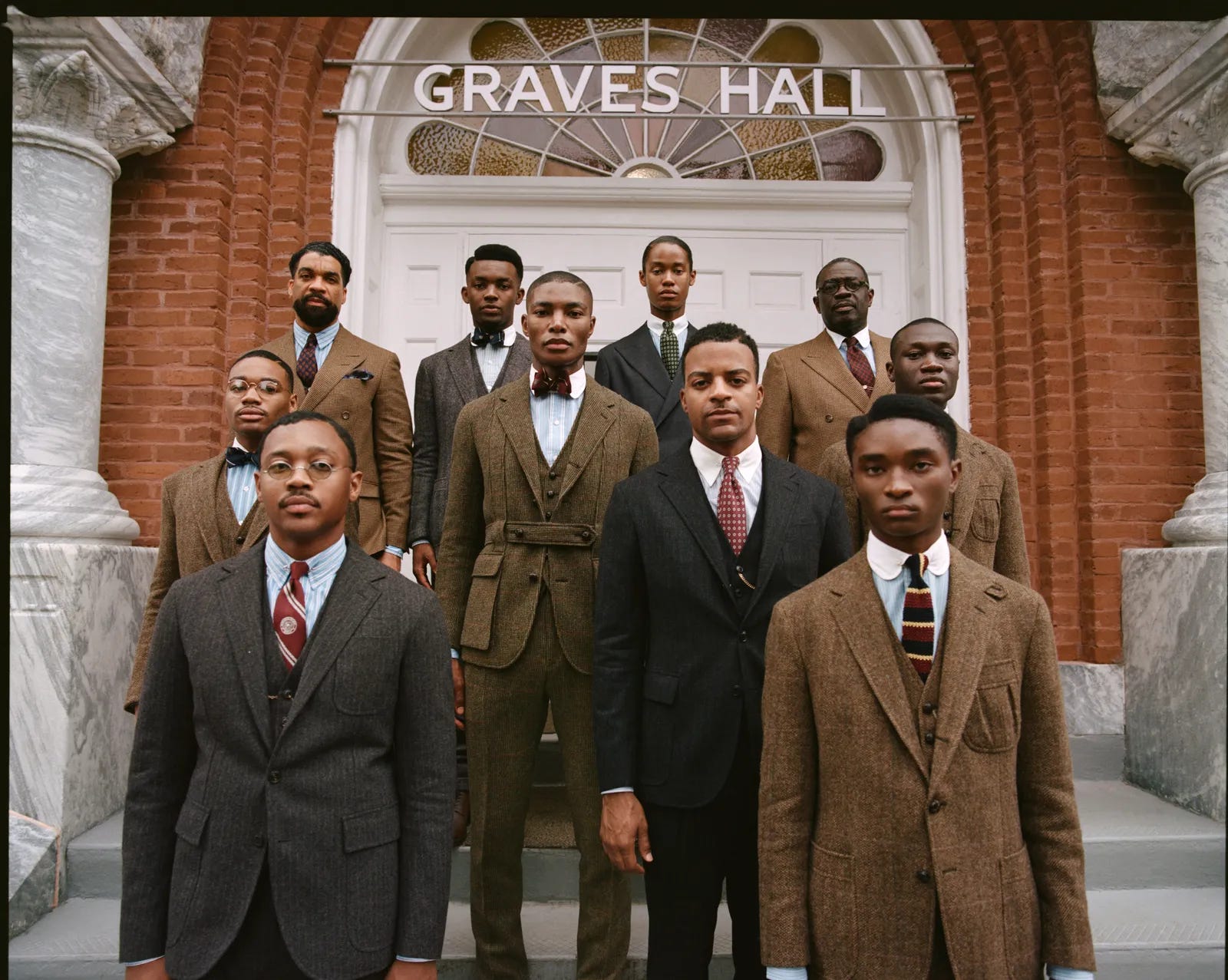
It was a celebratory acknowledgment that Black students have always been part of the preppy American fashion story, even if mainstream brands ignored them.
"It would be tempting to call these looks Ivy League style… But that's only because those who codified American achievement didn't account for Black students," fashion critic Robin Givhan observed, noting that Morehouse men in the 1950s wore the identical sack suits and striped ties as Harvard men—they simply weren't acknowledged by brands at the time. In partnering with HBCUs, Ralph Lauren was, in a sense, revising his narrative of heritage to include the very people he once excluded from it.
Emboldened by the success of that collaboration, Ralph Lauren continued this trajectory. Last week, the brand announced a new limited-edition line: Polo Ralph Lauren for Oak Bluffs. It sounds like a love letter to the Inkwell and its Black legacy. The collection, designed by Morehouse and Spelman alumni, blends classic coastal preppy style with references to Oak Bluffs' history. Think navy blazers emblazoned with lighthouse and sailing motifs, rugby shirts in Howard University colors, or a maroon satin varsity jacket honoring Morehouse's Maroon Tigers. A campaign film titled A Portrait of the American Dream: Oak Bluffs was even shot on the Vineyard, directed by James Jeter (Creative Director of Ralph Lauren), who spent summers there.
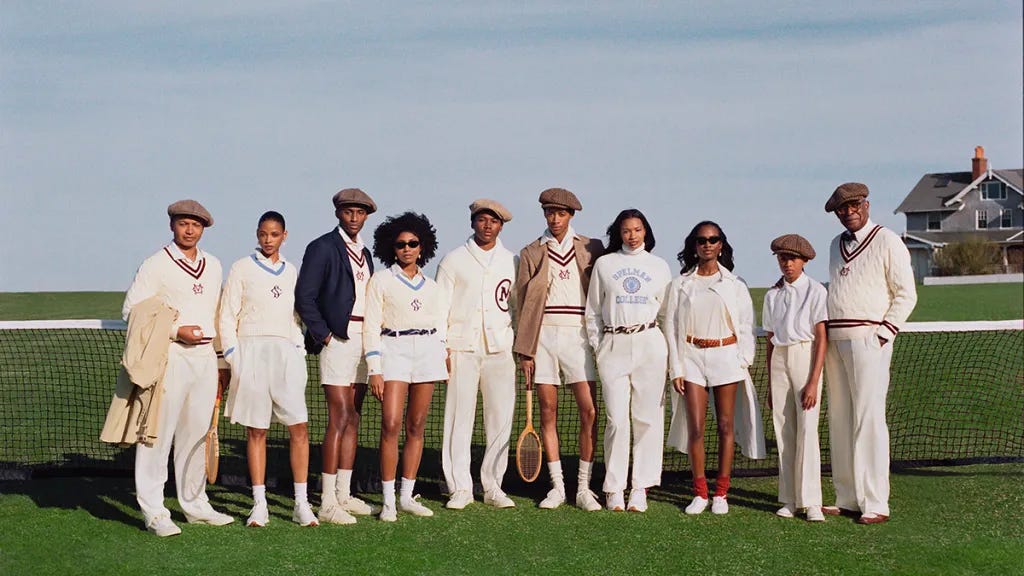
The imagery was beautiful: Black families in breezy white linens picnicking on manicured lawns, elegant couples in collegiate cardigans strolling past Oak Bluffs' famous gingerbread cottages. On Instagram and fashion sites, the photos glowed with hydrangeas and nostalgic charm. Yet, as a young Black woman who calls Oak Bluffs a second home, I felt a pang of dissonance. Seeing our intimate culture repackaged as a Polo lookbook made me pause. Ralph Lauren's campaign captures the style of Black Martha's Vineyard, but does it honor the soul?
Many in the Black community have asked this very question. Almost immediately, debate ignited online. Fans praised the collection's inclusive casting and the scholarships Ralph Lauren pledged to HBCU students, but critics smelled the sour notes of appropriation. On social media and in thinkpieces, some accused Ralph Lauren of "jacking Black culture without proper credit," essentially flattening a rich Black aesthetic into a commercial costume.
Others pointed out the uncomfortable optics: a white-owned brand profiting from imagery of Black excellence that was historically possible only in spaces created to escape white oppression. "Is the dream they're selling one that they're helping the Black community actually access?” one commentator asked pointedly. Does styling Black folks in Ralph Lauren equate to truly centering Black people in the narrative, or is it just decorative diversity?
There is a subtle but crucial difference between celebrating Black culture and strategically leveraging it. When I look at Ralph Lauren’s Oak Bluffs campaign, I don’t just see Black faces in linen or well-styled nods to history—I see a carefully curated lens, a vision of Martha’s Vineyard that feels flattened by intention. Yes, the brand partnered with nonprofits and employed Black designers. Yes, the campaign includes heritage. But it’s a very specific kind: one framed through Ralph Lauren’s long-standing ideal of the American dream—tidy, photogenic, and aspirational in the most capitalist sense.
As someone whose summers have been spent sweating through Polar Bear swims and seeing aunties in cargo shorts and flip flops, the images ring curated rather than lived-in. They reflect not the full spectrum of Black Vineyard life, but a high-end silhouette of it—one that conveniently fits Ralph Lauren’s decades-long aesthetic project. This isn’t just representation; it's a marketing strategy. At a time of deepening inequality, when brands are struggling to maintain cultural cachet, tapping into Black culture has become both morally fashionable and economically expedient. Ralph Lauren’s gaze, now trained on the Inkwell, is strategic. After building an empire on elite whiteness, his turn toward Blackness feels less like reconciliation and more like reinvention.
Full post drops 8am 08/05 EST!
In this light, the Oak Bluffs collection doesn’t lack soul or history. It has both. But they’re not centered. They're stylized, instrumentalized, and made to serve a fantasy of belonging that still benefits the brand more than the community. That’s the difference: who gets to author the narrative, and who gets commodified by it.
Long before Ralph Lauren turned his gaze toward Oak Bluffs, Black-owned brands had already been designing clothes that honored HBCU culture, summer leisure, and Black East Coast prep. Labels like Pyer Moss, Brandon Blackwood, Oak and Acorn, and Tier NYC have built collections that blend cultural pride with sartorial sophistication without needing to borrow imagery from communities they already belong to. Brands like The Brooklyn Circus have long drawn from historically Black collegiate style, using varsity sweaters and tailored pieces to tell stories of migration, dignity, and Black legacy. What Ralph Lauren packaged as new has been the creative lifeblood of Black designers for decades.
To be clear, there is nothing wrong with celebrating Black beauty and success. We deserve to be seen in all our splendor. It can be powerful to witness a major designer spotlight historically Black spaces and to employ Black talent in doing so. But celebration without structural investment often slips into extraction. Ralph Lauren’s team made a smart, aesthetically strong decision in recruiting Morehouse and Spelman alumni to design and model the Oak Bluffs collection.
Still, the ultimate author of this narrative remains Ralph Lauren, and the ultimate beneficiary is Ralph Lauren’s brand. Following the campaign, the company’s stock price rose, a reminder that when Black heritage is styled just right, it becomes marketable.
This recent turn toward “inclusive” Americana only came after decades of neglect. For over fifty years, Ralph Lauren built a fashion empire selling an ideal of the American dream rooted in Ivy League whiteness, ranchland masculinity, and elite leisure. It wasn’t until after the 2020 uprisings—after George Floyd’s murder forced institutions to re-evaluate their racial optics—that Ralph Lauren finally “saw” places like Oak Bluffs and institutions like HBCUs. That timeline matters. It reveals how long Black stories were considered marginal to his version of America, and how quickly they were reabsorbed once they became politically and economically useful.
When I stand on Inkwell Beach at dawn, I don’t wonder if I belong. My family and people like us built this place. But when I look at Ralph Lauren’s Oak Bluffs campaign, I see something different. However beautiful the images, they sit atop a legacy that never centered us. Now we’re being invited to the table Ralph Lauren set long ago—not necessarily to eat, but to decorate the setting. To be styled for inclusion is to be written into someone else’s story: visible, flattering, but expendable when the season ends. To be truly centered is to hold the pen. Our narrative doesn’t need a sponsor. It stands on its own, not as a campaign, but as a living, breathing truth.
If Ralph Lauren’s Oak Bluffs collection offers one filtered lens on Black heritage—glossy, curated, aspirational—then Michael Johnson’s photography is its soulful counterpoint. Where the designer stylizes, the artist preserves. For decades, Johnson has documented the rhythms of Martha’s Vineyard’s Black community: from Polar Bear swims at dawn to elders seated proudly on porch steps, from church hats to cannonballs.
His most iconic image, Joy, captures twenty-two silhouetted Polar Bears waist-deep in the surf, arms raised to the sky like praise. That moment, with its glimmering water and collective grace, “was really important to capture it photographically, culturally, historically,” Johnson once said. So he did. And the community embraced it. A large print now hangs in the Oak Bluffs town museum. And in 2017, under the hush of early morning, Johnson himself quietly installed a commemorative sign at the Inkwell, featuring the raised silhouettes of the Polar Bears and declaring what we’ve always known: “Inkwell Beach – Home of the Polar Bears.”
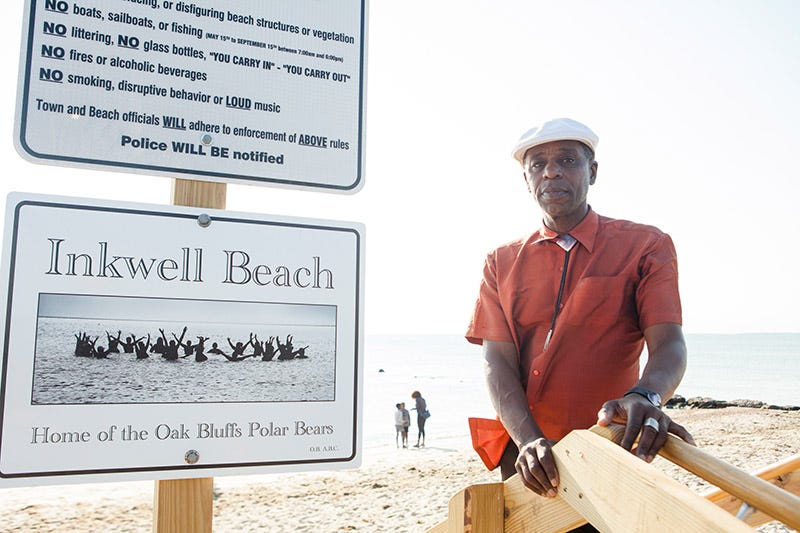
Where fashion campaigns market nostalgia, Johnson’s lens holds history. His images are love letters authored from within the community as acts of care. On his website, michaeljimage.com, you’ll find galleries of black-and-white photographs that honor this island: beachgoers laughing through salt spray, children balancing on towels, couples slow-dancing under parasols. His work frames joy gently and truthfully. He lets Black life name itself.
When I see Joy, I feel seen as Johnson captures what was already there. That is what it means to center Black joy rather than extract it. To trust it as complete, not in need of polish. His images have traveled far but their origin remains rooted: here, in this place where sun meets saltwater and tradition meets morning breath.
This is the art well I return to each summer. Not just the physical Atlantic, but the wellspring of ritual, resistance, and reflection that gathers each morning at the Inkwell. The Polar Bears taught me something that Ralph Lauren’s campaign could never sell: that I am the source of my joy. That in community, in tradition, in water, we generate infinite possibilities. Black intergenerational joy in water is powerful. It is the choreography of survival and song. It carries the weight of history and the lightness of a dance.
So yes, I critique Ralph Lauren not to reject visibility, but to remind us that true inclusion is context. It’s not enough to be photographed in the water; one must understand what the water means. Oak Bluffs, the Inkwell, the Polar Bears—these are not backdrops for brand storytelling. They are living sites of self-emancipation. Stories born from constraint. Joy wrested from sorrow. They are the American dream remade on our terms.
Each morning, in that cold surf, we lift our hands and faces to the sun and speak our truth aloud: I am the source of my joy and infinite possibilities. No one gives us our joy—we cultivate it. That is the art. That is the well. And thanks to Michael Johnson, that moment, Black joy, centered and eternal, shimmers forever on the water’s surface like a second sunrise.
☕ Enjoyed this piece?
If THIRD SPACE feeds you, consider becoming a paid subscriber or supporting with a one-time tip via Buy Me a Coffee. Your support helps keep this work independent, ad-free, and rooted in care.
For collaborations, commissions, or media inquiries, reach me at reachthirdspace@gmail.com. Thanks for reading and for being part of the archive!
Comments
Nothing yet. Say the first thing.
Sign in to join the conversation.