
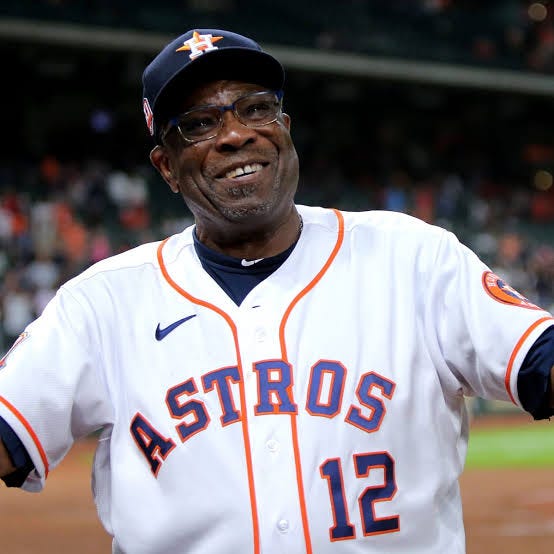
Dusty Baker was managing Washington in 2016. It was October, so he was in uniform. All five franchises that he managed found their way into at least one postseason. On this occasion someone was asking him about pitching, which he knew from his days of trying to hit it. “It’s really not that complicated,” he said. “Throw the fastballs up and throw the breaking balls down.” Clay fell from the eyes of those who were listening, and wax disappeared from their ears. It wasn’t the first or last time that Baker let us know that life is simpler than we think.
There is no more beloved figure in the game, even though Baker has finally left it, and his goodbye gift is “Crossroads,” the autobiography that he wrote with Steve Kettman. People were drawn to Baker by his aggressive humanity. There were no strangers in his world, just people he hadn’t met yet, and no one worth wasting his disdain. Instead of devoting his life to baseball, he took what he needed from the game and those who played it, and he applied its day-to-day lessons to everything else, like fishing and hunting and wine development and music appreciation and traveling. He was reading newspapers and books long after they lost their allure. This particular volume is just like its author, uncompromising and thoughtful and simple. He learned to keep things clean at home and in the Marine reserves, and his life remains decluttered.
Baker, now 77, played 19 years in the majors and, with the Dodgers, was the MVP of the 1977 N.L. Championship Series win over Philadelphia. He came up with Atlanta and is best known for his presence in the on-deck circle when Hank Aaron stroked home run No. 715 in 1974. But his managing career, in which he had a chance to counsel and motivate 25 men at a time, was his calling card. Baker won 54 percent of his games over 26 years, and he got to three World Series, finally winning with Houston in 2022, but also bringing the Astros back from an 0-3 deficit to a Game 7 against Tampa Bay in 2021 before losing an ALCS. Some of those job changes were troubling, but Baker’s worth was always measured by the suddenness of the phone calls from teams seeking help. From 1993 through 2023, he was out of work for only five years.
The losses hurt. After the Giants were run down and caught by the Braves in the 1993 N.L. West race, Baker kept going back to Candlestick Park for a week, making up stuff to do, hoping that, somehow, a 163rd game would present itself. In the book Baker soberly points out the bullpen decisions that kept backfiring over the years. He kept remembering 2002, when he removed Russ Ortiz with a 5-0 lead in Game 6 in Anaheim, and his three reliable relievers came crashing down, and the Giants went home empty. He made decisions based on heart and trust, not spread sheets, and his luck wasn’t all that good until he got to Houston. In Game 4 of that Rays series, Baker rememberd Ortiz, and he left Zack Greinke in a bases-loaded situation, and Greinke got the strikeout and Houston won. The constant push-pull with the civilians in the front office made 2023, the post-title year, nearly intolerable. But Baker already knew it was time, just as he knew his run with the Giants was over at the 10-year mark.
Besides, Baker knew why he was in Houston. The Astros were reviled for their electronic sign-stealing and trashcan-banging ways of 2017, when they beat the Dodgers in the Series. When the hammer came down they lost their manager and general manager, and Carlos Beltran lost his incipient chance to manage the Mets. The Astros needed a powerwash, and Baker had been cleaning something all his life. He told the club they would win a World Series with him, and in his third year they did.
But the games aren’t really the gist of “Crossroads.” The most powerful figure is Johnnie B. Baker Sr., Dusty’s taciturn dad, who always seemed to know what his eldest son was up to. One day Dusty pilfered a candy bar. Dad asked him to smile, which exposed the candy on his teeth. Out came the belt. The real lessons came in the odd jobs that Johnnie B. did and the know-how he passed along, along with his shoes, which Dusty had to polish every day.
Some of Johnnie’s parenting wouldn’t pass the sensitivity test today. He cut Dusty from his Little League teams more than once, usually for deportment. Later, when Dusty signed a contract with the Braves and didn’t tell him, Johnnie B. sued him, under the auspices of the California Child Actor’s Bill. Dusty refused to speak to his father for a while, but when he turned 21 he discovered that Johnnie B. had invested Dusty’s money in solid stocks, and he suddenly had money while some of his counterparts had blown theirs.
The other powerful figure was Aaron, whom Baker and Ralph Garr followed like lemmings. For everything Aaron did, he has remained an opaque figure to most of the public, but Baker was enthralled by his wisdom and judgment. When a work stoppage came along, Aaron told Baker to stay in shape, but Baker didn’t, and had a rough year as a result. He was sent down to Richmond and radiated such misery that an elementary-school girl wrote him a note that said, “You’re my favorite player, and if you’re not the same Dusty Baker, then send the other one back.” Teachers come in all ages.
Aaron was a savant who positioned the outfielders by watching where a hitter’s hands were, and often knew what pitch was coming before the pitcher got the sign. Before 715, Aaron told Baker, “I’m going to get this over with right now.” And when Aaron left for the Brewers, the Braves slowly fell apart. Baker was in New Mexico, recovering from what he thought was an alien encounter, when a hotel-room TV told him he’d been traded to the Dodgers.
Baker eventually got in tune with Dodger ways, and learned to appreciate Tom Lasorda’s family approach, but it didn’t start well. He hurt his knee playing basketball in the winter, which he knew was an unforced error, and then told the Dodgers the injury happened when he was playing with his dog. He had a futile season and was booed vigorously. Once his knee healed, Baker was a major factor in three World Series appearances in five years, and the championship in 1981.
Turbulence followed. Baker was dogged by rumors of drug use, which the Dodgers seemed to believe when they released him after the 1983 season. His first marriage was fraying. He railed against the drug testers, one of whom invaded a bathroom stall to watch Baker execute. His investments, managed by his brother Vic, began fluctuating, and when the Bakers fell victim to more stringent limits on tax shelters, Vic was consumed by guilt and suffered psychosis, which led to homelessness. Dusty fought an unmerciful IRS, which had not informed the Bakers of the tax-shelter change, and he finally reached a settlement he could live with, especially with a fat contract from the Cubs on the way.
But Baker was always able to compartmentalize his rage, although it threatened to overflow when he visited Ghana and saw a replica of the slave ships and realized the horrors of a month at sea. “I had moved beyond anger,” he writes. “I felt more of a sense of a deep and collective spiritual sorrow.”
He became a batting coach and then a manager, and he remarried and had son Darren, who, as a batboy in the 2002 World Series, was rescued from possible home-plate mayhem by J.T. Snow. Darren became a prospect as he played at Cal,, and eventually went 7-for-14 for the Nationals, but was released, signed with the White Sox and was released again in July. He’s 27 now. Without baseball, Darren and Dusty wouldn’t have been spring training roommates when the son was with Washington and his dad was managing Houston. Memories, unlike contracts, don’t expire.
During the Astros’ World Series run, Baker gathered leftover food from the clubhouse and took it to homeless shelters. There were innumerable encounters with strangers, particularly young ones who might have seemed misdirected, who get a couple of tickets from Dusty and become regular correspondents. One night Baker had a few drinks and started driving, and his heart sank when he saw blue lights behind him. The officer was ready to write the DUI ticket when he saw the name on the license. Baker, as a Dodger, had given him a baseball once upon a time. No harm, no foul, no blood-alcohol count.
Baker grew up in Riverside, Ca. and knew the Bonds family well. It would have been nice to hear Dusty make the Hall of Fame case for Barry, who broke Aaron’s record with Dusty as his manager, or to address those steroid days in general. Baker managed Sammy Sosa, too. But he makes it clear that he’s not telling us everything, and he takes pains to absolve those who stood in his way. Cincinnati fired him after two years and two division championships, but Baker blames nobody. He also points out that Alex Gonzalez’s error was actually the most damaging play in the Steve Bartman game of 2003, the Game 6 of the NLCS that the Cubs could have won to clinch, but didn’t. But Baker dutifully says Gonzalez makes that play 99 times out of 100.
“All this is baseball,” Baker writes. “People are always looking for explanations. Sometimes there aren’t any.”
Baker will be eligible for the Hall of Fame when the Veterans’ Committee meets in December. Most believe Baker’s World Series win will open his door. He was the second-oldest manager to win one, but then he often points out that lead singers and saxophone players and blues guitarists keep playing into their dotage, keep using the knowledge they accumulate from all the crossroads they meet.
Dusty’s dad told him that when he did come to an intersection, he should go the right way, meaning the virtuous one. Former basketball coach Al McGuire also used to say that you should go right, except he was referring to right turns, the ones without hassle or calculation. In truth they were saying the same thing, and Dusty is, too. Fortunately he has devoted a few months, and 405 simple pages, to the uncomfortably frontal task of looking back.
Comments
Nothing yet. Say the first thing.
Sign in to join the conversation.