
Chad Jones and Chris Tonetti joined Markus’ Academy for a conversation on their paper, Past Automation and Future AI: How Weak Links Tame the Growth Explosion. Chad Jones is a Professor of Economics at Stanford University and a research associate of the NBER. Chris Tonetti is an Associate Professor of Economics at Stanford University and a research associate at the NBER. Recent related episodes include Jones (2023) and Haskel (2025).
A summary in three bullets:
How much of past economic growth is due to automation? Around half. Jones and Tonetti built a standard task-based model to answer the question, and then simulated the model to speculate about the future of AI
Automation boosts growth by switching from slowly improving humans to rapidly improving machines on an increasing number of tasks. However, it can also create bottlenecks and spread capital thin. TFP growth may slow even as automation advances due to the slow-productivity-growing tasks that will still have to be done by humans
AI may deliver explosive growth, but with a 75-year delay due to the weak links. Humanity may have time to solve its problems around inequality, political economy, and AI’s existential risks
[04:19] The basic weak-link model of automation
The model has a final good which is produced by combining a variety of tasks with a constant elasticity of substitution across them. The EoS is smaller than 1, so tasks are complements
Firms providing tasks have a binary choice over using labor or capital. Each has its own task-specific productivity and they are perfect substitutes
The richness of the task-based framework comes from the interaction between task complementarity and labor-capital substitutability
A key assumption is that the new tasks being automated are those with the highest labor costs, or the least productive: Moravec’s (1988) Paradox
[26:20] How much of economic growth comes from automation?
Calibrating the model allows for growth accounting, decomposing growth between:
(1) Increases machine productivity
(2) Increases in human productivity
(3) A residual for other drivers of productivity like misallocation
Since 1950 they find that machine’s task level productivity has growth 5% faster than human productivity, and that 2% of tasks are automated every year
[48:03] The Future Consequences of AI
Some intuition for the weak-link mechanism: assuming infinite productivity in current software tasks raises GDP only by (≈2%) because growth is still dominated by the remaining weak
To study the long-run impact of AI, the model is enriched to allow for endogenous idea generation and for automating both the production of goods and ideas
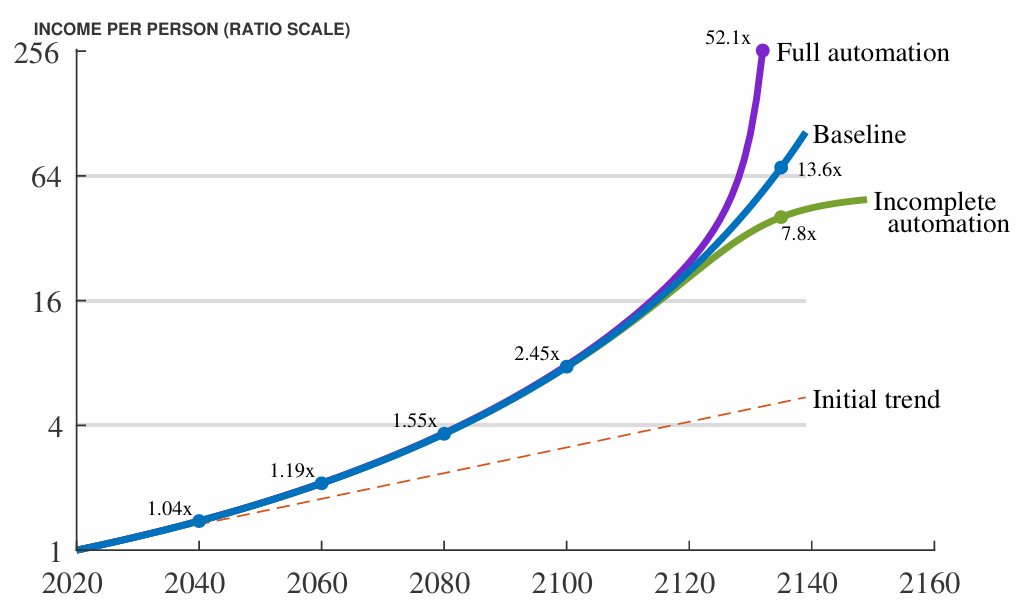
The model delivers three scenarios for economic growth in the next centuries:
(1) Full automation of all tasks: humanity reaches infinite income in ~2 centuries. The labor share of income goes to zero
(2) Incomplete automation: a set of tasks is permanently done by humans, slowing growth in the long run. The capital share falls to zero.
(3) A baseline case with vanishing but never-zero human tasks and a constant capital share of around 1/3
There are two forces: (1) the flywheel effects where the automation of ideas yields more ideas and more automation, (2) the weak link from non-automatable tasks.
In all scenarios explosive growth takes decades to arrive due to the weak links
* Summary produced by Pablo Balsinde (PhD student, Stockholm School of Economics)
Comments
Nothing yet. Say the first thing.
Sign in to join the conversation.