
Nick Bloom joined Markus’ Academy for a conversation on the impact of AI on US productivity. Bloom is the William Eberle Professor of Economics at Stanford University, a Senior Fellow of the Stanford Institute for Economic Policy Research, and the Co-Director of the Productivity, Innovation and Entrepreneurship program at NBER.
Watch the full talk below. A summary in four bullets:*
We see an extremely wide range of forecasts for AI’s growth impact—from Dario Amodei (2026), who projects 10–20% annual growth, to Daron Acemoglu (2025), who estimates 0.5% total additional growth over a decade
Given the uncertainty and the lack of clear historical precedents, managers’ expectations may be our best available data
In their recent working paper, Bloom and coauthors (2026) leverage existing central bank surveys to ask 6,000 executives about AI
They document four facts:
1) ~70% of firms use AI
2) ~75% of executives use AI, with an average 1.5 hours per week
3) AI has had little impact on employment and productivity in the last 3 years
4) AI is expected to double productivity growth over the next 3 years
[08:41] A new age of productivity growth?
The history of productivity growth has had three phases: (1) near zero until around 1800; (2) an acceleration until the mid-20th century, peaking around 4% in the 1960s; and (3) a secular slowdown since then, to roughly 1% today
Bloom et al. (2020) argue that the decline in productivity growth is due to the fact that ideas are getting harder to find. Will AI reverse this trend?
[19:05] What is the current data on firm AI use?
Individuals’ AI adoption has risen from ~10% in the spring of 2023 to 30–40% today
The Survey of Working Arrangements and Attitudes (also run by Bloom and his coauthors) shows people’s AI usage is more common at home than at work, and is strongly correlated with education, industry, and occupation
Yet, we have much less data on firms’ AI usage
Official business surveys, such as the US Census Business Trends and Outlook Survey, often report low and flat AI adoption (~17%). They likely understate true usage because responses are provided by junior employees lacking comprehensive knowledge of their firms
At the same time, many surveys where firms are paid to participate suffer from the “impostor problem”, being filled largely by bots
[24:58] The survey
They leveraged existing firm survey panels in US, UK, Germany and Australia. In all cases except Australia they are run by the central bank
The surveys are mainly answered by the CFOs and CEOs of firms that have an average of ~250 employees
Executives, while unpaid, participate because they see the data, and can see how they are benchmarked against other firms. Since answers remain private, they have no incentive to overreport AI usage
The surveys ask managers to forecast future sales, so they validate the responses by comparing them with realized sales; forecasts track actual outcomes closely
[29:29] Results on firms’ AI use
Only 69% of executives use AI for at least 1 hour a week. 29% do so between 1 and 5 hours a week
78% of firms use some form of AI technology. Firms that use more AI are younger and larger, and have higher labor productivity, better paid employees, and younger directors
Last three years: 91% report no productivity impact from AI; on average, respondents estimate AI increased sales growth by 0.24% in total
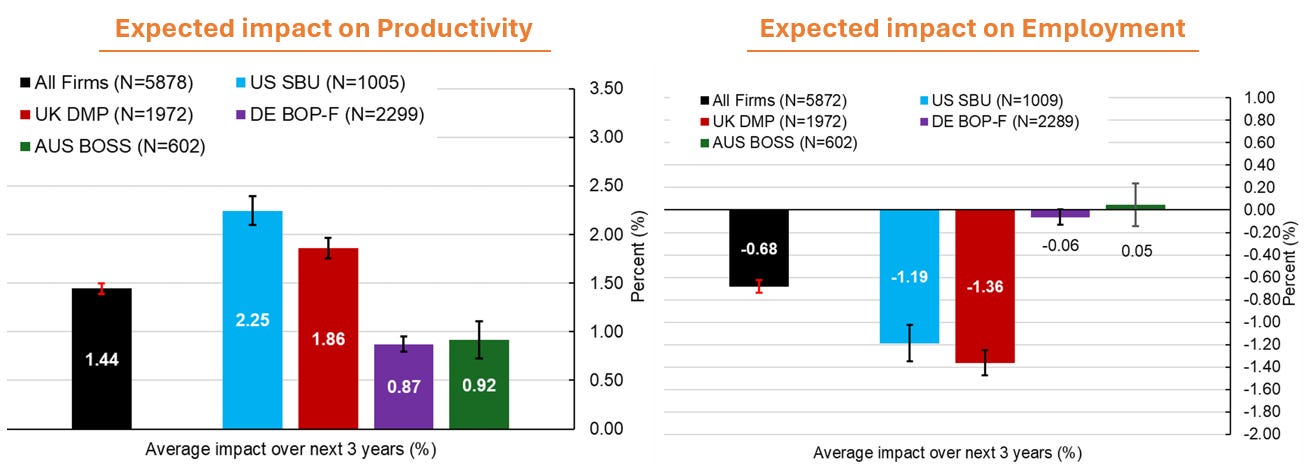
Next three years: 39% expect no productivity impact from AI; on average, respondents expect sales growth of 2.25% in total from AI. Expected gains are ~60% lower in Germany and Australia than in the U.S.
These estimates of AI’s future impact are striking, since productivity growth has been around 1% for the last few decades
They may justify cutting rates if they signal a sustained productivity-driven expansion in supply that lowers inflation pressure, as Kevin Warsh has suggested
[43:39] Employment effects and employee responses
In the next three years, only 42% expect no AI impact on employment; on average, respondents expect employment declines of 1.2% in total. Two thirds of this comes from less hiring
They also asked employees the same questions. Workers report a similar AI usage (1.8 hours per week)
Workers expect much smaller productivity gains (0.92% in the next 3 years). But are more optimistic on employment, expecting AI to increase it by 0.45%
One may argue employees’ responses are more accurate because they are closer to production bottlenecks, but executives are largely accurate on their sales forecasts. Executives’ confidence of their answers is also at pre-pandemic levels
* Summary produced by Pablo Balsinde (PhD student, Stockholm School of Economics)
Comments
Nothing yet. Say the first thing.
Sign in to join the conversation.