
By Mark Strand
The war against Iran has dominated the news and already carries serious economic consequences for the world. Yet the justification for U.S. action was never adequately explained—before the war began or even after the initial strikes.
As I wrote in my last column, the President needlessly picked a fight with Pope Leo, practically guaranteeing a defensive reaction from loyal, even very pro‑Trump, Catholics. That was a careless mistake, especially since the Church’s position is not nearly as simple as Leo’s rhetoric makes it sound.
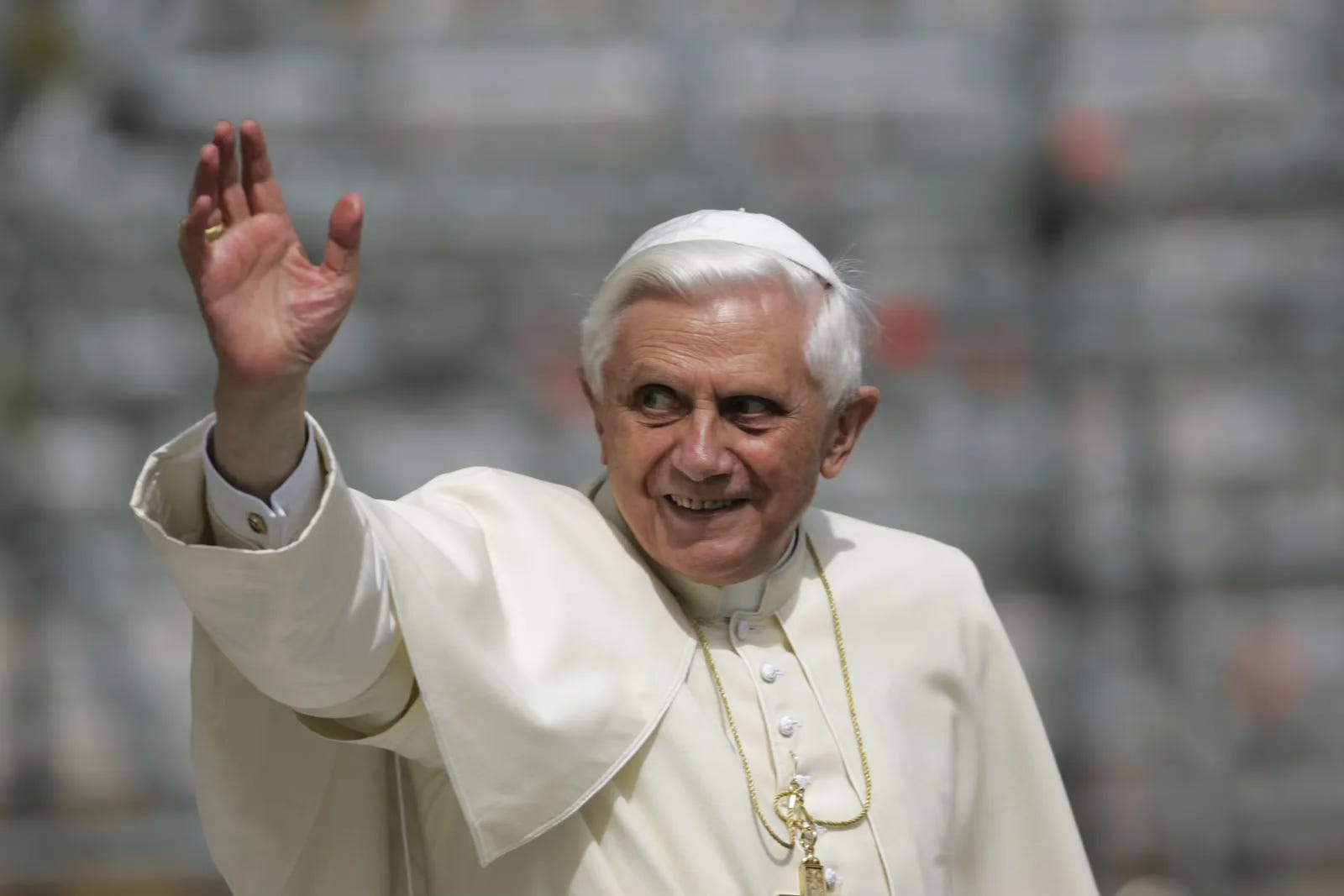
Pope Benedict XVI warned that “an absolute pacifism that refused to grant the law any effective means for its enforcement would be a capitulation to injustice.” Pope Leo’s absolutist rhetoric has seemingly made believers out of non‑believers and caused considerable consternation among believers—including me.
In Cameroon, he said, “Blessed are the peacemakers. But woe to those who manipulate religion and the very name of God for their own military, economic and political gain, dragging that which is sacred into darkness and filth.” I assume he meant to quote “Blessed are the peacemakers” (Mt 5:9) and then add his own apostolic riff. I hope so, because my Protestant friends already think Catholics have enough trouble sticking to Scripture.
Without defending the President’s earlier remarks, it’s hard to avoid the conclusion that the Pope has been dabbling in something that looks a lot like amateur politics. The danger is that we are getting a pope who is genuinely right to condemn the manipulation of religion for war and profit, but who is himself playing dangerously loose with both Scripture and the Church’s careful distinctions on war, peace, and the use of force.
Sidebar: Pope Leo and Pope Benedict
Pope Leo talks about war the way a good pastor talks about sin: it is “absurd,” always “a defeat,” something Christians should renounce almost as a matter of identity. He dreams of an “unarmed and disarming peace,” and in his public rhetoric at least, the guns never quite have a legitimate owner. It is powerful language, especially if your job is preaching rather than governing.
Joseph Ratzinger, the future Benedict XVI, looked at the same world and saw a different danger: “absolute pacifism” that “refused to grant the law any effective means for its enforcement” and thus became “a capitulation to injustice.” In his view, a legal order that will never, under any conditions, defend itself or the innocent is not moral; it is ornamental. The Church’s social doctrine quietly agrees, allowing that when whole populations face annihilation and all serious non‑violent means have failed, the international community may be not only permitted but “legitimate and even obligatory” to “take concrete measures to disarm the aggressor.” Leo’s homilies tend to skip over that hard corner of the tradition—which is convenient, unless you happen to live in one of the places where the aggressor is already busy.
I know this is fantasy, but here is what I wish the President had said, interspersed with notes from the Church’s own teaching. Humor me; I’m no Peggy Noonan, and I realize I’m asking Donald Trump to speak in a way wholly uncharacteristic of his signature style. Yet nothing in this contradicts the reasons he himself has offered for taking action.
The speech he never gave
Over the past month, the Iranian regime has done what tyrannies always do when they are afraid of their own people: it has answered courage with murder. The world has seen the bodies in the streets, the mass arrests, the attempted strangling of a movement that wants only what we claim to believe in—basic human rights and the chance to choose their own future. We cannot say we did not know.
At the same time, we face reports that this same regime is on the threshold of a nuclear weapon. A government that shoots its own citizens should not be trusted with the power to erase cities.
Tonight, I want to be very clear about what this moment requires of the United States.
First: we have used every serious non‑violent tool we have. That is not weakness; that is moral discipline. We have imposed targeted sanctions on the individuals, units, and industries directly responsible for repression and for the nuclear program. We have worked with allies to isolate the regime, not the Iranian people. We have supported efforts to document these crimes, to bring their authors before international courts, and to give Iranians a voice the regime cannot completely silence.
The Compendium of the Social Doctrine of the Church takes seriously both the urgency of avoiding war in an age of “terrifying” weapons and the duty to protect civilians who are being massacred or uprooted. It insists on exhausting non‑violent means, yet links the right of defense with “the duty to protect and help innocent victims who are not able to defend themselves from acts of aggression.” That is uncomfortably close to what we are now watching in Iran.
Second: we affirm something simple that too many are afraid to say—governments exist to protect their people, not to terrorize them. Law, whether national or international, has a purpose: to shield the innocent and restrain the violent. When a regime turns the machinery of the state against its own citizens and races toward nuclear arms, the world is not witnessing “internal affairs.” It is watching a threat to basic justice and to peace.
Benedict XVI, while still Cardinal Ratzinger, warned that “an absolute pacifism that refused to grant the law any effective means for its enforcement would be a capitulation to injustice.” If war is simply called, in Leo’s words, a “defeat for humanity” with little attention to who is defending whom, that can obscure the moral obligation to protect victims—whether in Iran, Ukraine, or elsewhere.
For a long time, the Christian just‑war tradition has lived with a hard truth. War is always a tragedy. It is always a defeat of human hopes. But the same tradition also warns against an “absolute pacifism” that refuses to give the law any real means of enforcement, and so surrenders the field to injustice. Refusing to act when innocents are being crushed is not peace. It is complicity.
So here is where the United States stands. We will not launch a war of aggression against Iran. We will not dress up a war of choice as “prevention.”
In 2012, the U.S. Conference of Catholic Bishops said essentially the same thing when talk of bombing Iran’s nuclear facilities was in the air. They quoted the Church’s social doctrine: “Engaging in a preventive war without clear proof that an attack is imminent cannot fail to raise serious moral and juridical questions.” The bishops insisted that Iran’s bellicose statements and lack of transparency, “in themselves,” did not justify military action. They rejected precisely the kind of “war of choice” my imaginary President now disavows.
We have learned, at great cost, what happens when we pretend we can remake another society at gunpoint. Any use of force must be a last resort, tied to a clear and limited goal: to protect human life and to disarm those who threaten it.
Here, too, the Vatican has been consistent. Since John Paul II, the Church has affirmed that war must be a last resort, but it has also taught that the international community has an obligation to intervene—with force, if necessary—when entire populations face annihilation. John Paul’s message for the 2000 World Day of Peace famously spoke of the “legitimate and even obligatory” duty to “take concrete measures to disarm the aggressor” when all other means have failed and a people’s survival is at stake. Later, in response to ISIS, Archbishop Silvano Tomasi said bluntly: “When all other means have been exhausted, to save human beings the international community must act. This can include disarming the aggressor.” Archbishop Giorgio Lingua, the papal nuncio in Iraq, agreed that U.S. strikes “had to be done, otherwise [ISIS] could not be stopped.”
But we will also not promise that force is off the table no matter what happens. If all serious diplomatic, economic, and political efforts fail; if the regime continues systematic violence against its own people; if it moves to deploy or use nuclear capabilities in a way that threatens massive loss of innocent life—then the United States will work with our partners, and in line with international law, to take concrete measures to disarm the aggressor and to protect the innocent.
That is not a threat. It is a responsibility. Sovereignty does not give any government the right to butcher its people or to prepare mass destruction with impunity. When a regime crosses those lines, the world cannot simply look away and call it “peace.”
Catholic theology starts with self‑defense, not with war. A person—and by extension a people—has the right, and sometimes the duty, to protect innocent life from unjust attack. That basic principle lies underneath everything else. Just war is what happens when the Church asks a further question: under what conditions may a state exercise that right by waging organized war, and how must it fight if it does? The answer is a much narrower category with many more brakes: just cause, right intention, legitimate authority, last resort, proportionality, a reasonable chance of success, and strict limits on targeting non‑combatants. Self‑defense is the moral foundation; just war is the heavily conditioned, reluctantly permitted way a political community may sometimes live that principle out.
One more thing: nuclear weapons. For decades we and others have lived under a nuclear shadow, telling ourselves that terror could keep the peace. Whatever one thinks of that history, we must admit that nuclear weapons are different. They do not distinguish between soldier and child, between the guilty and the innocent. No regime that treats human life as expendable should command that kind of power.
That is why we must prevent Iran from getting the bomb, but also, as I have long advocated, strengthen real arms control and move, step by step, toward a world less dependent on nuclear terror. We cannot credibly oppose an Iranian bomb while shrugging at an endless global nuclear status quo.
For many years the Church has been deeply hostile to nuclear weapons but tolerated deterrence as a temporary expedient on the way to mutual disarmament. Under Francis, the argument has sharpened: even possession is increasingly described as morally unacceptable. Given that trajectory, and the obvious incompatibility of nuclear weapons with the principles of discrimination and proportionality, it should be clear that the Church would strongly object to placing such weapons in the hands of a regime with Iran’s human‑rights record.
To the people of Iran: our quarrel is not with you. We see your courage in the streets. We hear your demand for dignity, for freedom, for a future that belongs to you. We do not come as conquerors. We stand, however imperfectly, for the belief that your lives are not bargaining chips in someone else’s negotiations.
To our allies: this is a test of our principles as much as our strength. It is easy to say “never again.” It is harder to act—carefully, lawfully, but decisively—when “again” is happening in real time. We must stand together, not as lovers of war, but as people who know that a peace purchased by turning our backs on victims is not a just peace.
To Americans: we are taking every precaution to protect innocent human life and using every available tool to keep our servicemen and women as safe as possible. But we cannot pretend that neutrality is possible when innocent blood is being shed and when a regime that despises human life stands on the edge of nuclear capability.
Our goal is a Middle East where the Iranian people are free from terror, where no regime can hold its neighbors hostage with nuclear blackmail, and where disputes are not settled by massacres in city streets. That is not utopia. It is simply the minimum justice that human dignity demands.
That is the path we will try to walk—with restraint, with resolve, and with a firm commitment to both justice and peace.
There is nothing in this speech that is incompatible with Catholic social teaching or with what Leo’s predecessors have actually said.
Last resort in a nuclear age
Whatever else one says about American policy toward Iran, it has not been a 47‑year sprint to war. Since 1979, we have tried almost everything short of invasion—sanctions, back‑channels, EU‑brokered talks, the JCPOA, “maximum pressure,” and a revolving door of threats and inducements. None of it has persuaded the Islamic Republic to stop murdering its own people or to abandon the nuclear option as the ultimate insurance policy. If “last resort” means “you must keep trying what has already failed for another fifty years,” then the phrase has quietly been emptied of content.
All of this brings us to the real knot in the rope: what “last resort” means in a nuclear age. For good reasons, Catholic just‑war teaching is allergic to talk of “pre‑emptive” or “preventive” war. The Church warns that striking first, without clear proof that an attack is imminent, raises serious moral and juridical questions, and the U.S. bishops leaned on that language when they opposed proposals to bomb Iran’s nuclear facilities in 2012. Preventive war is not just another policy choice; it is precisely the sort of “war of choice” the tradition is trying to fence off.
That said, nuclear weapons make the old notion of “imminence” harder to apply than it was when Augustine was worrying about Visigoths. When the weapon is a tank column, you can see it massing at the border; when the weapon is a nuclear device on a mobile launcher, your warning time may be measured in minutes. By the time you have courtroom‑grade proof that a regime intends to use a nuclear weapon, you may be looking at a radar screen, not an intelligence estimate. In that setting, “wait until the attack is imminent” can become a pious way of saying “wait until it’s too late.”
“Nuclear weapons compress ‘imminence’ from months to minutes—and by the time you’re certain, you may be staring at a radar screen.”
On nuclear weapons themselves, the Church has been getting steadily less patient. John XXIII and Vatican II condemned indiscriminate destruction and the arms race; later popes grudgingly tolerated nuclear deterrence only as a strictly conditioned, temporary expedient; today, Francis and many episcopal conferences openly question not just the use but even the possession of nuclear weapons as incompatible with respect for human life. A weapon that cannot be used without turning cities into mass graves does not sit comfortably inside a moral framework that demands discrimination and proportionality.
Put those two strands together and you get a genuine dilemma the magisterium has not fully worked through. On one side, the tradition says: no preventive wars of choice, no “we feel uncomfortable, therefore we bomb.” On the other, the same tradition now says: no morally acceptable nuclear use, no pretending that incinerating a metropolis can be squared with the Gospel. In between lies the hard question Iran forces back onto the table: what counts as a licit “last resort” when the cost of waiting for absolute certainty may be a mushroom cloud—and when our decades of non‑violent efforts to change the regime’s behavior have already failed?
Pope Leo’s rhetoric, for all its sincerity, tends to glide past that question. To say, over and over, that “war is always a defeat” and that we must seek an “unarmed peace” is admirable in the abstract; no sane person wants the alternative. But when you are dealing with a government that guns down its own citizens and edges toward a capability that could turn the next “war” into one afternoon of mass extermination, “never again war” is not a policy. It is a hope, and hope needs to be disciplined by the recognition that, in a nuclear age, the space between crusade and capitulation is agonizingly narrow.
Comments
Nothing yet. Say the first thing.
Sign in to join the conversation.