
The President actually posted the image below on his Truth Social account right after his missive against Pope Leo XIV. The quasi‑messianic imagery is, at best, in poor taste and, at worst, flirts with sacrilege, quite apart from any legitimate criticism he may have of the Pope’s political judgments.
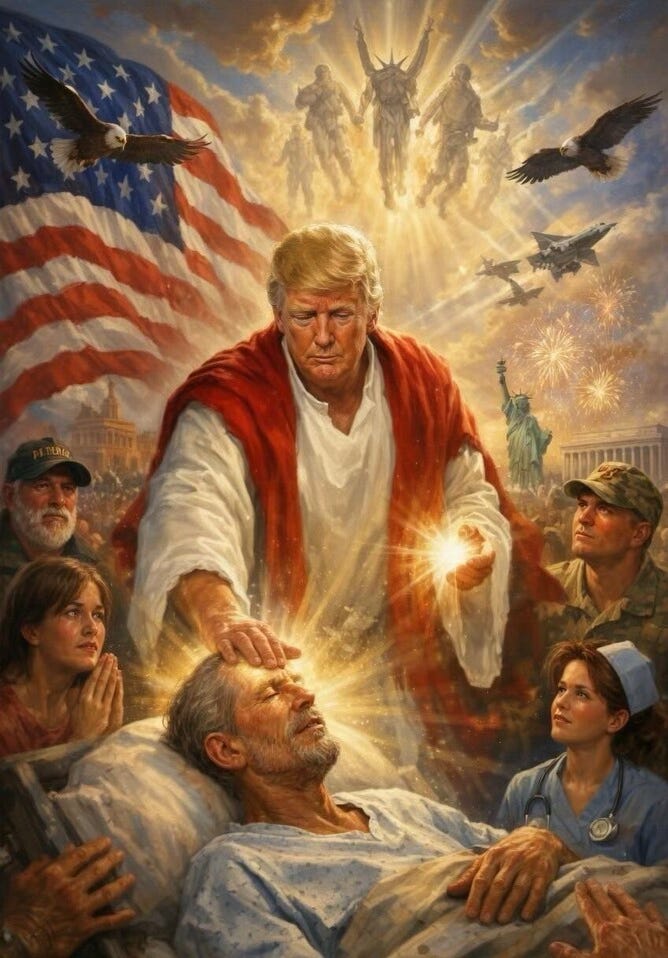
President Trump is unwise to launch a personal attack against the Pope, who is the visible head of the Catholic Church’s 1.4 billion members (of which I am one). At the same time, Catholics know that a pope’s prudential political views are not covered by papal infallibility; they are serious, but not binding, judgments. Leo has been unusually sharp in his rhetoric compared to the way John Paul II criticized President George W. Bush’s decision to invade Iraq in 2003.
In the Liturgy of the Hours, Catholics pray daily for the Pope and for the intentions he proposes to the Church. On prudential matters, Catholics are free to disagree respectfully, but they still owe a real devotion to the successor of St. Peter, whom they believe was chosen under the guidance of the Holy Spirit—not because he was useful to any particular head of state.
The President wrote on Truth Social: “Leo should be thankful because, as everyone knows, he was a shocking surprise. He wasn’t on any list to be Pope, and was only put there by the Church because he was an American…”
In fact, among the American cardinals who might have been elected, Leo XIV is probably the least nationalistic and least likely to be chosen as anyone’s instrument for domestic American politics. Even if one adopts a highly cynical—and non Catholic—view of papal elections, it is hard to see his election as a clever move to “deal with Donald Trump.”
Is the U.S.–Israel war against Iran justifiable under the just war framework developed by Augustine and Thomas Aquinas? At most, it is borderline, and serious Catholic scholars and bishops are already divided on the answer. One major objection is that the opening strikes were pre emptive rather than clearly defensive in response to a large scale current attack. Yet it is also dangerous simply to say that one must “wait to be hit” when a regime has threatened the U.S. and Israel for decades and is credibly pursuing nuclear weapons. In a theocratic system where jihad is valorized by some leaders, waiting until Iran actually detonates a nuclear device against Israel or another target could plausibly entail casualties orders of magnitude greater than the (so far) under 2,000 Iranian deaths.
On the classic “jus ad bellum” (conduct during war) criteria, the picture is mixed at best. Was war truly a last resort? That depends on how close Iran actually was to weaponizing its nuclear program, and whether serious diplomatic avenues had truly been exhausted. Was it proportionate, in the sense that the expected good outweighed foreseeable harms? That again depends on the reality of the nuclear threat and on whether striking now reduces, or instead inflames, the long term risk of regional war. Is there a reasonable hope of success? That seems to depend on U.S. political resolve and the military’s ability to dismantle Iran’s enrichment capacity and secure or destroy existing stocks. On “jus in bello,” the record so far is mixed: apart from the apparently accidental bombing of a girls’ school on the first day, U.S. and Israeli forces have taken notable steps to limit civilian casualties—but the President’s threats to “destroy Iranian civilization” cut directly against the requirement to avoid targeting civilians and to fight with limited, discriminate means. On that last point, the Pope’s criticism is hard to gainsay.
The presidential criticism of the Pope is plainly unwise, and certainly the way Trump did it, is over the top. Still, the Pope has been less than accurate in his criticism, and perhaps, one might conjecture, overcompensating for his election as the first American Pope.
Defending wars against Muslim powers has a long record of papal support.
Pope Leo XIV said that “God does not listen to the prayers of those who wage war and try to use religion to justify it.” Taken literally and without nuance, Church history complicates this claim. Popes have not only tolerated armed force but at times organized, financed, and liturgically supported wars they judged necessary for the defense of Christian communities, even as Catholic teaching sought to restrain and morally evaluate warfare rather than bless it indiscriminately.
In 1571, Pope Pius V put together the “Holy League,” an alliance of Catholic maritime powers (Spain, Venice, the Papal States and others) expressly to break Ottoman naval dominance in the eastern Mediterranean. This coalition fought the Battle of Lepanto on 7 October 1571, decisively defeating the Ottoman fleet; contemporaries understood it as a papally sponsored Christian crusade at sea. Pius V helped bankroll the fleet, sent his own papal commander Marcantonio Colonna, blessed the League’s banner, ordered public prayers, granted plenary indulgences to those participating in or supporting the campaign, and later instituted a new Marian feast (Our Lady of Victory, now Our Lady of the Rosary) in thanksgiving for the victory.
When the Ottomans besieged Vienna in 1683, Pope Innocent XI supported the Habsburgs and their allies with substantial financial aid and spiritual incentives (indulgences) for those who came to the Empire’s defense, again, under a justificatory logic that today we would describe in just war terms.”. He was instrumental in encouraging the Polish–Habsburg alliance that brought King John III Sobieski and the relief army which broke the siege. In the aftermath, Innocent XI celebrated the victory, and later a “Holy League” was formed under papal auspices (including the Empire, Poland-Lithuania, Venice and eventually Russia) for the wider Great Turkish War against the Ottomans.
The papacy also supported wars against Muslim powers in the Crusades and in the Reconquista of Spain, with spiritual incentives and liturgical support that clearly linked prayer to military success.
Many of these campaigns—especially Lepanto, Vienna, and significant parts of the Reconquista—can be articulated in terms of just war criteria: defense against sustained aggression, protection of vulnerable Christian populations, and recovery of occupied territory. Whether every dimension of the medieval Crusades meets those standards is more contested, but it is at least clear that the Church has, in practice, sometimes blessed armed defense against Muslim powers.
Does the war against Iran, that has a record of supporting terrorists groups that target Christians and others, meet the definition of “just war?” Does the threat of Iran getting a nuclear weapon meet the definition of a defensive war? Maybe, maybe not, but would it be morally wrong to wait until Iran launched a nuclear weapon against Israel or a European capital before going to war? It’s a reasonable debate.
We should trust the Holy Spirit to guide the Pope and the Church, but it falls to the American public to restrain direct attacks on the papacy and the promotion of quasi messianic images by any president. Whatever one thinks of the Iran war—and reasonable Catholics will debate its justness—the President is unlikely to win a war of words with the Pope. In picking that fight, he forces the nation’s Catholics, roughly a quarter of the population, to confront a needless insult to their spiritual leader and to the ecclesial institutions that elected him.
Comments
Nothing yet. Say the first thing.
Sign in to join the conversation.