
There are increasing calls to tax the incomes and wealth of the rich. These are necessary steps to begin to undo the changes in the laws and regulations made by the rich and corporations over the past fifty years. But most of these changes created a globalized, highly concentrated, and financialized economy that has serious negative results for the bottom 90% of the population. To truly repair the economy, many of these changes need to be reversed.
The monopolization of the US economy over the past fifty years is one of the commonly unrecognized outcomes of the changes made by the rich and corporations. Even the production of fire engines is monopolized.1 Market concentration (that’s economist talk for monopolization) has numerous negative effects:
• First, highly concentrated markets often exhibit elevated prices due to diminished competition.
• Second, in the labor market, reduced competition for labor between corporations holds down wages.
• Third, in many markets, particularly rural ones, there are very few suppliers of a commodity or service. Consumer choices are very limited.
• Fourth, monopolistic companies can dictate prices paid to their suppliers, resulting in minimal profits for the suppliers and consequently very low wages for their workers.
• Fifth, monopolized markets eliminate small competitors and significantly increase the challenges for new firms entering. This stifles innovation in new products and services.
Without unions, workers have essentially no power to affect their wages, working conditions, and benefits. Bringing us back to at least the 35% unionization rate of the 1960s is a key step towards redressing the power imbalance between owners and workers.
Laws and treaties entered into between the late 1970s and early 2000s created a world economy with very few barriers to the movement of money, goods, and services. One significant result was the movement of millions of high-paying manufacturing jobs to low-wage countries. In 1970, manufacturing jobs were 24% of the workforce. Today, it is less than 11%.
Don’t be deluded by today’s rhetoric about returning manufacturing to the US. Take note: US manufacturing companies have consistently undertaken campaigns to increase productivity, mainly through automation and work rationalization. These efforts aimed to reduce the amount of human labor required to sustain production. For example, between 1962 and 2005, the US steel industry cut 400,000 jobs while maintaining the same level of steel production.2 Whatever manufacturing will look like in the future, it will employ far fewer people.
In the 1960s, banking, Wall Street, and other parts of this sector represented 3% of the whole economy. Today it is over 8%, but in a disturbing development, it takes in 23% of all corporate profits. What are we getting from this sector that spends so much time and money speculating, gambling is my preferred word here?
Just a single example, for illustration. Derivatives are bets on the future value of some other financial asset. The notional value of derivatives in the global financial markets was $632 trillion (6,320 billion) in June 2022.3 This exists in a world with an approximate global GDP of $97 trillion.
I can’t resist. In 2022, international trade in merchandise, services, and digital services totaled $35.92 trillion. In April 2022, the daily turnover in global foreign exchange markets reached $7.5 trillion.[1] Annualized, this amounts to $1,620 trillion in foreign exchange trading, supporting the actual world trade of $35.62 trillion in goods and services. This results in a total foreign exchange turnover of over 46 times the real-world trade volume. Speculation on a breathtaking scale. What other purpose can this serve than the extraction of money without producing any goods and services, the real economy?
This gambling was chiefly legalized under Democratic President Clinton with the elimination of the Depression-era Glass-Steagall Act and the Commodity Futures Modernization Act in 1999. These changes can be reversed.
This may be the least recognized change, but most consequential.
Before the 1980s, traditional corporate management focused on long-term strategy, developing and retaining employees, and performing tasks that add value for customers, suppliers, and staff. Developing new products and services was a key activity considered essential for successful management, which thrived by creating conditions that allowed employees to be effective, learn new skills, and grow within the company. The main belief was that sales and profits would increase if these tasks were performed well. This management approach worked very well for the thirty years following WWII.
Starting in the early 1980s, with the rise of the neoliberal movement, a major shift happened in how management success was defined. Long-term profits, satisfied customers, product and service innovations, and a stable workforce became outdated ideas. The only goal of a corporation was now to maximize profits for shareholders. Financial incentives, stock options, and performance bonuses were introduced to align top management with the goal of changing companies from focusing on making goods and services to generating the most money in the shortest time.
A key example of financialization is the rise of stock buybacks4 as a strategy to return corporate profits to shareholders and top management. This has resulted in many $ trillions of corporate profits not being reinvested, rather being handed over to shareholders and top management. Keep in mind that the entire output of the US economy in 2023 was $27 trillion.
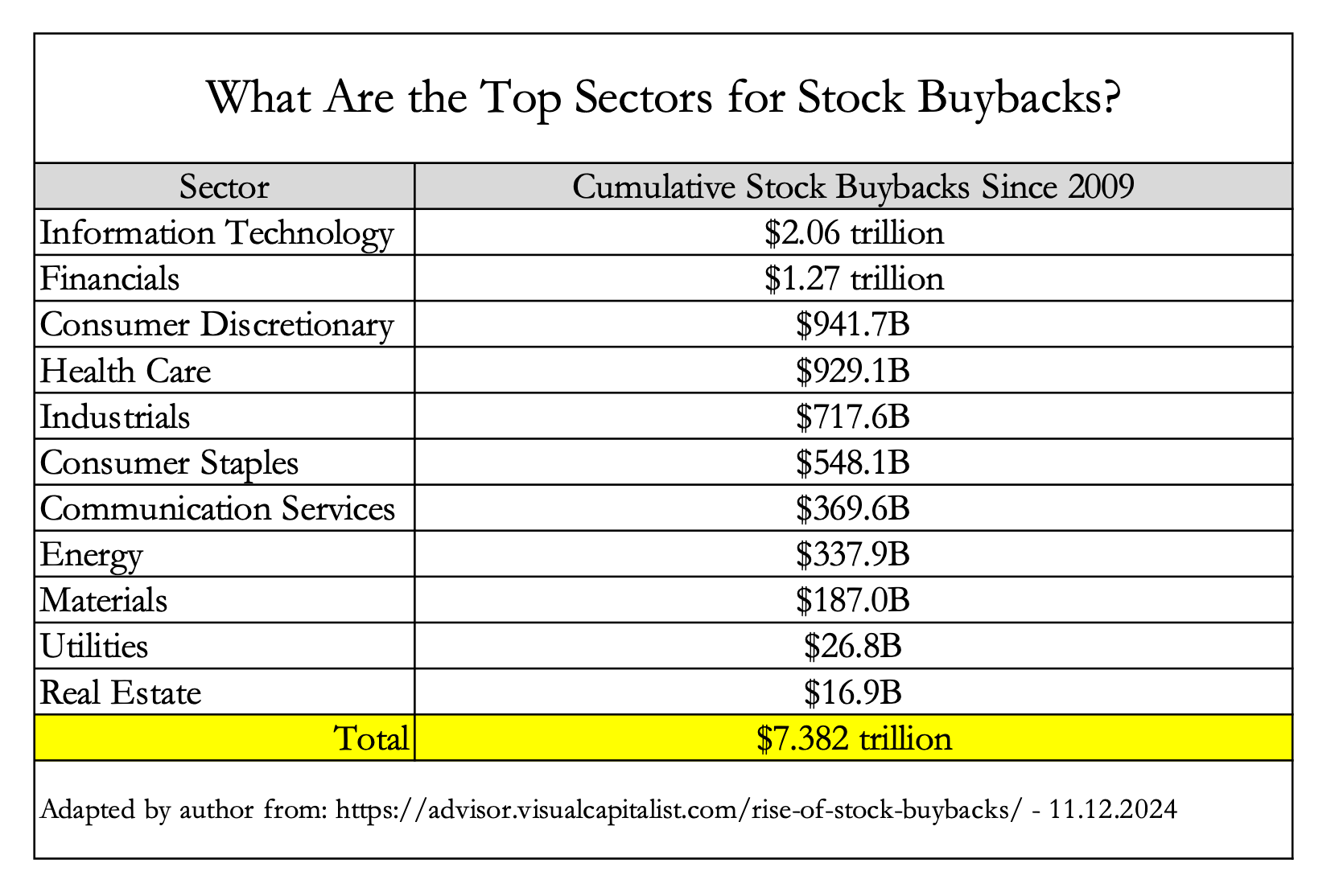
We desperately need to eliminate perverse management compensation practices that reward self-dealing and inflate personal wealth at the expense of the company's overall health.
Enforce existing antitrust laws using the metrics that served us well from the Great Depression through the 1970s. Break up the monopolization of almost every sector of the economy. Bring competition back to life.
Support unionization across the board.
End the gambling in the finance sector. End the use of derivatives and the myriad other gambling vehicles, including the most recent Prediction Markets.
End top management compensation tied to stock shares and/or purely financial targets.
Return top management compensation ratios to average worker pay to 25 to 1 that marked the era between the end of WWII and 1975. Today it is over 350 to 1.
For an in-depth agenda of change, see my earlier post A Progressive Agenda for the US Economy: undoing the last fifty years of rule by the rich and corporations
Collard-Wexler, Allan, and Jan De Loecker. Reallocation and Technology: Evidence from the U.S. Steel Industry. Working Paper No. 18739. National Bureau of Economic Research, 2013. http://www.nber.org/papers/w18739.
Notional value is used to describe the value of derivatives, options, and currency exchanges amongst other financial products. This is not a market price. Experts claim that the market value of these derivatives is significantly lower. The mathematics of calculating notional value are complex and filled with assumptions. Very murky.
A stock buyback occurs when a company uses its financial resources to repurchase its own shares on the market. This reduction in the number of shares outstanding causes the price of the remaining shares to increase. Before 1982, stock buybacks by corporations were essentially banned because lawmakers and regulators viewed them as stock price manipulation.
Comments
Nothing yet. Say the first thing.
Sign in to join the conversation.