
Being a typical Aquarian, I always go with the underdog. Spotting this vase at a specialist glass fair a few years ago, I felt I had found an underdog par excellence. Reviled as revolting, laughed at for being unfashionable, or passed over entirely in a very British way of ignoring distasteful things, I felt such derision and ignorance was wrong. What a wonderful thing! So I walked away with it for £40, much to the amusement of some of my colleagues and friends. What would you have thought?
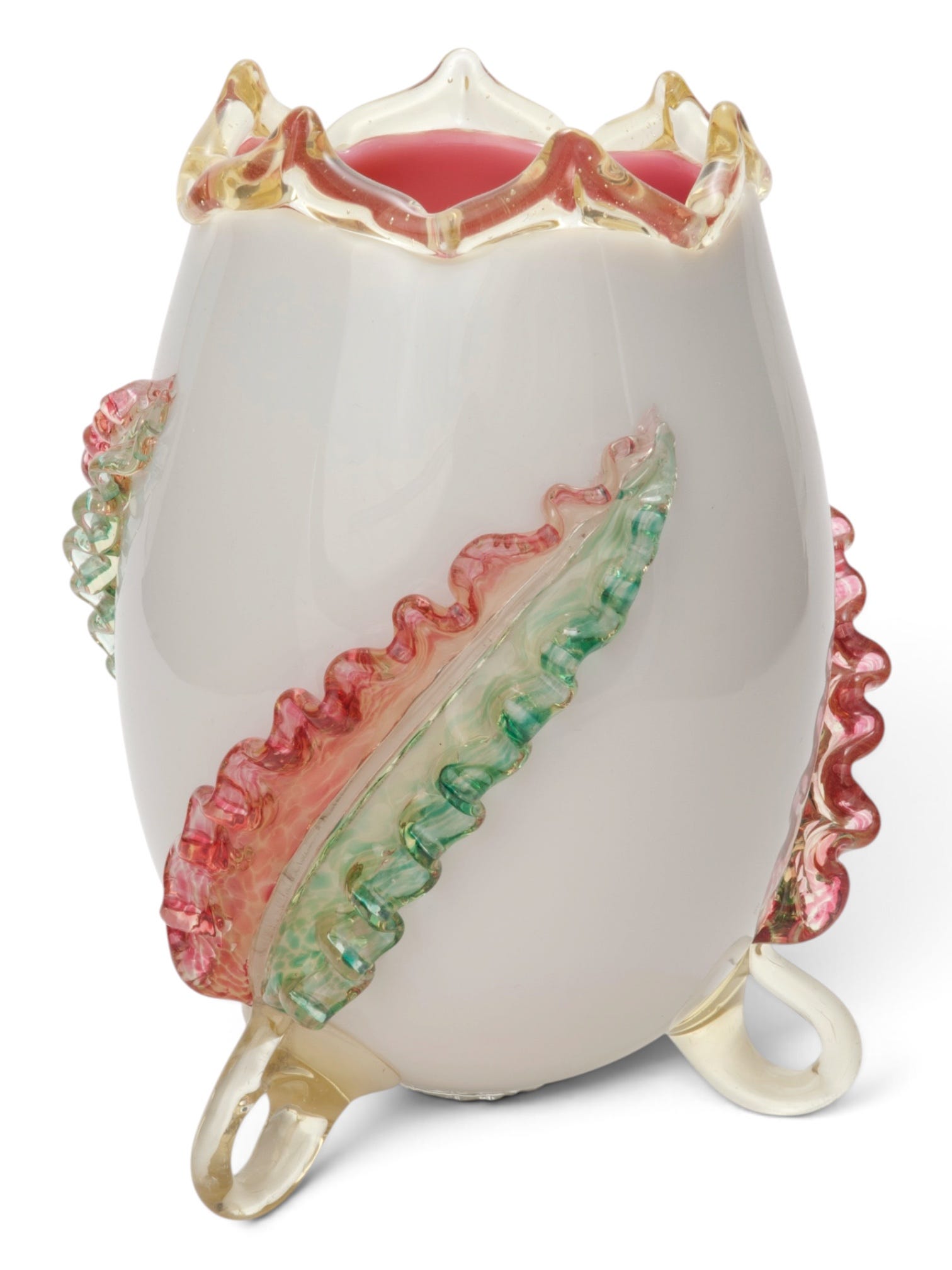
It looks a bit like a strange Easter egg, with the top taken off to reveal a clashing pink interior. With a jagged applied yellow rim, and with almost Christmas-inspired reddy-pink and green leaves spiralling around the body. And mounted on three curling feet. It looks almost unnatural, and slightly uncomfortably so. Maybe it’s the fleshy pink? Delicate yet heavy, over-decorated, fussy, frilly, and ohhhh so very High Victorian. Midcentury modern glass has dominated desirability in the glass world for decades now and this is about as far away from the cool, clean lines and balanced decoration of Scandinavian glass, or the vibrant experimentation of Murano glass, as can be. So much Victorian glass is deeply out of fashion.
But my father, a retired Formula 1 engineer, always taught me to look at the way something was made, and my brain was fizzing with excitement over this hotworked vase which was formed entirely at the furnace when the glass was molten. So let’s look at it. First of all, a small opaque pink gather of glass was made, and covered in a layer of opaque white glass. This was then blown into an egg-like form with a blowing iron and hand moulds. The piece was then reversed onto a pontil rod, so the rod was at the bottom of the extant vase form. The top section attached to the blowing iron end was then cut off in zigzags, and shaped to form a round aperture and undulating rim. A yellow trail was then applied evenly to the rim, accentuating the zigzags.
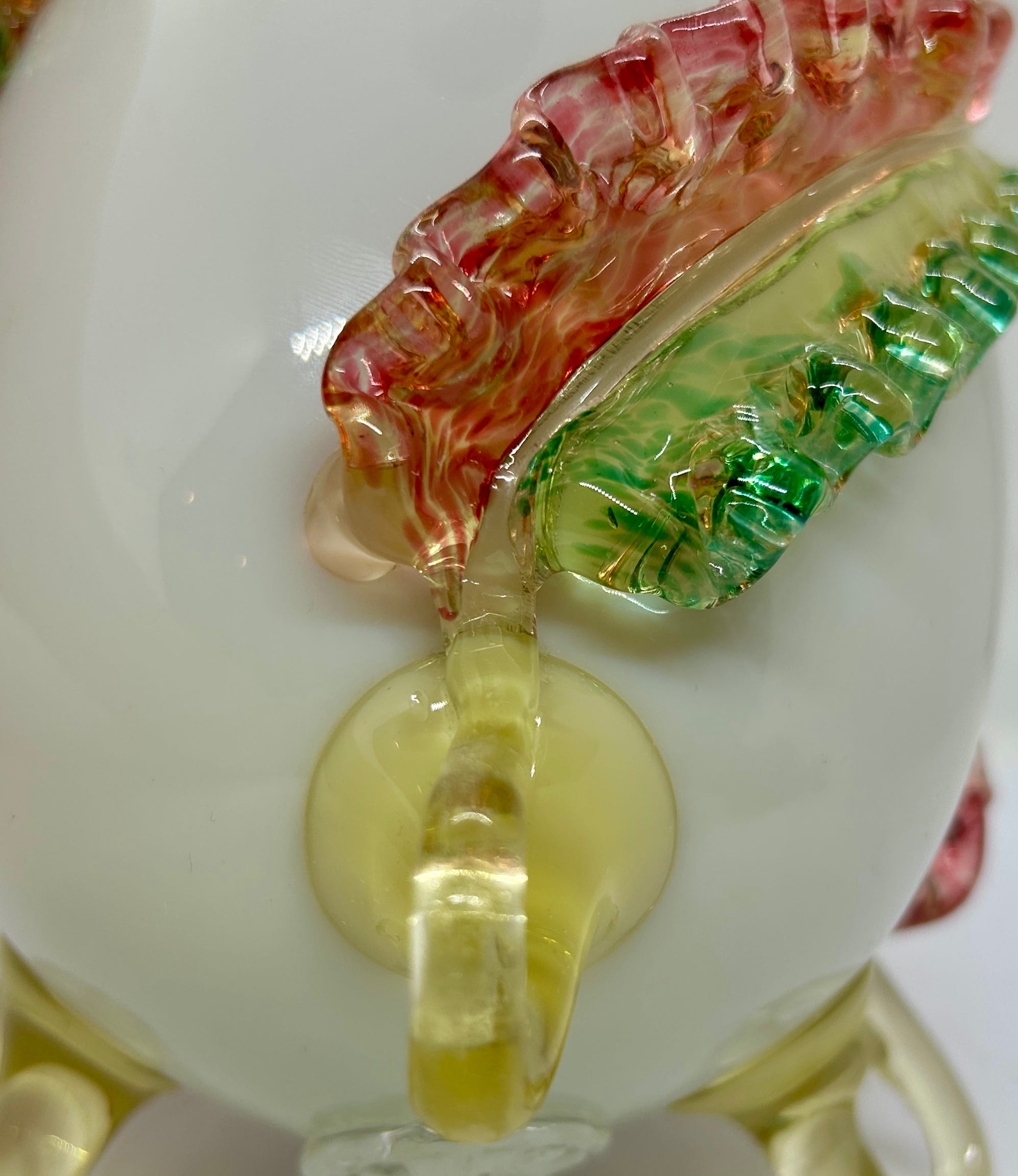
It’s likely that the same gather of yellow glass was then used to form and apply the curling feet and the leaves that they lead into - each foot and leaf was formed one single trail as the photo above shows. The mass of glass for each would have been carefully controlled to give enough glass for each of these three applications. The leaf ends needed to be dipped in reddy-pink and green enamel powder or chips, hence the mottles seen above, and then crimped to form the leaves. And then applied to the body. All the while all the components, including the body, needed to be kept at the right working temperature - enough to make the molten glass ductile and plastic, and even and consistent across the entire piece so that thermal shock doesn’t cause one component to break, or to break another. Quite a feat of glassmaking, right?
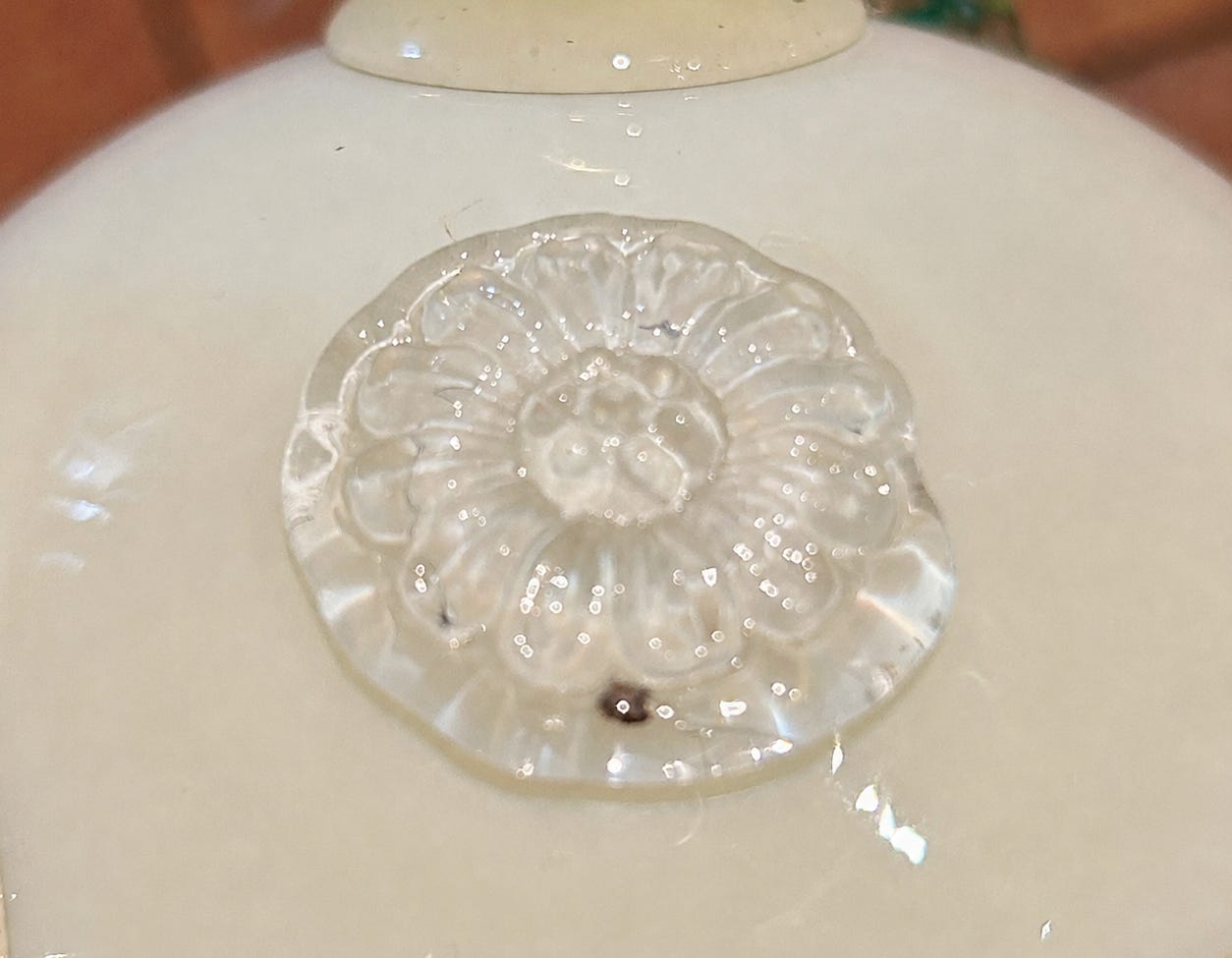
But who made this complex confection? You’d think it would be easy to find as it’s so, ummm, recognisable. The only clue is a daisy or rosette shaped applied prunt on the base. A blob of colourless glass was applied and then a stamp impressed into it. So it’s not a maker’s name, but a mark, as such. And not one I know or can trace.
If you ask AI, it says that it’s from British factory Stevens & Williams’ similarly complex ‘matsu-no-ke’ range, from the 1880s and designed by Frederick Carder. But I don’t feel that that is true. I can see what it means as regards the high relief applied foliate decoration and use of several bright colours, but the bodies are totally different and the styles are too diversely apart. The deliberate rosette/flower mark also wasn’t used by Stevens & Williams. So, this attribution just doesn’t hold water for me. It’s time to hit the reference library…
(And stay tuned for a surprise at the end!)
The late 19th century was a period of great innovation and experimentation, even in the world of glass. Companies across Europe and the UK vied with each other to produce ever more complex triumphs of glassmaking, by combining techniques, pushing boundaries to limits never seen before, and by using centuries old techniques in new ways. Colour, pattern, texture, and decoration all reached an orgasmic ornamental high. Companies also copied each other when they could, with varying levels of success. Partly due to the AI results, my first stop was to look through ‘The Bible’ for British Victorian glass, ‘British Glass 1800-1914’ by renowned expert and author Charles Hajdamach, published by Antique Collectors Club in 1993.
Comments
Nothing yet. Say the first thing.
Sign in to join the conversation.