
A new episode of This is Business is out.
This time, Tanvi Raut Dessai sits down with Prashant Sachan to explore a question that sounds almost contradictory: can faith, something so personal and deeply rooted in physical rituals, actually move online?
They talk about how Sri Mandir is trying to make pujas, prasad and temple access available through a phone, and what it takes to convince devotees, priests and temples that an app can be trusted with something as intimate as prayer.
This week’s Market Bites comes with a little something extra.
We’re collaborating with Millions to bring you this edition, combining our usual bite-sized take on the markets with Million’s perspective on money and investing.
Same Market Bites. Just with a new friend at the table. ☕
Anthropic has done something that would have sounded pretty unlikely even a year ago.
The AI company behind Claude has reportedly crossed $65 billion in annualised revenue run rate, according to Bloomberg. OpenAI, meanwhile, is running at roughly $40 billion.
For context, Anthropic was at roughly $1 billion at the beginning of 2025. By August that year, it had crossed $5 billion. It ended 2025 at around $9 billion. Then things went slightly bonkers. Revenue run rate touched $14 billion in February 2026, crossed $30 billion in April, $47 billion in May, and is now above $65 billion.
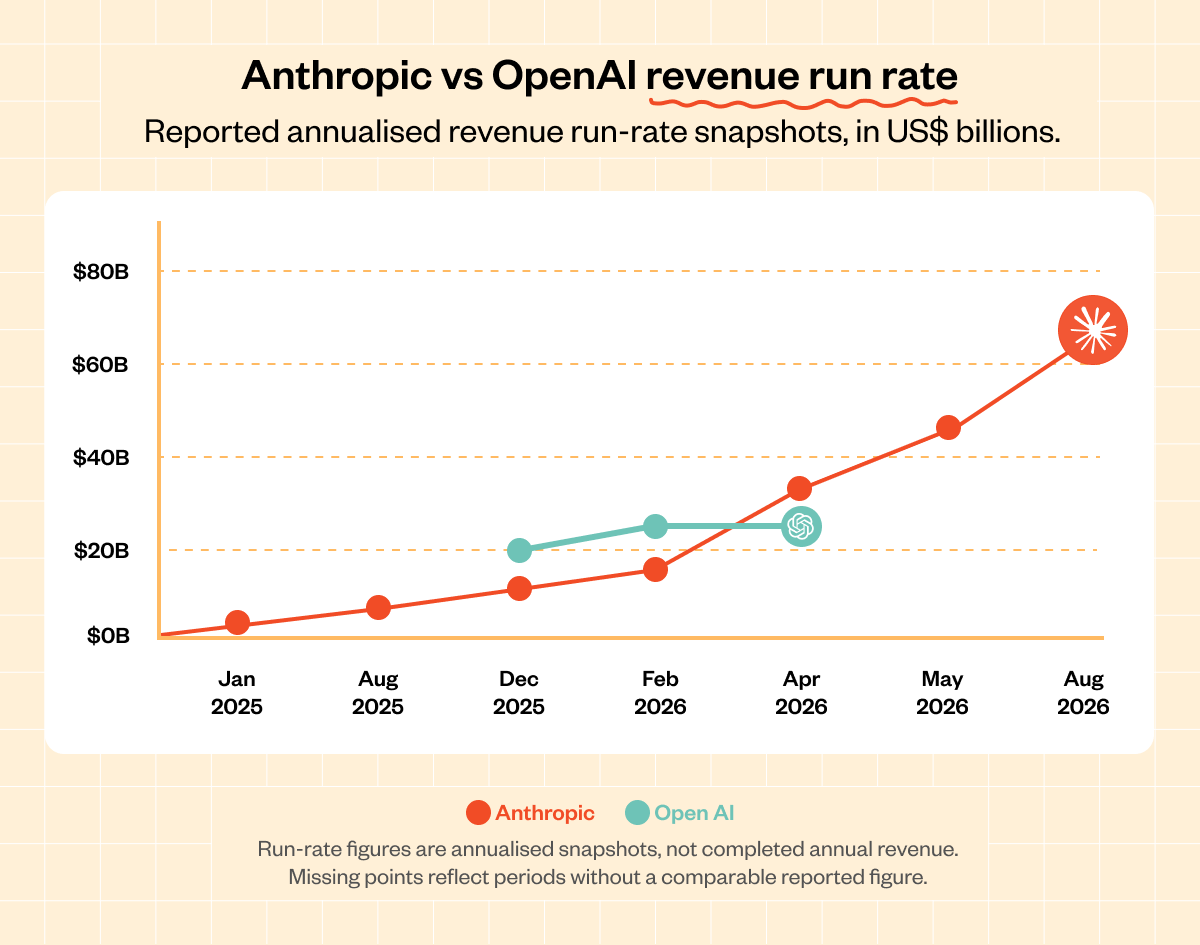
Before we go any further, a small clarification. Anthropic has not actually collected $65 billion over the past year.
A revenue run rate takes the company’s current pace of revenue and stretches it across 12 months. So if Anthropic is currently making roughly $5.4 billion a month, that translates into an annualised pace of around $65 billion. It is useful for a company growing this quickly, but it is still a snapshot rather than audited annual revenue.
Still, Anthropic moving ahead of OpenAI is remarkable because the two companies entered the AI boom from very different positions.
OpenAI had ChatGPT.
By early 2023, people who had never heard the phrase “large language model” were asking ChatGPT to write emails, solve maths problems and explain their Excel sheets. OpenAI had the consumer brand, the traffic and one of the most recognisable technology products in the world.
Anthropic never really matched that consumer reach.
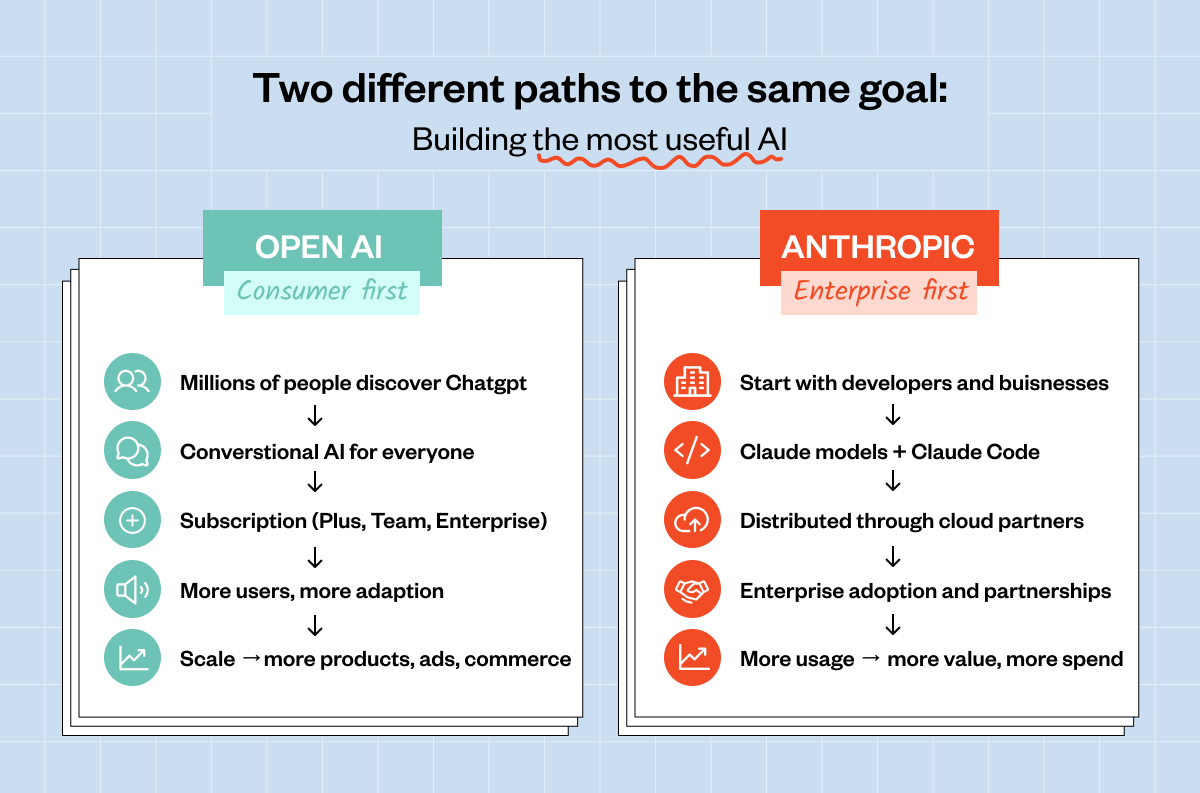
Instead, it built its business around people who could spend much more money than an individual ChatGPT subscriber: developers and companies.
That strategy is starting to show up very clearly in the numbers.
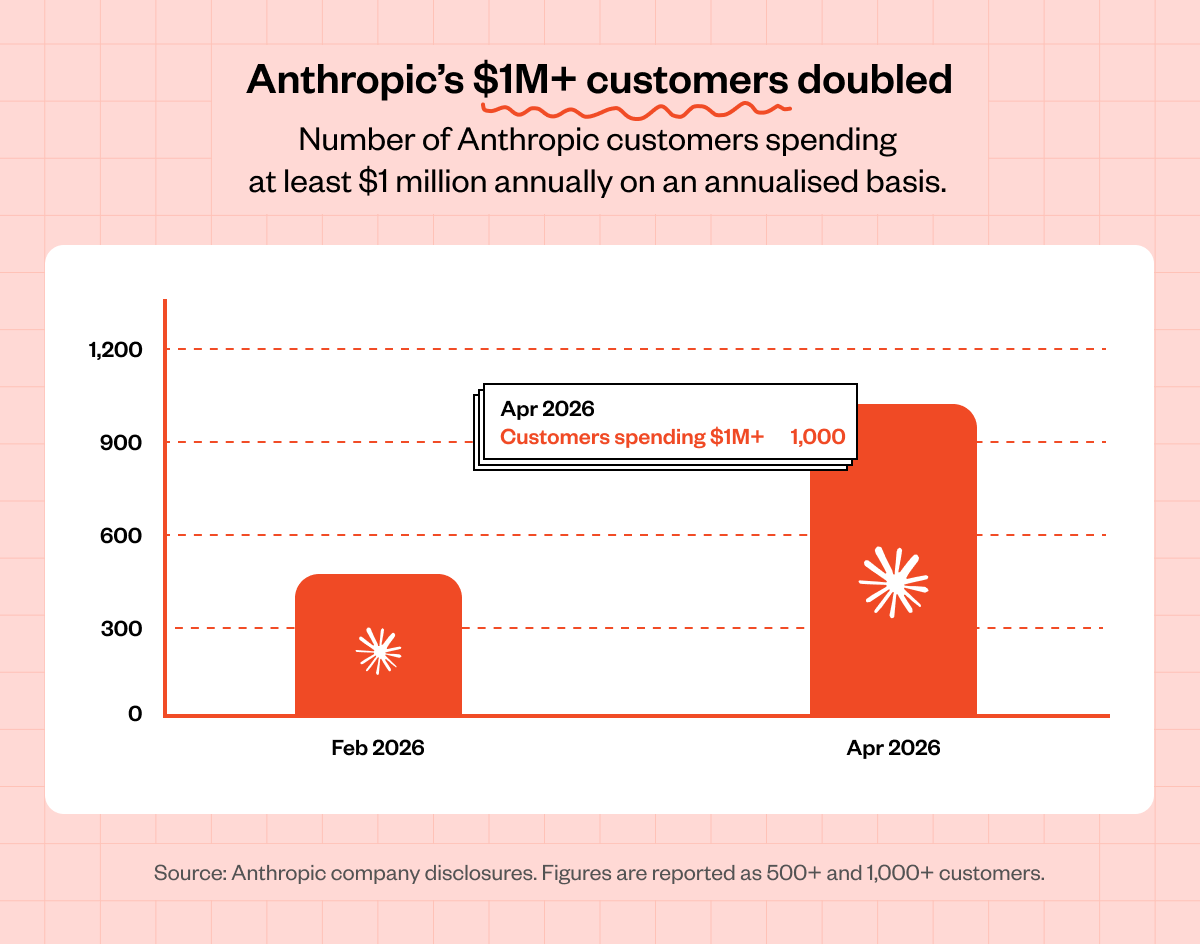
Anthropic said it had more than 300,000 business customers by August 2025. More importantly, the amount individual companies were spending kept climbing. In February 2026, more than 500 customers were spending over $1 million a year with Anthropic on an annualised basis. Less than two months later, that number had doubled to more than 1,000.
Think about the difference in economics.
A regular consumer might pay around $20 every month for an AI subscription. A large company can give the same AI to thousands of employees, use its API inside its own software and allow automated AI agents to run throughout the day.
One company can therefore be worth millions of dollars in annual revenue. And Anthropic found one particularly effective way of getting inside these companies: coding.
Claude Code became publicly available in May 2025. Six months later, it was already doing more than $1 billion in annualised revenue. By February 2026, that had jumped beyond $2.5 billion, with enterprise customers contributing more than half of Claude Code’s revenue. Business subscriptions had quadrupled since the beginning of the year.
Coding also happens to be almost perfectly suited to the economics of AI.
You may open a consumer chatbot a few times during the day, ask five questions and leave. A software developer can have an AI agent reading thousands of lines of code, debugging a problem, writing tests, editing multiple files and checking its own work. And it can keep doing this for hours.
Which means more tokens processed, more usage and more revenue for the model provider. Anthropic’s own research now says Claude usage is increasingly shifting away from simple back-and-forth conversations towards long-running agentic tasks, partly because of products such as Claude Code and Cowork.
Anthropic has also made Claude relatively easy for big companies to buy.
A company already running its technology on Amazon Web Services does not necessarily want to sign up for an entirely new AI infrastructure stack. So Anthropic made Claude available through Amazon Bedrock. It is also available through Google’s Vertex AI and Microsoft’s Azure Foundry.
Anthropic says Claude is the only frontier model currently available across all three major cloud platforms.
That gives Anthropic three enormous distribution channels without having to convince every company to completely change the way it buys technology.
And the strategy is moving beyond Silicon Valley.
In India, Anthropic says its revenue run rate has doubled since October 2025. Air India is using Claude Code for software development, while CRED says the tool helped it deliver features twice as quickly and improve test coverage.
There is now another layer being added to this distribution machine.
In March, Anthropic launched a partner programme for consulting and IT services companies. By June, more than 40,000 firms had applied and over 10,000 consultants had received Claude certifications. It has also struck agreements with companies such as DXC, which plans to train tens of thousands of engineers to deploy Claude inside banks, airlines, insurers and other large organisations.
Basically, Anthropic isn’t only selling an AI model anymore. It is building an ecosystem of cloud providers, developers, consultants and enterprise IT teams that can sell and deploy Claude for it.
OpenAI has noticed the same opportunity.
Its enterprise business now generates more than 40% of revenue, and the company expects business and consumer revenue to reach roughly equal levels by the end of 2026. Its APIs are processing more than 15 billion tokens every minute, while Codex has grown into one of its fastest-growing enterprise products. OpenAI has also expanded Codex and its models through AWS and partnerships with large technology companies.
Anthropic hasn’t discovered some market OpenAI forgot existed. It simply leaned into it earlier and harder.
There is also an uncomfortable part of these numbers that shouldn’t be ignored. The company raised $30 billion in February at a $380 billion valuation. Three months later, it raised another $65 billion at a $965 billion valuation. It has struck massive computing agreements involving Amazon’s Trainium chips, Google’s TPUs and Nvidia GPUs.
That tells us how unusual the AI business currently is. A company can generate tens of billions of dollars in annualised revenue and still require tens of billions more in fresh capital to keep serving customers and building better models.
These rankings can change remarkably quickly. OpenAI still has enormous consumer distribution, its own rapidly growing enterprise operation and Codex competing directly with Claude Code.
But Anthropic’s rise does tell us something about where the money in AI is moving.
Where does India Stand?
India is already seeing that demand build up.
Sify Infinit Spaces, the data-centre arm of Sify Technologies, has received SEBI approval for a ₹3,700 crore IPO. Yotta Data Services is also reportedly looking to raise up to ₹8,000 crore through an IPO to fund its AI infrastructure expansion.
So while companies like Anthropic and OpenAI are fighting the visible AI race, there is another race happening underneath it: who builds the infrastructure all of this AI will run on?
Because the AI opportunity may not sit only with the companies building the models. It could also sit with the companies building the servers, data centres and computing infrastructure behind them.
The first phase of generative AI was largely about getting hundreds of millions of people to talk to a chatbot. The next phase is increasingly about getting AI to do work inside companies.
Anthropic positioned Claude heavily around that shift. And once companies started putting these systems into actual workflows, their spending rose much faster than anyone expected.
Even Anthropic appears to have underestimated it.
At the end of 2025, the company was reportedly aiming for around $20 billion to $26 billion in annualised revenue by the end of 2026.
It is August. And it is already at $65 billion.
This article is based on publicly available company disclosures and credible media reports. Revenue run-rate figures are annualised estimates and should not be treated as audited full-year revenue. Customer counts, product growth and usage metrics cited from Anthropic and its partners are company-reported and may not be independently verified.
If you made it this far, hopefully the next time someone says ChatGPT is winning the AI race, you’ll ask: winning which race exactly?
We’ll be back in your inbox next week with another business rabbit hole worth going down.
Got a story you’d like us to unpack? Send it our way. If we brew it, there might just be a little Filter Coffee surprise waiting for you.
See you on the next brew.
Filter Coffee ☕️ × Millions
No posts
Comments
Nothing yet. Say the first thing.
Sign in to join the conversation.