
There are films that change the course of people‘s careers, some for better, some for worse, and some in quite unexpected ways. What’s interesting about Peeping Tom and its director Michael Powell is both the changes it drove in his career and the contrast between the treatment of Powell’s film and how Hitchcock’s Psycho was received.
By 1960 both Powell and Hitchcock had developed reputations as directors with a long track record of making great films. Hitchcock had come off a run of critically and commercially successful films when he decided to make Psycho for which he was only able to find limited support. Paramount, believing the movie would do poorly at the box office, only agreed to proceed after Hitchcock deferred his salary in lieu of a percentage of the box office. With a limited budget Hitchcock had to shoot in black and white and rely on crew members from his TV show. The film was not only influential, it was also a monumental critical and commercial success.
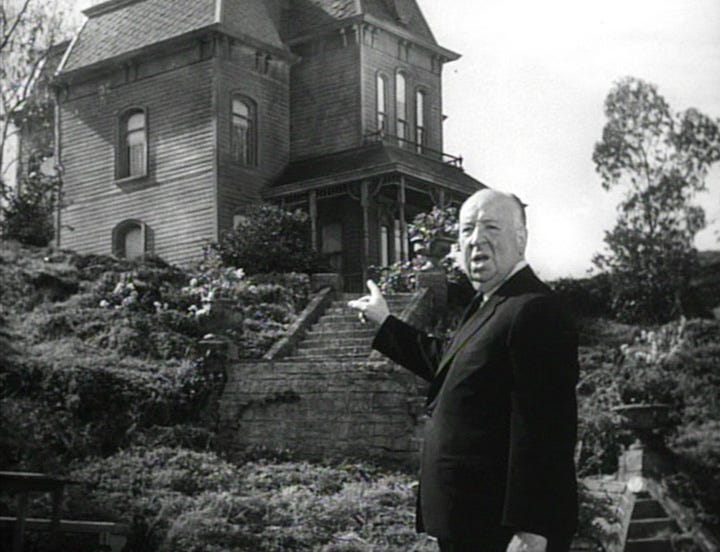
Michael Powell had built a mighty reputation through the 1940s alongside Emeric Pressburger making films such as The Life and Death of Colonel Blimp, The Red Shoes and Black Narcissus. Powell too committed himself to a project for which he found little support. His long-time collaborator Pressburger refused to work with him on Peeping Tom because he found the subject matter distasteful. Powell persevered, making a film that not only treads similar ground to Psycho but does so in a far more effective and authentic way.
However the reception that Peeping Tom received, at the time of its release, was essentially the complete opposite to that enjoyed by Psycho.
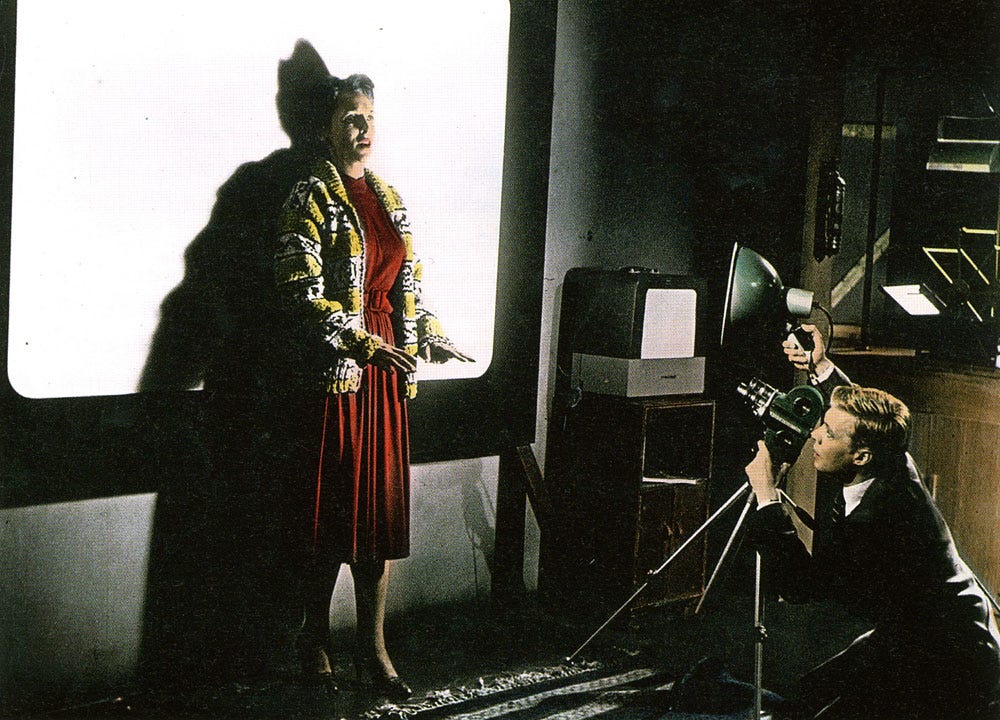
Peeping Tom suffered a critical mauling followed by public outcry which resulted in it being pulled from British cinemas after just five days. Powell was criticised for using himself and his son as the central character’s father and that character as a youngster respectively, suggesting that Powell overly identified with the movie and that the use of his son bordered on abuse.
The film is ground-breaking, regarded as one of the first slasher films and the first mainstream British movie to feature female nudity. The controversy began on-set when after filming a nude scene a photo-journalist snuck on-set in an attempt to get photos of Pamela Green, the “first nude woman in a British feature-length film.”
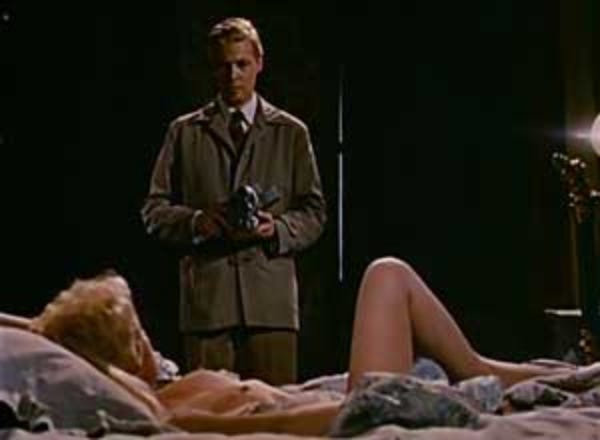
The backlash against the film was due to a combination of the onscreen nudity and what people saw as its distasteful content. The film centres on a serial killer who seeks out women to murder so he can film their terror as they die, cutting the footage together to make a snuff film for his private viewing pleasure.
An early sign of trouble was seen at the premiere where following the screening nobody from the audience went to shake the hand of either the film’s lead (Karlheinz Böhm) or Powell. Narratives about this marking the end of Powell’s career began soon after with British reviews exhibiting over the top levels of negativity, in the case of the Monthly Film Bulletin Powell was likened to the Marquis de Sade.
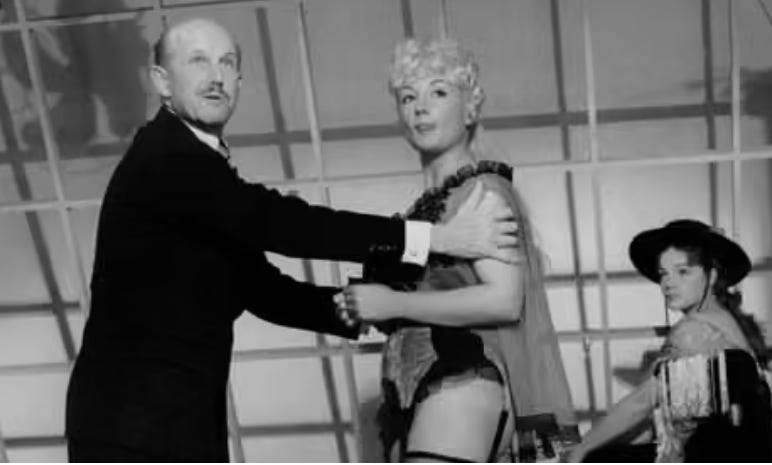
Kinematograph Weekly provided one of the more supportive reviews stating “Most of the national critics were not enamoured with the subject matter” but the magazine found it “a powerfully gripping, well-produced picture” that should “do very well as an X certificate booking.”
In contrast, Derek Hill of Tribune magazine suggested that “the only really satisfactory way to dispose of Peeping Tom would be to shovel it up and flush it swiftly down the nearest sewer”. Len Mosley of the Daily Express found the film more nauseating and depressing than the leper colonies of East Pakistan, the back streets of Bombay, and the gutters of Calcutta. While Caroline Lejeune of The Observer wrote: “It’s a long time since a film disgusted me as much as Peeping Tom”. Alexander Walker of the Evening Standard called it “loathsome” and The Huddersfield Daily Examiner believed the film was made for “perverts only.”
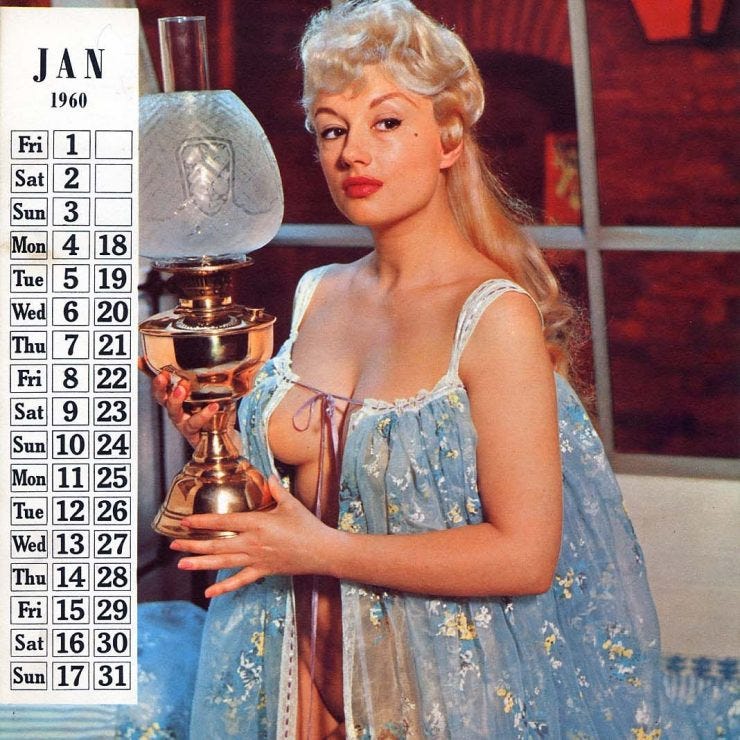
Pamela Green felt the public relations department was missing an opportunity to promote the film, so she posed for several photos in movie-related costumes as well as nude to drum up publicity. Images were sent to mainstream newspapers and magazines, with the nudes used in magazines Green was connected with.
Peeping Tom was first released in the United Kingdom by Anglo-Amalgamated, who through films like Horrors of the Black Museum and Circus of Horrors had become associated with themes of voyeurism, disfigurement, and sadism. While their films were typically released in the US by American International Pictures, AIP were not interested in handling Peeping Tom.
Astor Pictures picked up the US distribution rights in 1962 distributing it alongside genre horror films, art films and exploitation films. It failed to find an audience in part because it received a B rating from the National Legion of Decency for being “morally objectionable in part”.
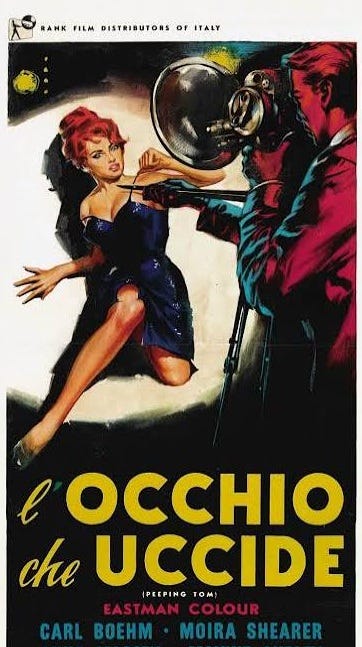
When first released in Italy in 1960, the Committee for the Theatrical Review of the Italian Ministry of Cultural Heritage and Activities rated it as VM16: not suitable for children under 16. In order to be screened publicly, the Committee required the removal of a number of nude scenes.
The film was banned in Finland until 1981.
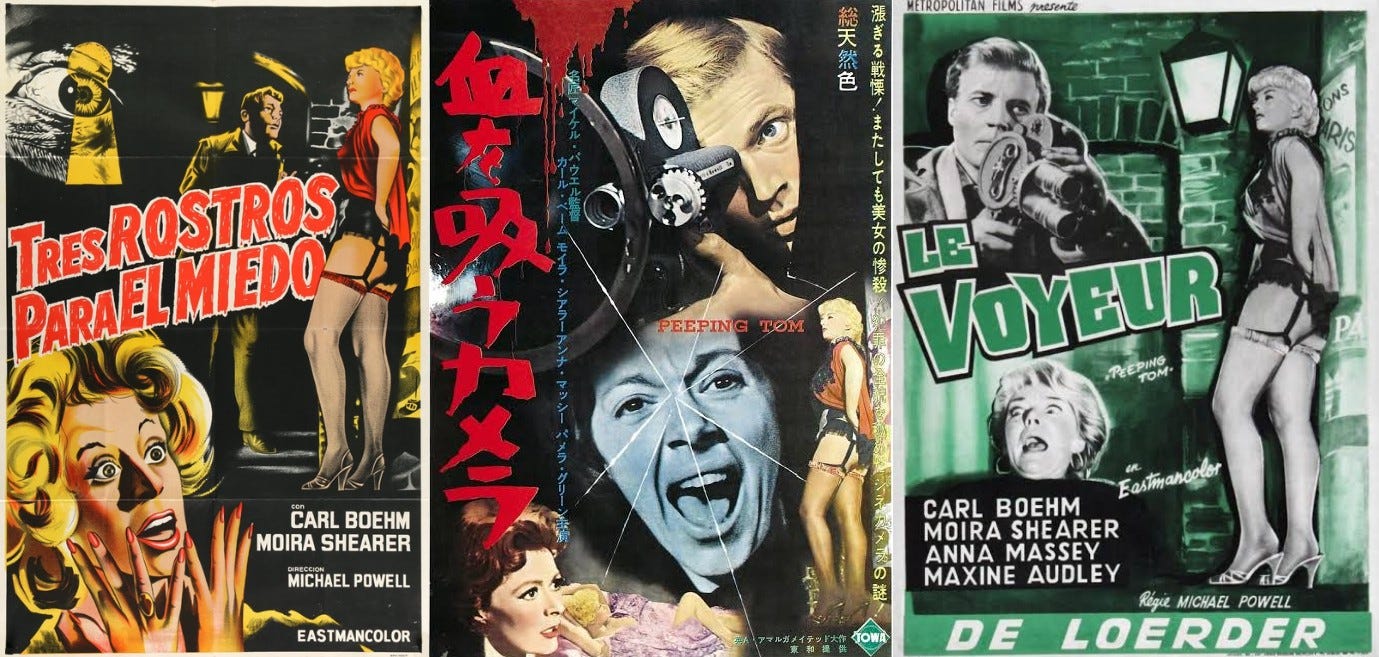
Peeping Tom later enjoyed a cult following, especially among filmmakers, and subsequently earned a critical reappraisal. While the comparisons to Psycho have long been acknowledged filmmakers typically cite it as being more influential for treating the killer in a more tragic and sympathetic way, which was a major innovation.
The film is now considered a masterpiece and among the best horror films of all time, with The Guardian ranking it 10th while somewhat predictably ranking Psycho at number 1. Its among Martin Scorcese’s favourite films, Premiere magazine voted it one of “The 25 Most Dangerous Movies”. It’s on Roger Ebert‘s “Great Movies” list and is one of the “1001 Movies You Must See Before You Die”
None of this was lost on Powell who noted in his autobiography: “I make a film that nobody wants to see and then, thirty years later, everybody has either seen it or wants to see it”.
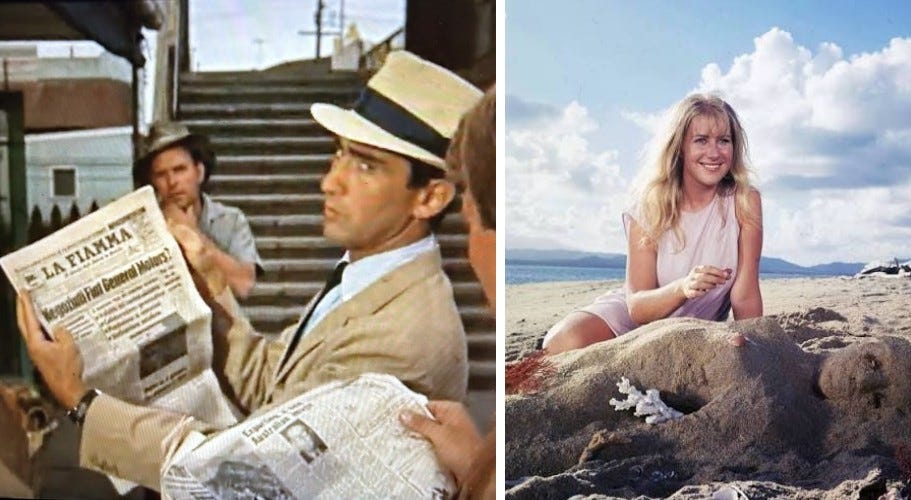
To suggest that Powell’s contribution to film ended with this film is sadly misguided. He may have subsequently been faced with few opportunities other than making films in Australia, but his contribution was immense. Australian film production had not been in a more moribund state when he made They’re a Weird Mob, which was not just a fabulous film but its success was responsible for reigniting interest in making Australian films. He returned a few years later with a very young Helen Mirren to make the under-rated Age of Consent, which is another of his under-appreciated films.
In my eyes Peeping Tom was a monumental success on several different measures, but it was a film that didn’t fit for a long time.
Comments
Nothing yet. Say the first thing.
Sign in to join the conversation.