
Millions of words must already have been written about Andy Burnham’s prospects as Prime Minister before the guy has even crossed the threshold of 10 Downing Street. Obviously, as a lifelong progressive and a pragmatic idealist when it comes to politics, I wish Burnham well.
Among the deluge of recent opinions, I was intrigued to read this piece by tax expert Dan Neidle in support of Land Value Taxation (LVT) in last week’s Sunday Times, of all places. I’d only just recovered from the shock of a Rupert Murdoch-owned newspaper supporting such a ‘radical’ proposal when The Times followed up with another article, this time by the estimable Edward Luce, signposting Neidle’s piece and giving strong support to his arguments.
Both articles mentioned a piece Andy Burnham wrote for The Guardian back in 2010, when he was running for the Labour leadership in a contest eventually won by Ed Miliband, in which he made the case for reform of the tax system, including the introduction of a tax on land values. I remember Burnham’s piece well, as it followed a number of articles in the mainstream press in support of LVT. It was beginning to feel like an idea whose time might finally have come. In my excitement I penned this piece for The Guardian a couple of weeks later.
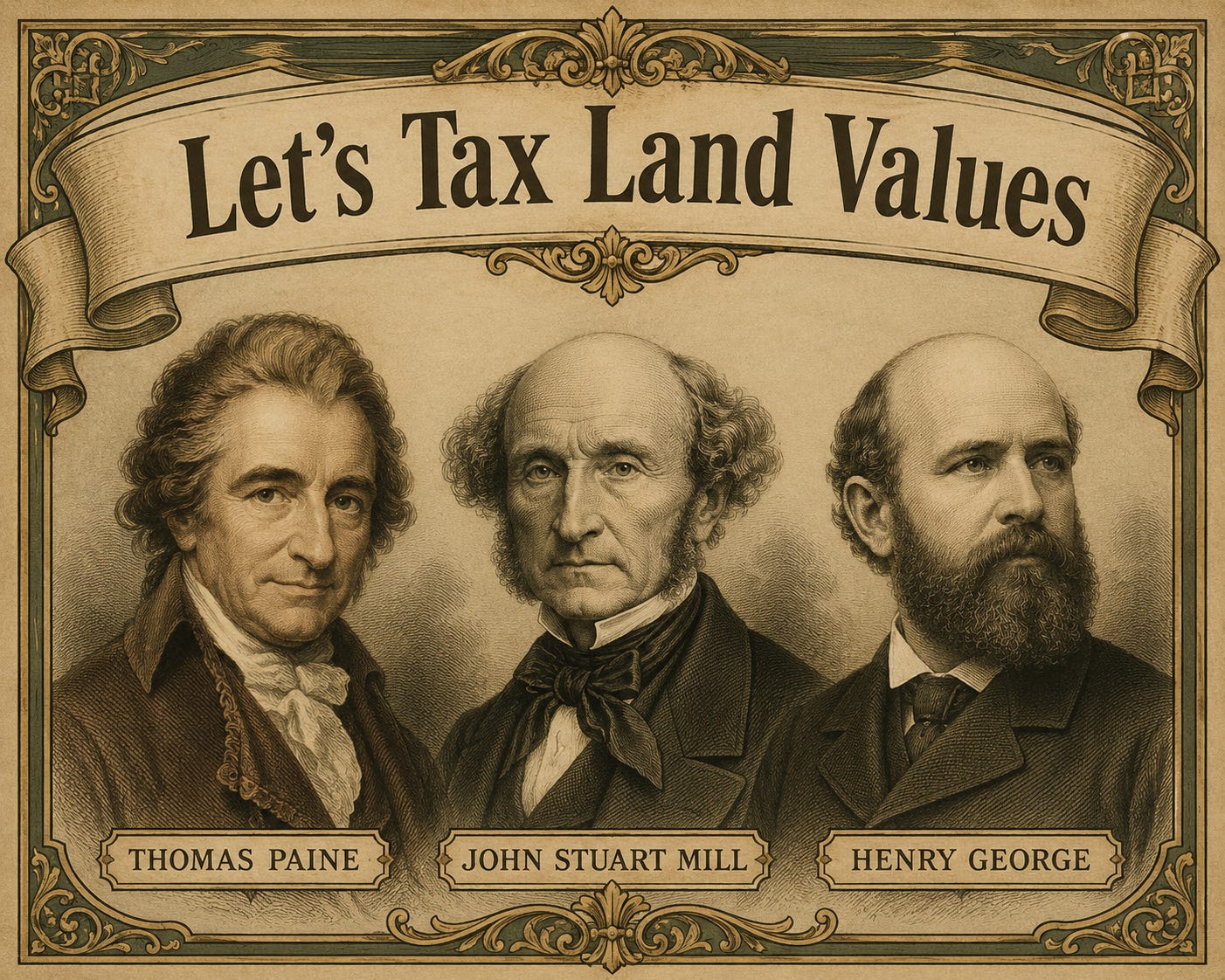
The idea of taxing land values to keep the price of land steady and prevent it becoming a largely inaccessible hoard of wealth that could otherwise be used for productive investment, goes back at least as far as Thomas Paine in Britain, and the Physiocrats in France.
John Stuart Mill’s call for a tax on the unearned increment of land was shaped by Paine’s earlier work, and his thinking was developed by the American economist Henry George, whose seminal work, Progress and Poverty, was so popular at the turn of the 20th century that it outsold The Bible for a number of years.
This was, of course, a different time: a time when ordinary people in their millions were unafraid of educating themselves by reading a six hundred page work of economic philosophy. Then again, it is beautifully written and compellingly argued, and I guess the Edwardians had to find something to do in their spare time. George’s book is still in print if you want to discover what all the fuss was about.
I don’t know if Burnham has read it, but he certainly seems to have got the gist, an impression reinforced by a number of recent statements that suggest he is fully aware of the structural and institutional barriers to creating a more equal and just society.
For the first time in a very long time, Britain will have a Prime Minister who realises that a more inclusive society cannot be created simply by better managing the prevailing economic system. The system itself has to be changed. And this is where he faces his greatest danger: the super rich (and quite a few people who are not so well off, but who identify with the system that has created the current glut of billionaires) will fight tooth and nail to prevent such change.
Even if they represent as much as ten percent of the electorate, in a democracy that shouldn’t be a problem. But their wealth gives them disproportionate political power, allowing them to neutralise the equalising influence of democracy. This is why Burnham has to tell a new story, and actively engage the vast majority of voters who stand to gain from a more inclusive economic system.
But back to Land Value Tax. Both articles in The Times concentrate on the possibility of taxing residential land (as an alternative to council tax and stamp duty). They ignore the fact that the most valuable and profitable land in Britain (and all other countries) is owned by companies, which, if LVT is to be effective, will also be required to pay the new tax.
Commercial property owners do especially well out of their land holdings because of government investment in public infrastructure. Take London’s Elizabeth Line for example: properties close to the new line saw substantial increases in their values as soon as the route was announced. Huge sums of money were added to landowners’ balance sheets as a direct result of taxpayer-funded investment. Why should that value accrue to landowners? Under LVT it would be recycled, and used for further infrastructure improvements, and so further drive economic growth.
In terms of residential property, we need to stop seeing our homes as an investment, the value of which can only rise. This means solving the problem of insecurity in old age, and reversing the assumption that we should be able to pass on something to our children. In an economy in which all work was properly rewarded, and less heavily taxed, as it would be under a tax regime that included LVT, it wouldn’t be necessary for children to depend on handouts from the bank of mum and dad simply to be able to maintain the living standards their parents enjoyed.
Both Neidle and Luce also mention the supposed difficulty in valuing the land element of property separately from the buildings that occupy it. But where LVT has been tried, in many places around the world at local and regional levels, no such problems have been encountered. Here in Britain, insuring buildings already involves an assessment of ‘restatement value’ - the cost of rebuilding should a property be destroyed by fire, for example. It is not difficult to value the cost of bricks and mortar and therefore deduce an accurate value for the land it sits on.
Edward Luce suggests that LVT
‘will work far better than gimmicky schemes such as wealth taxes.’
I fear Luce has missed the point here: LVT is clearly a tax on wealth, but it is a tax on unearned wealth. And if, by some Burnham-shows-his-true-mettle miracle, LVT does come to be implemented here in Britain, it will hopefully open up a debate about just how much of the wealth of the richest is, indeed, unearned.
Elon Musk may be the wealthiest man in the world, but only because he holds a shed-load of shares in his own companies, the prices of which are inflated beyond any reasonable expectation of future returns, because so many investors want a piece of the action. Musk is sat atop a gigantic bubble which is one day bound to burst.
Once he’s sorted LVT, perhaps Burnham could review the legislation governing the ownership of joint stock companies? Because with things as they are, too many investors are making a killing without doing any work whatsoever. Their gains are entirely unearned, and while such gains go untaxed, the operation of the free market is distorted and the economy fails to allocate resources and opportunities such that everybody can find work that pays sufficiently to provide for their essential needs.
In the weeks since his elevation became inevitable, Burnham has been talking a great deal about the importance of place, and the need for communities to be allowed a say in how things are run locally.
His argument that power must be returned to communities should be applauded, but if control over much of the local economy has been ceded to large multinationals, or private equity-owned companies interested only in turning the quickest possible profit for their investors, then this kind of communitarianism can become little more than an exercise in solidarity among the dispossessed. It might make being dispossessed slightly more tolerable, but it doesn’t solve the underlying problem, and doesn’t help improve the economic independence or security of people for whom the focus of their lives is the local community, and who are not plugged in to the globalised free market economy.
Jonathan Portes got it right last week when he wrote that,
‘Britain does not need higher taxes as an objective in itself; it needs a tax system that raises the revenue required for a civilised state while doing less economic damage and distributing the burden more fairly.’
Further support for the idea of rebalancing the economy through changes to the tax system came from the ResolutionFoundation’s Ruth Curtice in her open letter to the incoming Chancellor of the Exchequer.
‘But it remains unlikely that we can sustain internationally low tax rates on median incomes as we climb out of this hole. So you should seriously consider rebalancing the taxes paid by employees versus other forms of income, through a reduction in employee National Insurance and an increase in Income Tax.’
But, as James Ball pointed out on Saturday, the prospects for Burnham successfully taking his radical, reforming zeal into government will depend on one key decision: whom he appoints as Chancellor. If he opts for Shabana Mahmood, it will be business as usual. Mahmood is a lawyer, she has no experience of economics, and she will, like Rachel Reeves and plenty of others before her, be neutralised in any progressive ambition she might have by Treasury orthodoxy.
If Burnham is serious about real change then he must appoint Ed Miliband, a trained economist, someone passionate about social justice, and fully aware of the need to take urgent measures to address the rapidly unfolding disaster of climate change.
In my 2010 Guardian article, I concluded with five points that anyone serious about implementing LVT must take on board. I am reproducing them here, with minor additions and modifications.
LVT should be sold as a tax on unearned wealth. The gains made by landowners, are, as Martin Wolf of the FT wrote many years ago, ‘the reward of owning a location that the efforts of others have made valuable’. This is not a difficult story to tell for a gifted communicator like Burnham.
LVT should be part of a package that targets other forms of unearned income, notably the super-profits enjoyed by the shareholders and senior executives of banks as a result of their being allowed to issue money; and the returns accruing to the already wealthy through speculative investments that otherwise serve to destabilise the real economy.
LVT should be adopted as an alternative, not an additional, means of raising public revenue. As incremental changes to the tax system are implemented, nobody in the bottom 90% of wealth holders should be taxed any more heavily than under current arrangements.
Measures must be put in place to prevent the financial markets scuppering the project before it is underway. This will require international co-operation in advance of implementation, and possibly emergency legislation. If the bond markets are serious about wanting an economy that drives sustained economic growth built on fiscal foundations that ease the burden of taxation on productive work and entrepreneurship, then they should embrace LVT.
Finally, legislators must be aware that in shifting taxes away from work and enterprise and on to unearned income, they will be striking at the very foundations of elite wealth and privilege. This is not something to be afraid of. Quite the opposite: in a democracy it should be a strong selling point. That said, it will impact the vast wealth of the billionaire class, and a strategy to neutralise their power will be required.
For twenty-five years now, I’ve been convinced that taxing land values is crucial if we are to level the economic playing field, and give everyone a fair chance in life. As part of wider reforms that also target the consequences of allowing privately owned banks to create new money, and a financial system that priorities short-term financial gains while largely neglecting the real economy, it could help usher in new economic arrangements, ones that serve the interests of every citizen, instead of the current situation where the majority are forced to labour in an economy designed to line the pockets of the few.
Thanks for reading. If you enjoyed this post then please to click on the ‘like’ and ‘restack’ buttons for I am told that engagement is the key to success on substack and helps get one’s writing in front of more readers. Many Thanks, Mark.
Comments
Nothing yet. Say the first thing.
Sign in to join the conversation.