
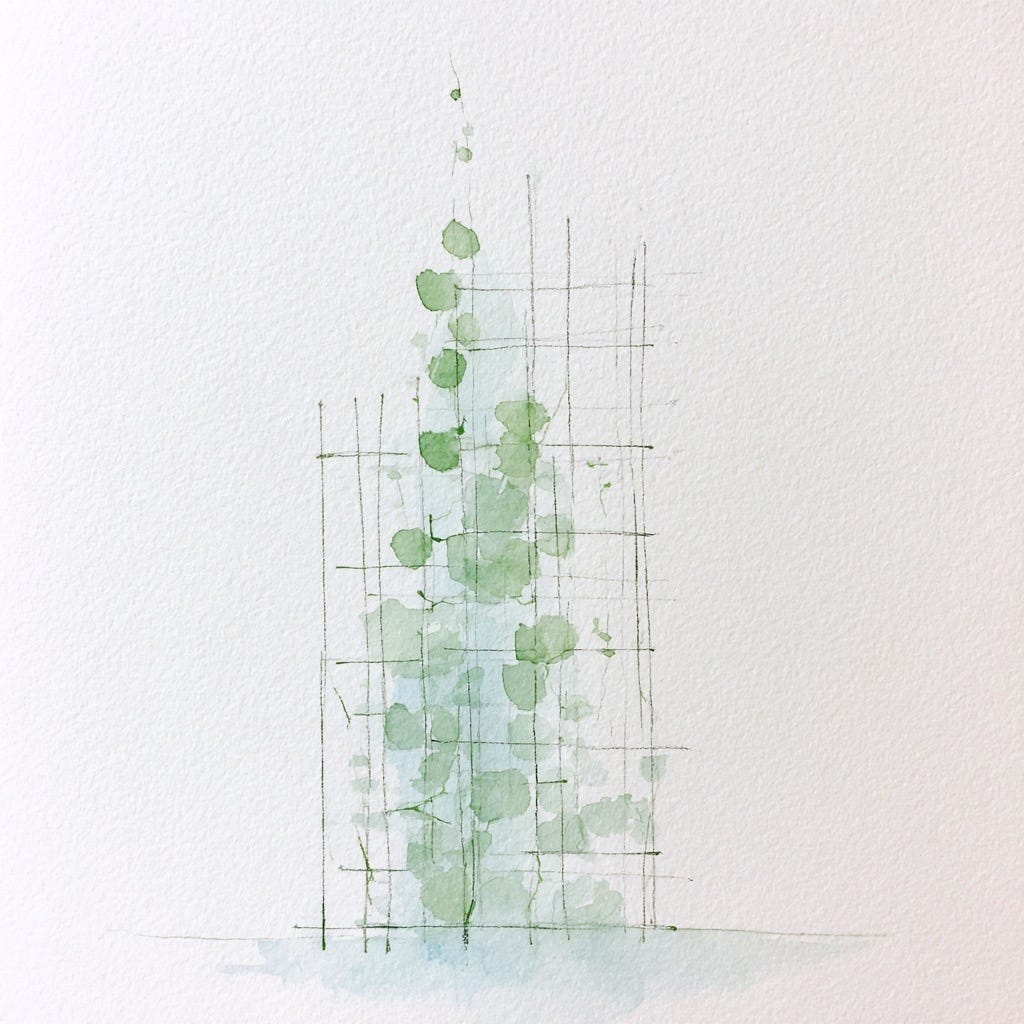
Does freedom require autonomy? The two seem to belong together. And yet, the connection is less straightforward than it seems. It all depends, for a start, on what we really mean by autonomy…
We tend to think of autonomy as needing no one and nothing, as though relying on support somehow made us less autonomous than managing entirely on our own. But does it? Look a little closer and it becomes clear that our lives rest on countless dependencies, most of them so ordinary we barely notice them.
We depend on the air we breathe, on farmers for the food we eat, on engineers to keep the lights on, on doctors when we fall ill, on the people close to us to carry us through certain stretches of life. Our societies are vast architectures of interdependence.
Part of the difficulty lies in the word “dependence” itself. It can simply mean relying on something outside ourselves. But it can also describe a pathological relationship in which someone persists in a harmful behavior despite its consequences. These are, of course, very different things.
Take a pair of glasses. They create a dependency, certainly, but in the most ordinary sense imaginable. Would anyone think of taking away a nearsighted person’s glasses to “strengthen their autonomy”? Of course not. Quite the opposite. Glasses expand their freedom and make more of the world available to them. That doesn’t mean we shouldn’t wonder where they choose to direct their gaze once the world comes into focus. (Seeing clearly, after all, is no guarantee of seeing well.)
If we can sometimes learn to read the world more clearly, there is still the matter of making sense of what is going on inside us. Have you ever had an intuition, several ideas colliding at once, a thought whose outline you can feel without quite being able to grasp it, perhaps even an almost complete line of reasoning that has yet to take a form clear enough to share?
So you give the AI a few fragments. And the ping-pong begins. It rephrases. Yes, but that’s not quite it. You correct it. It suggests a structure. Hmm, maybe… actually, no. Not even close. Bit off the mark there, Claude. Data center getting warm? And then… wait. There’s the start of something there. You can feel it. so you qualify, refine, nudge things into place. You turn towards the AI like a plant towards the sun and start to photosynthesize. Suddenly, eureka. A burst of chlorophyll. Yes. That’s it. That’s exactly it. The thing you’d been trying to say all along.
Sound familiar? :)
To describe this as mere delegation would miss something essential about the experience. There is a kind of maieutic process at work. Through the repeated effort of putting something into words, revisiting it and making it more precise, a thought that was once diffuse gradually finds its form. Once it can be grasped, it can also be questioned, challenged and sent back out into the world to meet reality.
The screen may postpone human contact, but it also creates a protected space. There can be a kind of consideration, in sparing someone else the noise of our inner monologue while we work things out without fear of judgment. This detour does not always avoid genuine encounter, cause it can prepare us for it.
In trying to make our thoughts clearer to others, we sometimes become clearer to ourselves. And that distinction matters. I mean, how can we make sound choices when we struggle to make sense of ourselves?
Knowing what we want is one thing. Actually setting out to do it is quite another.
We tend to think about what is possible in terms of what we are capable of, with that very human fondness for binaries. I can do this/ I can’t. I’m able to / I’m not. Acceptable/ out of bounds. Real life, of course, has an inconvenient habit of being far more complicated. Between the possible and the impossible lies a vast territory filled with things we could, in theory, do, but whose cost of entry is simply too high at that particular moment.
In that territory, the currency is courage. It is no coincidence that the word itself leads us back to the heart. What matters is never only what we are capable of doing, but also what matters enough to us that we are willing to try. The difficulty is getting ourselves into motion. And the amount of courage required depends, in part, on the height of the step in front of us. Lowering that step can sometimes leave us with just enough courage to take the first one. This is precisely where AI can change the equation, by lowering the cost of entry enough to make certain experiments feel possible.
And off we go. Since we are already on the move, we might as well get on a bike. An electric one, naturally. Electric assistance promises more speed with less effort. True. But that is not really the most important part. Think about it. For someone who would have stayed home because of the first hill, the battery does more than make the road easier. It makes possible a journey that, without it, might never have happened at all.
One question remains, and not an entirely trivial one. How much help is enough to widen the realm of the possible without eventually choosing the road for us? Make the slope too easy and we still need to make sure we don’t go sailing happily into the ditch. The fashionable answer these days often comes down to a single word, sycophancy. AI systems may flatter us too much, agree too readily and challenge us too little. There is something to that. Still, keeping us out of the ditch hardly requires turning every journey into a mountain stage. Being challenged has never made anyone autonomous simply by virtue of being challenged. And trading an automatic yes for a principled no is unlikely to take us much further.
Psychology knows a thing or two about getting the measure right. Heinz Kohut spoke of “optimal frustration”. Neither too much nor too little. The point is to pitch it at a level we can actually work through. And what counts as enough changes with the person and the moment. A contradiction might help me grow today and, tomorrow, when I have little left in reserve, simply make me give up. Good assistance does not remove every bit of resistance. It attunes itself. This is the intuition behind Lev Vygotsky’s “zone of proximal development”. The support we lean on today prepares the autonomy of tomorrow.
Isn’t that, after all, something attachment theory has been telling us all along? A child does not explore the world because we withdraw our presence to force independence. They venture out because they have a sufficiently secure base, knowing that support remains within reach if needed.
Perhaps there is something here for how we think about our relationship with AI. A support present enough to let us explore, attuned enough to leave us our part of the journey. Because somewhere between the dependence we fear and the autonomy we idealize lies another, quieter risk. Standing still before a step we might have taken with just a little help… however non-human it may be.
MD
Co-written with the insight of Matthieu Ferry, clinical psychologist and AI expert, whose work at the intersection of theory and practice can be found on Intelligences Plurielles and IA et Psychothérapie, both in French.
No posts
Comments
Nothing yet. Say the first thing.
Sign in to join the conversation.