
There is a phrase I often encounter in my community, offered with a resignation that dissimulates as wisdom.
Everything in life is sealed, already written and pre-destined.
This kind of thinking appears during moments of crises, after a diagnosis of a grave illness, in the aftermath of a preventable tragedy and during a genocide unfolding in real time. The discouraging language of surrender, and unquestioned acceptance.
But, what can we do?
This is how God has willed it.
It’s all predicted in the Quran.
We simply have to make peace with how the world is.
There is a stark difference between surrender to the divine, and willful paralysis.
I have witnessed people I love abandon self-advocacy in healthcare because illness was approached through the lens of fate, rather than a call to action to pursue efforts toward self-preservation, and life longevity.
I have heard grief and emotional overwhelm be dulled into utter resignation, when accountability or prevention would have been a far more more ethical response.
I have also discerned that moral exhaustion is perceived as spiritual maturity, especially in the face of preventable mass suffering, our blind spots, privileges and participation denied. Inaction is medicated with prayer, piety and meditation, instead of striving for tangible, uncomfortable change.
People often justify their postures of resignation, through religion, and spirituality.
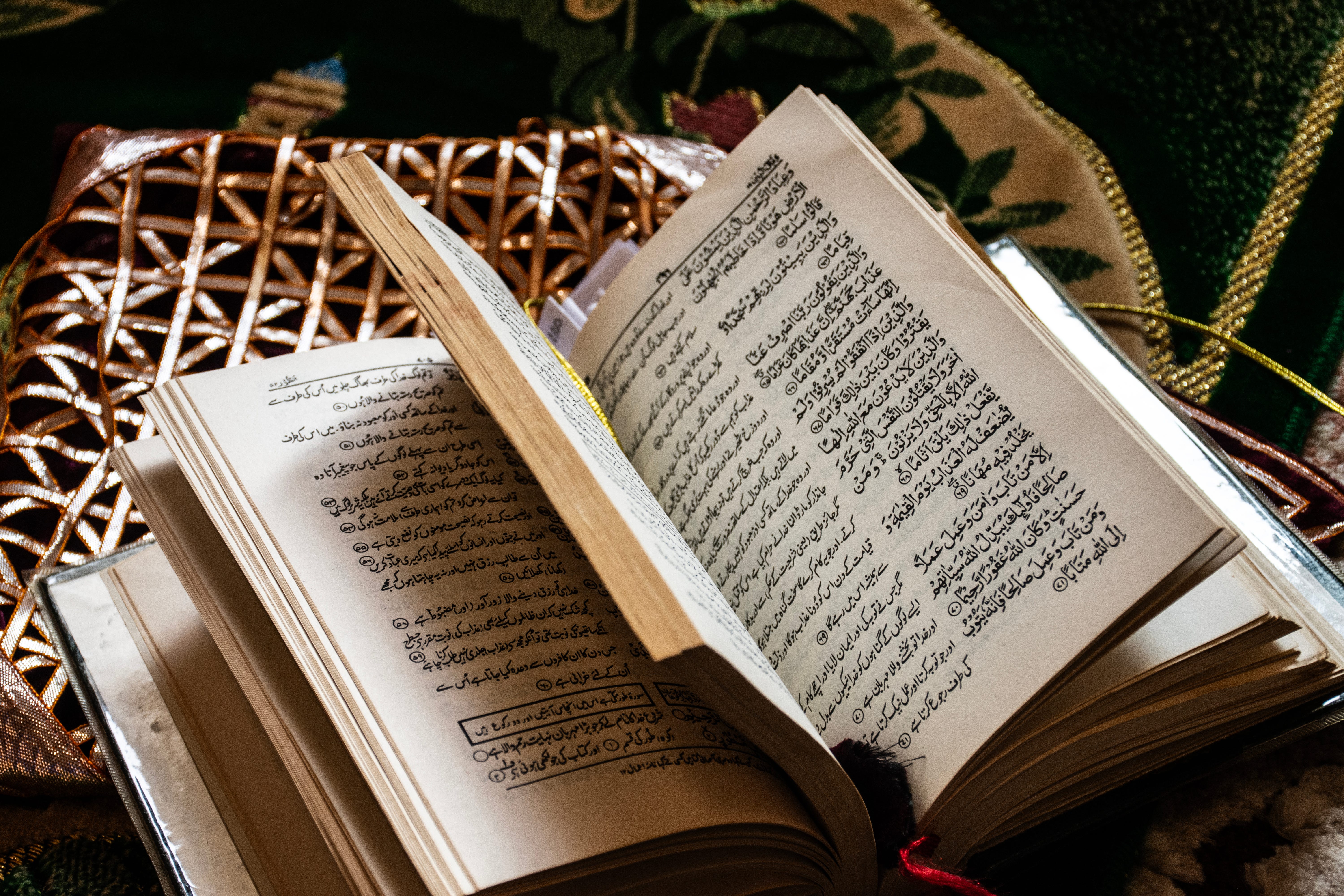
Yet, when I return to the Qur’an, a book I have read in multiple translations, time and time again, year after year, in an attempt to fully absorb the text, a book that serves as the primary moral, and spiritual code for Muslims, I encounter a message that is in diametric opposition to the above.
The Qur’an does not sanctify lethargy, passivity or unquestionable, lazy surrender to circumstance.
The Qur’an implores readers to unpack and understand the constant tension between divine knowledge and human responsibility, an empowering liminal space that exists between trust (tawakkul) and effort (amal), destiny (qadr) and struggle (jihad, but in its most expansive, ethical sense).
The Qur’anic narrative is filled with examples about historical characters who act, and think, with courage and clarity. There are stories after stories about Prophets who argue with God, depicting robust dialogue and critical thinking skills, harnessed in conversations between mortals, and the divine.
There are also several empowering, feminist examples of women who plan, organize, protect, and fund movements.
Resilient communities that migrate, resist, build, fail, and rebuild.
In my readings, the Qur’an clearly, and strongly, discourages complacency.
“Allah does not change the condition of a people until they change what is within themselves.” (13:11)
The Qur’anic language, and code of conduct, is built around freewill, effort, choice and agency.
Even suffering, in the Qur’anic imagination, is not an excuse for inertia. Struggle, both inward and outward, against internal and external forces is strongly encouraged, as necessary and formative, a responsibility that we collectively, and individually absorb, in exchange for the gift that is consciousness.
Nowhere is this clearer than in the life of Prophet Muhammad.
If ever there were a figure who could have claimed divine pre-ordination as justification for inaction, it was him. And yet, his entire recorded life is marked by deliberate action, mobility and movement.
Migration, organization, negotiation of treaties, while enduring boycotts, exile, poverty and violence. Building communities from fragments, often at enormous personal cost. Nothing about his life resembles passive submission to a pre-ordained script unfolding on its own.
To live according to the ethos of Islam, is to live with the weight of effort, constant, life-long, aspiring effort. At the heart of that effort stands a powerful, businesswoman who is too often flattened into symbolism. Bibi Khadijah.
Khadijah was a formidable entrepreneur in her own right. A strategic planner and savvy employer, her impressive trade caravans stretched across regions. She garnered wealth through competence, trustworthiness, and tactical vision. She invested with precision, materially and emotionally, in a philosophy before it became popular with the masses, taking calculated risks with limited guarantee of success. Her support of the Prophet was logistical, financial, and incredibly pragmatic. She understood, that movements require infrastructure, and cannot survive on faith alone.
Khadijah did not “leave it to God.”
She laboured tirelessly, and trusted the divine, within that work.
This pattern repeats across Islamic history, particularly amongst women.
Fatima al-Fihri, a Muslim woman born in 9th-century Morocco, utilized her inheritance to build what is widely recognized as the world’s first university: Al-Qarawiyyin. She could have resigned herself to a life of comfort and excess, but instead chose to plan, fund and oversee the execution of an educational institute, successfully transforming private wealth into public knowledge.
These are women, who were determined not to conflate reliance on God with intellectual, or material negligence.
Contrary to popular opinion, the Sufi tradition often deemed to be the mystical core of Islam, does not endorse naïveté, despite what modern romanticizations suggest.
I remember attending a sermon by Baba Saleh, the late leader of the Bawa Muhaiyaddeen Fellowship, a Sufi community with roots in Columbo, Toronto and Philadelphia. Addressing the women and girls directly, he spoke with startling clarity about aging, finances, and independence. He urged us to plan effectively for old age and retirement, organize our savings with diligence, and avoid total dependence on spouses, parents, brothers or governments. His message resonated with me precisely because it was so unembellished:
Naïveté is not spirituality, nor is it the path of Islam. To be a Sufi is to be grounded, unsentimental and most importantly, awake.
In an age saturated by AI-powered deepfakes, algorithmic misinformation, miracle-cure profiteers, and the seductive pull of superstition disguised as “alternative truth,” our inner jihad takes on a newly urgent form. We wage an ongoing struggle against intellectual laziness, emotional manipulation, and the erosion of shared, objective reality. This struggle requires that we actively seek credible, accountable, and scientific sources, and refuse to circulate unverified claims or dangerous medical falsehoods, that we remain anchored to objective truths even when fantasy, and conspiracy, presents itself as the ultimate soothing escape. To think critically and rationally, in today’s climate, is our moral responsibility as practicing Muslims. The deliberate choice we make toward ethical resistance and critical thinking, is rooted in a scholarly tradition that dates back 1400 years. Truth-seeking, is in itself, an undeniable act of faith.
Spiritual surrender, through this empowering framework, can then be positioned as a total and utter refusal to allow fear, delusion, emotion or arrogance to dictate our choices. We are called to act ethically, analytically and deliberately, even and especially, when outcomes are uncertain.
Which brings me to a story my late mother, Mohtarma Rubina Magsi aka Adeen Taji once told me.
A king, preparing for war, went to a palm reader and asked if he would be victorious. The seer studied his hand and said, “No. You do not have the line of victory.” The king grabbed a knife, cut his palm, and drew the line himself, blood pooling into destiny. He returned to the battlefield, and won.
I do not retell this story as an endorsement of violence or superstition, but rather because it captures a truth our communities often resist, positioning fate as a phenomenon that is discovered, when in essence fate is actually carved out, with assistance from the divine. Faith, at its most honest, will rarely ever anesthetize us to injustice.
If we believe everything is written and pre-ordained, but ignore that we are also doing the co-writing with the divine, through our choices, silences, labour, refusals, actions and inactions, then are we really practicing faith, or are we simply giving up our divinely gifted powers of agency and autonomy, while outsourcing our conscience altogether?
The core tenets of Islam demand that we avoid slumbering through life in a haze, numbed and resigned, waiting for fate to unfold, or an external force to come save us from ourselves.
Harnessing the life-altering power of conscious, accountability, effort, action and strategy, Islam demands that we wake up!
No posts
Comments
Nothing yet. Say the first thing.
Sign in to join the conversation.