
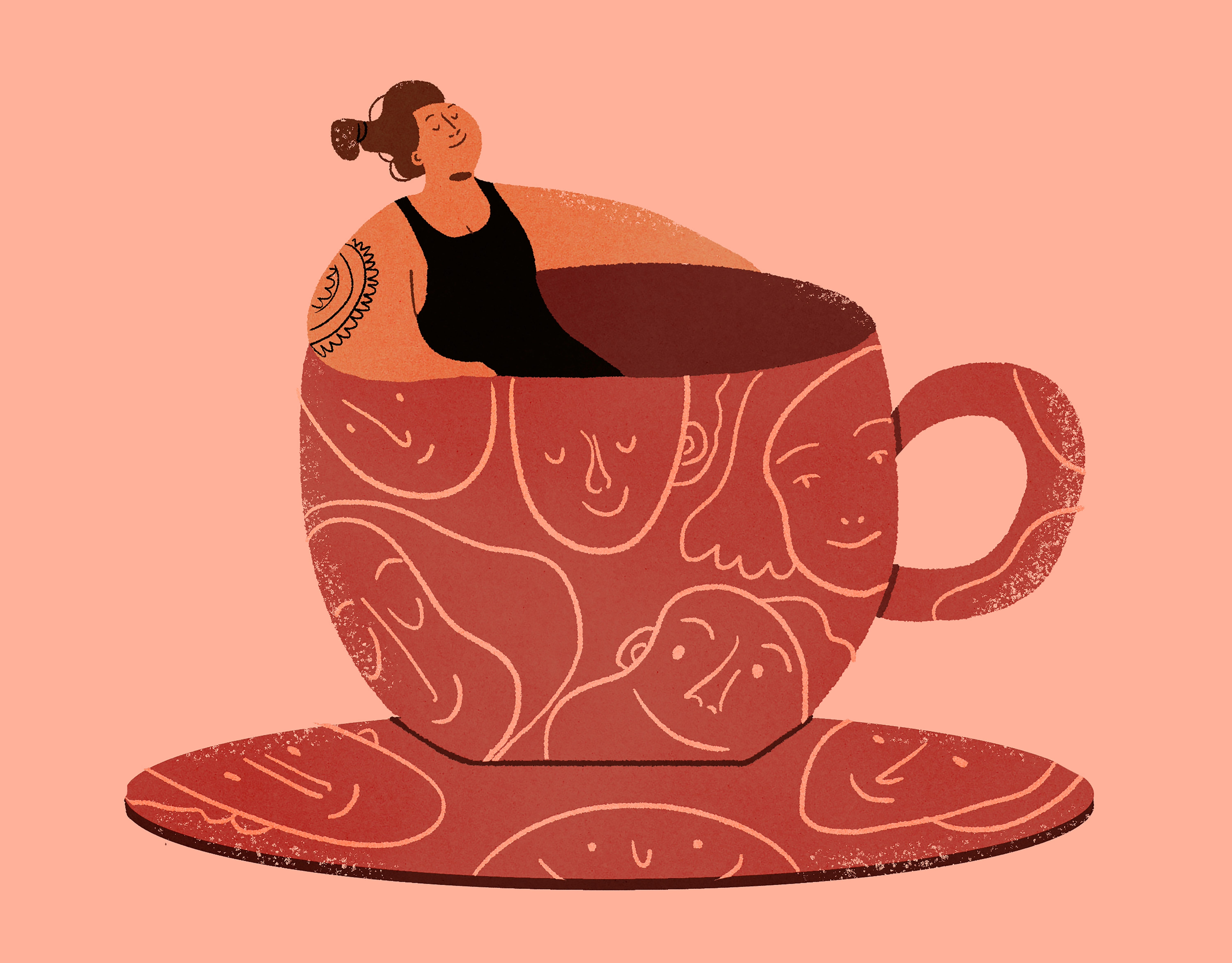
Many women I know grew up oriented toward marriage and children. They longed for perfect weddings, knew what they wanted to wear on their big day and had even decided upon names for their future children.
I had very different dreams and ambitions growing up. While I knew that I wanted a steady, loving partnership, I hadn’t quite foreseen a wedding or children in my imagined future.
In fact, I was very critical of the institution of marriage, really only relenting for the sake of my family, primarily my mother, whose wish it was to have a wedding for her eldest daughter. She was unwell, and her time on this planet was limited, and so I granted her this wish. I also do not come from a culture that is forgiving toward women who make decisions that deviate from the norm, and so family reputation and public image were also at stake.
What I have always known, with utmost certainty, is that I want to leave a mark on this world.
Of course, over the years, so much has happened. I did get married, and my husband’s family is quite gender-conforming. He himself had no idea what he wanted, we were only in our early twenties when we met, but there were many people whispering in his ears, advising him not to waste his genes. I find interference in any couple’s private life to be deeply unsettling.
He shifted from assuming he wanted children, largely because that’s what is culturally expected once you reach a certain stage of life, to realizing he didn’t want them at all. For both of us, witnessing the realities of parenting up close, the exhaustion, the emotional and financial strain, the constant negotiation of self, has only clarified and strengthened our certainty. Parenting is demanding, often thankless work, and I don’t believe it is a universal calling.
Nor is it our responsibility to make the world larger, or do the bidding of capitalism.
Right now in the United States, we are watching the pronatalist movement step out of the shadows and into the halls of political power. Elon Musk, a man who fathers children across multiple women with the apparent philosophical consistency of a spreadsheet, has positioned himself as civilization’s saviour, declaring that low birth rates are a graver threat than climate change.
The Trump administration has floated baby bonuses and a “national medal of motherhood.”
At conferences like Natal Con, speakers have openly argued that women should be socially stigmatized for having careers.
The agenda is quite clear.
Bodies for the workforce, consumers for the economy, and soldiers for the state.
When the richest man on Earth tells women what to do with our bodies, under feigned concern for humanity, we are witnessing a power grab camouflaged as demographic anxiety.
To be quite honest, and we don’t make enough space for this conversation, I don’t love children.
Do I want all children to have access to safety, nutrition, education, loving homes, shelter, and not be massacred in genocides?
Absolutely, with every fibre of my being.
And I will stand on the frontlines of every protest, write relentless letters appealing to bodies of governance, and follow an ethical framework that demands that all children, the world over, be protected.
Do I consider all children to be my children?
Yes, without a doubt.
But do I love them enough to want them? No.
This does not make me an evil bitch.
Quite the opposite, actually.
It makes me a self-assured, assertive human being who thinks big decisions through very carefully and critically, instead of jumping into the pond just because everyone else is jumping in too.
I am a wonderful aunty and mentor to many, but I am also not the person you leave your kids with for long durations. I like children around for a little while, and then, please take them back. I have absolutely no tolerance for crying, screaming, tantrums, and the chaos that comes with young children and toddlers. This is largely in part due to my health issues, and also because the nature of my work, especially editing, writing, thinking and imagining, demands quiet, uninterrupted time.
Feminist author Mona Eltahawy, who grew up in an Egyptian family, has written and spoken with brave candour about choosing herself. She writes: “I’m childfree by choice because I am the worst thing a woman could be: selfish. I’m childfree by choice because I chose me.”
The pressure women face to become mothers is structural, and relentlessly enforced. A 2023 systematic review published in Sex Roles found that unpaid domestic and child-care work is distributed with consistent detriment to women across virtually every country studied, and that this disparity directly impedes women’s workforce participation, income, and well-being.
Research published in the Journal of the Abdul Latif Jameel Poverty Action Lab found that as of 2018, women around the world conducted over three-quarters of all unpaid childcare work. A sixteen-country survey found that 24% of women with a child under six spent nine or more hours a day on child-care, compared to 7% of men. Six hundred and six million women were outside the workforce due to household responsibilities in 2018, versus forty-one million men.
The Yale Journal of International Affairs observed in a 2026 analysis of the 4B movement, originating in South Korea, that protest against marriage and motherhood is increasingly understood as “an economic and political protest against a system that drains women through unpaid care labour.” South Korean women, facing the world’s lowest fertility rate are refusing to be treated as birth machines by a state, that ignores their personhood, while demanding their productivity as reproducers.
Women’s full participation in public life has always depended on support in the domestic realm. Without it, motherhood remains a penalty.
We are watching this reality play out in real time in the United States, where the Supreme Court’s overturning of Roe v. Wade in 2022 stripped people of federally protected reproductive autonomy, the right to end a pregnancy, and the right to have any meaningful say in whether bodies become vessels for the state’s demographic ambitions.
Access to abortion, contraception, and reproductive healthcare is increasingly treated as a political concession rather than a basic human right. When governments decide what happens inside our bodies, choosing to be childfree is then the ultimate act of resistance.
Since 2023 we have been witnessing atrocity and violent horrors live-streamed on gadgets that fit in the palms of our hands. I wake up every day to mothers crying over the desecrated bodies of their young children. The world we are being asked to bring children into today is one in which children are being killed as they’re being born.
In Gaza, an entire generation of Palestinian children has been devastated by war. Bombed in hospitals, schools, playgrounds, their bodies buried under rubble.
In Iran, young people have been imprisoned, tortured, and executed for daring to protest state repression, while elsewhere in the region, foreign military actions by the United States and Israel have resulted in the killing of more than 150 school-aged children. Different contexts, different mechanisms of violence, but the same devastating outcome. Young lives cut short by power, ideology, and impunity.
In the United States, children are sent to school and shot in their classrooms, while the legislature calls it a tragedy and does nothing.
In Canada, Indigenous children are still being taken from their families at staggering rates through the child-welfare system. Many grow up separated from language, land, and kin, repeating a cycle born of colonial violence.
Children are inheriting a world scorched by extraction where forests are burning faster than treaties are signed. Ecological collapse steals their right to a future that is breathable, livable, and safe and the military industrial complex teaches them that power is more important than collective care.
The global foster care system holds millions of children who are waiting for stability and permanence with chosen families.
Any honest conversation about bringing new children into the world must hold space for the children already here, suffering, unseen. The ethics of bringing new lives into an already fractured world, amidst climate collapse and accelerating political instability, are rarely questioned.
I have been told everything under the sun.
No one will be by your side when you’re old. You’'ll die alone. Just wait until your sisters and cousins have children, your ovaries will be quivering to have them too. But it’s your religious duty. How can you not have children? There’s no life without children. Doesn’t your husband want to pass on his legacy? There is no greater reward than having children. You’re just being rebellious for no reason. You will regret this decision.
Well. I am forty years young now, and I would like to inform you that I do not have children, I have chosen not to have children, and thus far, I am living with zero regrets.
What I do have is an immeasurable amount of inner peace, a peace that I fought long and hard to attain.
I have the ability to keep pursuing my dreams.
I have time to generate income, remain independent and stay focused on my health and well-being.
I have fostered meaningful relationships and I have cultivated communities with intention and care.
I have the freedom to travel, embark on new projects, and follow the call of my heart.
I have also been thinking about intimacy, in all its forms. The assumption that sexuality must culminate in procreation is one of patriarchy’s most enduring distortions. Pleasure, companionship, and emotional or physical closeness stand complete in themselves. They are fully valid experiences that need no biological purpose to justify their existence.
Research consistently shows that couples who choose to remain childfree are usually happy with their decision decades later, and that it is parents, in fact, who are statistically more likely to report some form of regret. Millions of people, many of them women, the world over, are exercising a form of sovereignty over our own lives that our ancestors were largely denied.
So, what can legacy building look like for those of us leading child-free lives?
A life of creativity, intellectual pursuit, and community service.
A life of love and care that extends outward.
A life of presence and becoming and belonging.
A life that is not organized around the endless needs of dependents.
I do not reject children, nor will I ever shame or judge those who choose to become parents. Parents, and particularly mothers, do some of the most demanding and important work that exists.
Our collective attitude toward personal decisions about having children requires a fundamental rethinking. The norms that treat childfree women as incomplete, selfish, tragic, villainous or evil must be re-examined. The weaponization of family pressure and religious obligation against personal sovereignty cannot be justified through culture. The political systems that legislate reproduction without consulting the people doing the reproducing must be held accountable.
For those of us living child-free by choice, there often comes a point where the surrounding social landscape shifts with many peers partnering, building families, and orienting their lives around children. It is especially important to stay alert to how comparison culture operates, amplified by social media and reinforced by mainstream narratives. We see carefully framed fragments, moments of harmony, milestones, and idealized versions of family life in our feeds 24/7. The exhaustion, complexity, and emotional labour that exist alongside those curated moments are far less visible. Without a critical lens, it is easy to mistake representation for reality.
This is why discernment matters.
Learning to meet images and stories without surrendering our own sense of truth, alignment and timing is crucial.
At the same time, community can also play a vital role.
Being in relationship with others who are also living outside dominant scripts, whether child-free by choice or constructing family in non-normative ways, can offer grounding, recognition, and ease.
As friendships evolve and life circumstances change, differences in availability and obligations can naturally emerge, even in relationships held with deep care.
In that shifting terrain, finding or even building our own spaces of shared understanding, can offer a sense of belonging. Some of my closest relationships at this stage of life continue to strengthen with friends, cousins and siblings who have also chosen to embark on lives without children.
Grief can exist alongside certainty, by the way.
I am confident in my decision not to become a parent, but I also find moments where I think about continuity, especially coming from large, sprawling families with long lineages. All of the stories, traditions, rituals, prayers, recipes, ways of loving and seeing and adapting and surviving, and how inheritance moves through me, even without children of my own.
I think about the objects I will one day leave behind. Books, artworks, ornaments.
I think about how I carry forward my mother’s legacy, and those that came before her, in sentimental ways of remembrance. Will I be remembered in the ways I remember them? Will someone pray for me the way I prayed for them?
My lineage is transforming and expanding outward in forms I do not yet fully understand.
And it is okay, necessary, even, that some of these questions remain unanswered.
Lived, rather than solved.
At forty, I live without children by choice, I am parenting a gorgeous kitty and many, many plants, and I am grounded in peace, purpose, action, and a life that feels incredibly full.
I regret nothing. Even when I grieve, I regret nothing.
If this essay spoke to you, whether you are childfree by choice, by circumstance, or still deciding, know that your life is complete as it is. The fullness of a life is not measured in progeny.
No posts
Comments
Nothing yet. Say the first thing.
Sign in to join the conversation.