
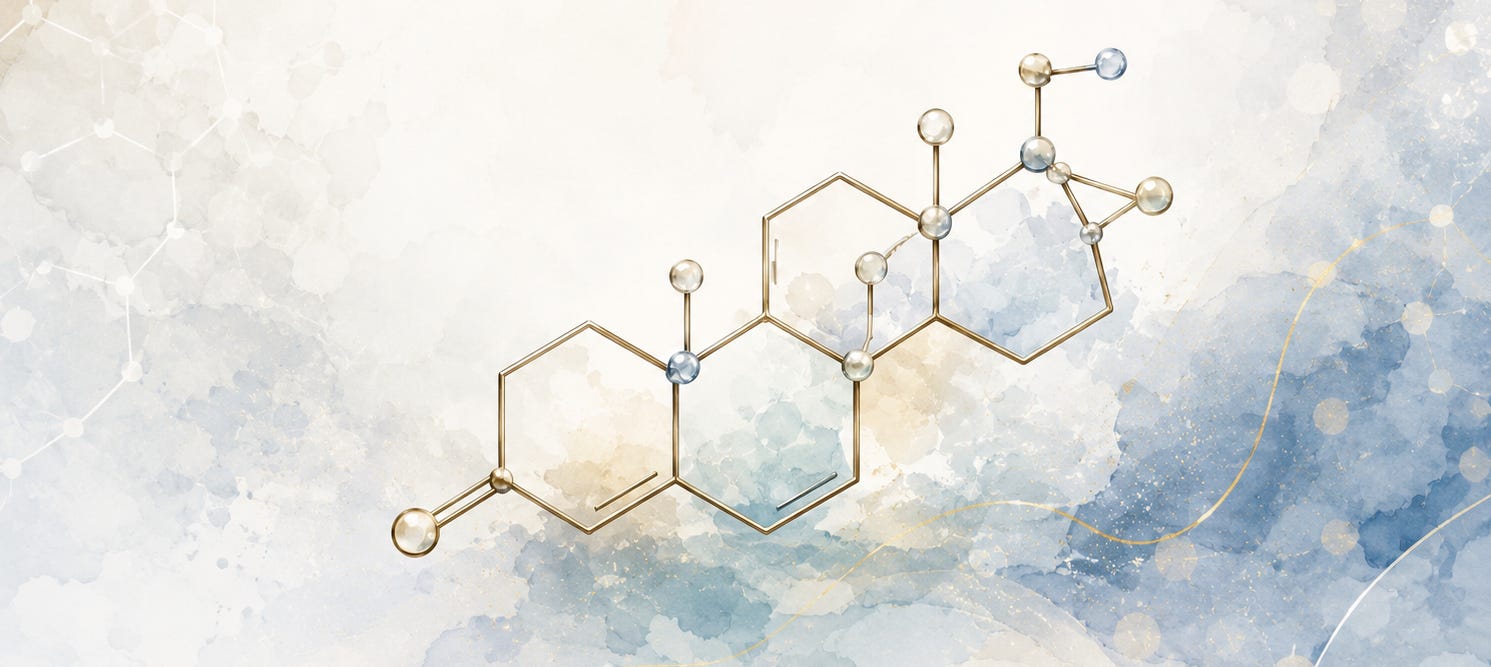
Bioidentical progesterone is chemically identical to endogenous progesterone. That is what “bioidentical” means.
It has the same steroid structure and the same molecular capacity to bind and activate the progesterone receptor as progesterone produced by the body.
This is an important distinction from synthetic progestins.
Synthetic progestins are structurally different molecules. Because of that, they may differ not only in which receptors they bind, but also in how they activate the progesterone receptor itself. Different ligands can stabilize different receptor conformations and thereby influence downstream signaling in different ways.
Some progestins may also interact with other steroid hormone receptors, including androgen, glucocorticoid or mineralocorticoid receptors.
That is an important biological discussion. But it is not the discussion in this article.
Here, the focus is on bioidentical progesterone, and how the biological exposure may differ from endogenous progesterone when it is taken orally, for example as part of hormone replacement therapy.
The question is therefore not whether the molecule is the same, but what happens when that same molecule is delivered in a different way.
Endogenous progesterone is not delivered as a single dose.
After ovulation, progesterone is produced by the corpus luteum and released gradually during the luteal phase. This creates a sustained endocrine exposure, where progesterone-responsive tissues are exposed to the hormone over time.
That matters since hormone signaling is not only receptor activation.
It is receptor activation over time.
A progesterone receptor exposed to a gradually maintained luteal-phase signal is not in the same biological context as a receptor exposed to a sharp concentration peak followed by decline.
The ligand may be identical. However, the exposure pattern is not.
When micronized progesterone is taken orally, it enters the body as a dose.
It is absorbed through the gastrointestinal tract, passes through the liver and then reaches systemic circulation. During this process, part of the progesterone is metabolized into downstream steroid metabolites.
One of the most important metabolites in this context is allopregnanolone.
Allopregnanolone is a neuroactive steroid. It does not primarily act through the progesterone receptor. Instead, it can modulate GABA-A receptors in the brain.
GABA-A receptors are part of one of the brain’s major inhibitory signaling systems. In simple terms, they help regulate how excitable neurons are. When GABA-A receptor signaling is modulated, this can influence sedation, sleep, calmness, emotional tone and anxiety.
This is why oral progesterone can feel very different from what we might expect if we only think about progesterone receptor activation. The effect is not only progesterone binding to the progesterone receptor. It can also involve progesterone being converted into neuroactive metabolites that act on the nervous system.
This pathway is not artificial.
Endogenous progesterone is also metabolized.
During the luteal phase, progesterone produced by the corpus luteum can also be converted into allopregnanolone and other neuroactive metabolites. This may contribute to normal luteal-phase changes in sleep, calmness, emotional tone and nervous system sensitivity.
So the distinction is not that endogenous progesterone has no connection to GABA-A signaling, while oral progesterone does. Both endogenous and oral progesterone can give rise to neuroactive metabolites. The difference is the kinetics.
With endogenous progesterone, the body is exposed to a gradually produced luteal-phase signal. With oral progesterone, a larger amount of progesterone enters through the gastrointestinal tract and liver over a shorter period of time.
That can provide more progesterone substrate for metabolism at once.
As a result, oral progesterone may generate a sharper rise in allopregnanolone and therefore a more pronounced and temporally concentrated GABA-A receptor modulation than the slower neurosteroid exposure produced during the luteal phase.
In other words, oral progesterone does not create a new pathway.
It can change the amplitude, timing and concentration curve of a pathway that already exists.
And this matters because GABA-A signaling is not simply “calm.”
Comments
Nothing yet. Say the first thing.
Sign in to join the conversation.