
Using natural language to code is an example we should all pay attention to throughout education and beyond. Coding agents reveal how advanced AI has gotten and how much it still lacks. We’re likely not going to get the much-hyped, super-powerful Artificial General Intelligence any time soon, but that doesn’t mean the immensely capable AI tools that already exist won’t continue to change and challenge us through 2026 and beyond.
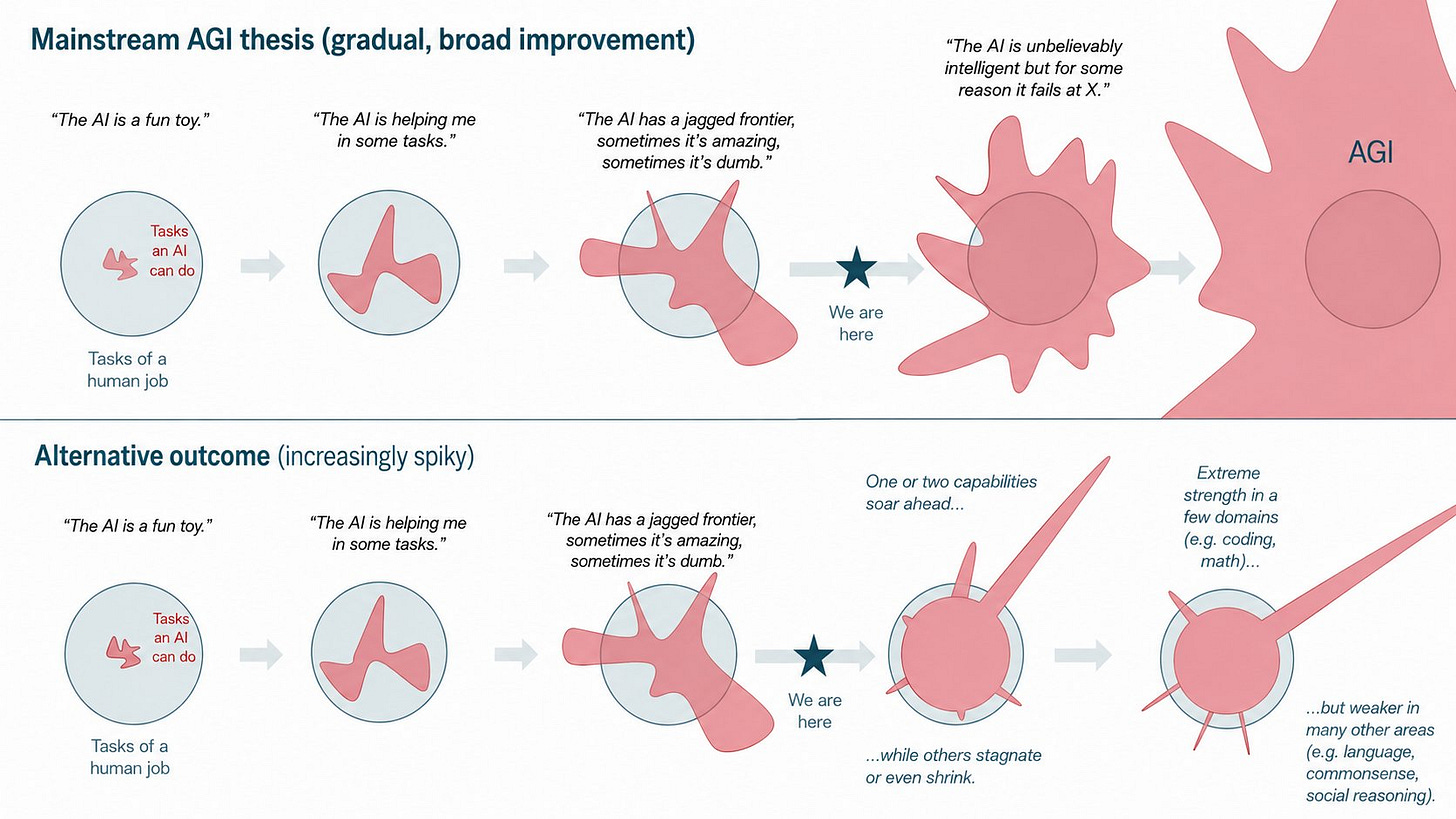
Frontier models can be amazingly proficient in one category (coding) and completely unimpressive in many others (writing, social reasoning, etc.). Knowing the difference matters. Yet many appear to ignore it. For people who don’t code, it can be hard to see an immediate use for this skill or view it as a threat. As a teacher in the classroom with a background in history and creative writing, I didn’t always think I’d need to consider AI coding. That’s changed for me, and I think it will change for many of us in education. Rapidly.
Below is a short video of an activity I created for my students to explore the cost of housing using Gemini, GPT 5.6, and Claude Fable.
AI coding is going to lead to some weird experiences for faculty and students. Right now great efforts are being taken to preserve, mourn, or otherwise call into question what it means to learn now if AI can do a task for you, like write, read, or solve a problem. Few have taken the time to work out what it means if the interfaces we use daily to type on to express ourselves are all suddenly using generative code to allow such human expression.
We’ve witnessed visceral and often compelling reactions to AI in writing, images, videos, and music, but there is no such equivalent in code. My theory is it is because those fields all have a history of visible authorship behind them, while coding often remains opaque to the public. Professions with deep cultural standing and a claim to authorship feel threatened by AI displacing what they do, while many in coding fields have been displaced by the technology yet still use AI to code. To some degree, programming has always been about automating itself, so it isn’t a surprise to see that shift.
The ecosystem we communicate our words through is being rebuilt upon a foundation of generative code and few appear to acknowledge or examine the implications this has for us all. Let’s begin with a provocative question—if you can now build something practical using natural language, what would it be, and who would it be for?
Instead of creating endless wrapper apps that use AI tutors or summarizers, some faculty are using AI to code experiences that allow students and the public to interact with data and historical artifacts in thoughtful ways.
Breen used a combination of OpenAI’s GPT 5.6 and Claude’s Fable to create a searchable database of prize-winning and nominated nonfiction. Breen argues that reading quality non-fiction books are the antithesis of AI slop, but it has become really hard to find exceptional writing authored by human beings. Creating an easily searchable database of human writing in response to AI-generated slop spreading across our social feeds is something many anti-AI people can get behind. I think he’s right. And he’s sophisticatedly used a combination of different AI tools to establish a response to the public’s generally unsophisticated use of ChatGPT. That move toward sophisticated use of AI is one area I believe universities are aptly positioned to help take a leadership role in, one that isn’t readily apparent in many of the AI labs. Namely, how well-trained human beings are using AI to address challenges they encounter and being able to articulate why this is meaningful.
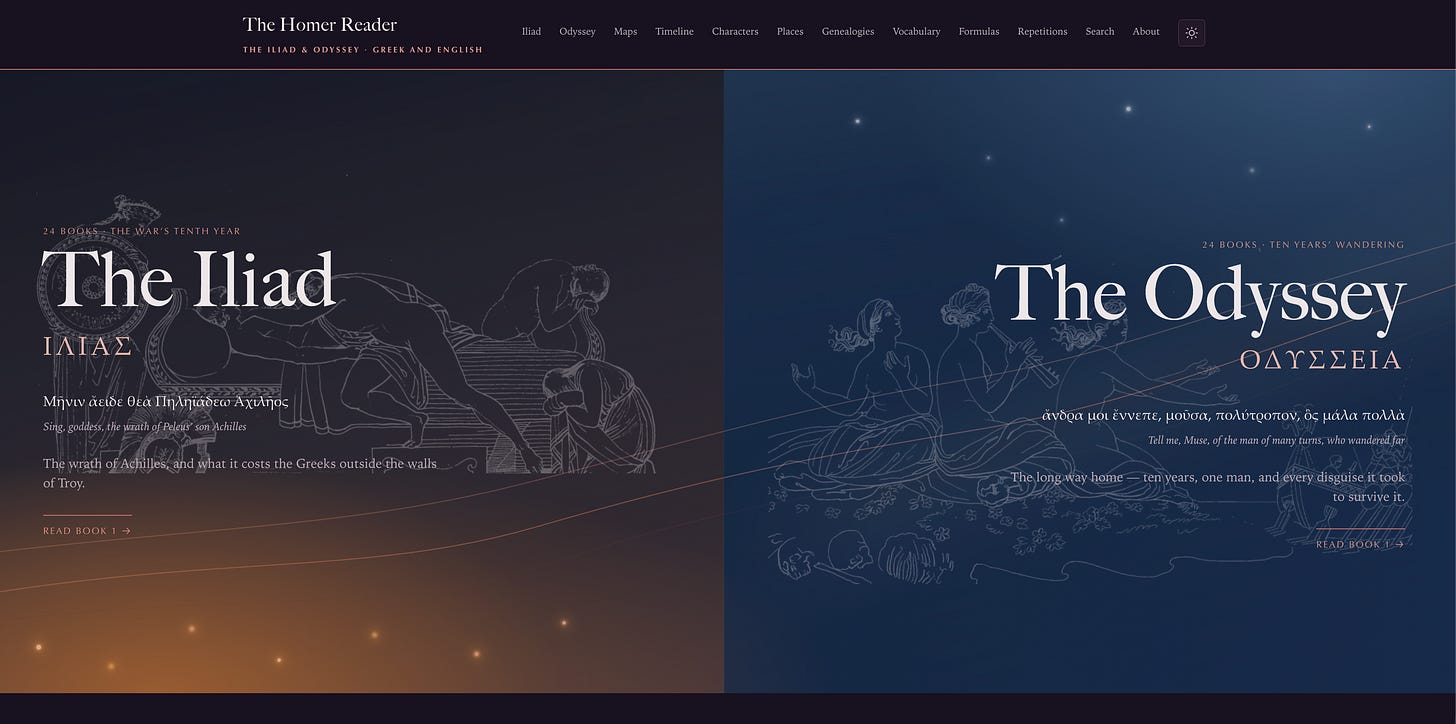
You might have heard about Christopher Nolan’s film The Odyssey and been aware of the critical response it has garnered. John Boyer created a side-by-side reading experience of the Iliad and the Odyssey featuring the original Greek text alongside multiple translations. In a world awash with AI summarizers and quick answers, creating a tool to help a reader slow down and experience reading an original source next to multiple translations is a welcome response to the much hyped efficiency offered by machine intelligence. There’s no embedded AI ‘companion’ to help a reader suss out meaning—just you and the texts on an interface made by AI.
I teach a number of Allied Health majors, and these students are awash in medical apps that present the human body through the filter of generative images, text, and video. So I created an educational anatomy comparison workshop to help my students practice critical judgment about AI-generated visual content. Students rotate an AI-generated organ mesh 1, compare it with two curated images/ illustrations of human anatomy taken from Wikimedia and Stanford’s Bassett collection, document uncertainty, and export their reasoning.
All three of these projects developed AI-coded apps built as a response to AI slop. I don’t believe using AI intentionally in this way to create more human experiences for students and readers is a contradiction. Instead, I view it as an emerging backlash with roots deeper in our cultural responses to technology. Years ago, Clay Shirky recognized that his computer science students often built software for themselves or small groups of people instead of millions of users. What Shirky dubbed as Situated Software was an example of personalized and often bespoke experiences built to address a specific audience or challenge. 2 AI coding is now making that possible for the general public.
This allows code to be used by those with professional expertise in domain specific fields in ways traditionally only open to those with backgrounds in programming. What makes this compelling is the work people are putting into it. None of these projects use single-shot prompts. Each uses a variety of AI tools and calls upon intentional design, editing, and thoughtful negotiation between existing databases and new AI capabilities. In a moment where AI slop is becoming the norm, we should strive to show colleagues and students what working intentionally with these tools can mean.
As I created my anatomy app, I realized that a much better approach would be to have students label the AI generated anatomy and learn by the process of doing and making, not simply comparing. If I had bought a learning package with this activity, I would have been wedded to it. With AI code, updating the app now only requires a few sessions with a $20 per month plan from OpenAI or Anthropic.
Using AI code, we no longer have to rely on a vendor to provide us with a digital product. We can now create those experiences, edit them, take ownership of them, and respond in real time. Edtech companies are using the same AI to code learning experiences and build interactive apps for our students. Why shouldn’t we consider the possibility that we may no longer need them to make software for us? We can wrest control of that space using our natural language and a commercially available AI tool. I guarantee, many companies are keenly aware of this.
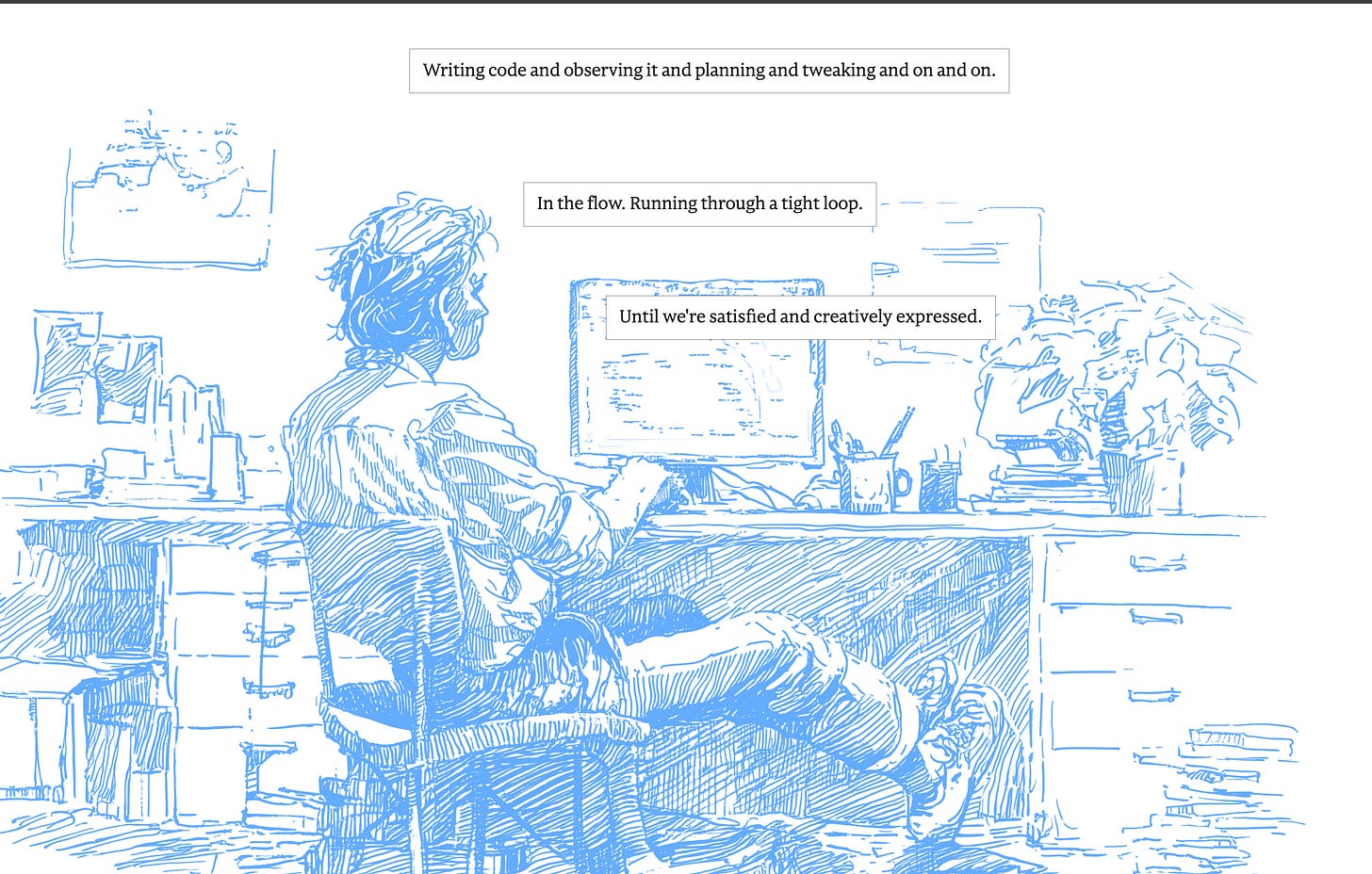
But coding heavily with AI can have its own unique costs, as Amelia Wattenberger argues in Code was our medium for thought. When we turn too heavily to automation, we can lose the experience of being grounded and present in a project. Tasking Codex or Claude Code to complete a project is increasingly voyeuristic—you watch a machine do the work and wait for it to finish. We should have interactions and engagements beyond a reasoning trace. Wattenberger argues that a human being needs to see the work and suggests a whiteboard-like experience to help make the process more present. In many ways, what she is arguing for is an interaction like Hypercard from decades ago. That’s something we should consider as more and more workflows are pushed to heavy automation.
It’s time to admit something sobering—ubiquitous AI transcends many of the existing relationships we have with knowledge, judgement, labor, truth, meaning, and relationships. Can we create the environment where generative AI stops being the default many students use for offloading work, and starts to become another tool in deeper, more deliberate work? This fall marks four years since ChatGPT was released and generative AI became a reality for students and faculty alike. A student entering campus as a true freshman will have had four years of access to some AI system. That’s four years of exposure to AI, four years of offloading thinking to it, four years of playing a cat and mouse game with their teachers, and possibly four years of figuring out how to learn with it. I’m not keen on repeating that cycle for another four years with them.
Those students will be entering college courses where each professor decides their own AI policy, and often the conditions students learn in. This means students will take four or five courses, some in-person, some online, some where faculty require them to put away devices and use pen and paper, some where faculty encourage them to use AI, and most worrisome of all, more than a few instances where faculty probably don’t feel comfortable communicating any guidance about AI in a course. I want to offer them more possibilities than this existing binary of yes/no AI use.
Institutional and course-level AI policies are something we should all consider, though there’s no evidence that these will adequately address AI’s impact in our courses or stave off the types of negative behaviors we hope students learn to avoid. Students often ignore course AI policies and take their chances being caught, and faculty likewise turn to a variety of AI detection methods to try and catch them, sometimes uploading student work to a slew of services their campus hasn’t contracted with. What happens to that student data isn’t clear. Too many students and faculty treat policy and guidelines as suggested speed limits on the Autobahn.
I know many faculty are reevaluating AI detection now that Pangram’s newest classifier is all the rage across Substack. Here’s something to consider and why I think ignoring AI coding is a very bad idea. One popular method to bypass AI detection is to purchase a $20 a month plan and buy access to Pangram’s API. For a few dollars a month, anyone can task their AI coding agent to rewrite text hundreds of times, testing it against Pangram’s classifier until it passes detection. The process takes moments and all the technical knowledge needed is buy this, tell AI to do that, wait until it finishes. That’s it.
We all have agency in practicing the discernment needed to take advice from a chatbot or ignore it. I also believe that I have responsibilities to my audience who reads this newsletter under the assumption and tacit understanding that 1). I’m human, and so are they 2). I owe it to them to disclose AI assistance for the sake of transparency and that human relationship. That’s not a difficult concept for me to live with and it is something I wish more faculty would model with students. Coding experiences using AI should be an opportunity to embody this principle.
Instead of policy statements, a more meaningful activity we could practice with students is asking them the following and placing ownership of AI usage onto them:
If you use AI, what does responsible usage look like to you?
What do you expect from your peers or teacher if they use AI in this class?
How do your values inform when you use or refuse to use AI?
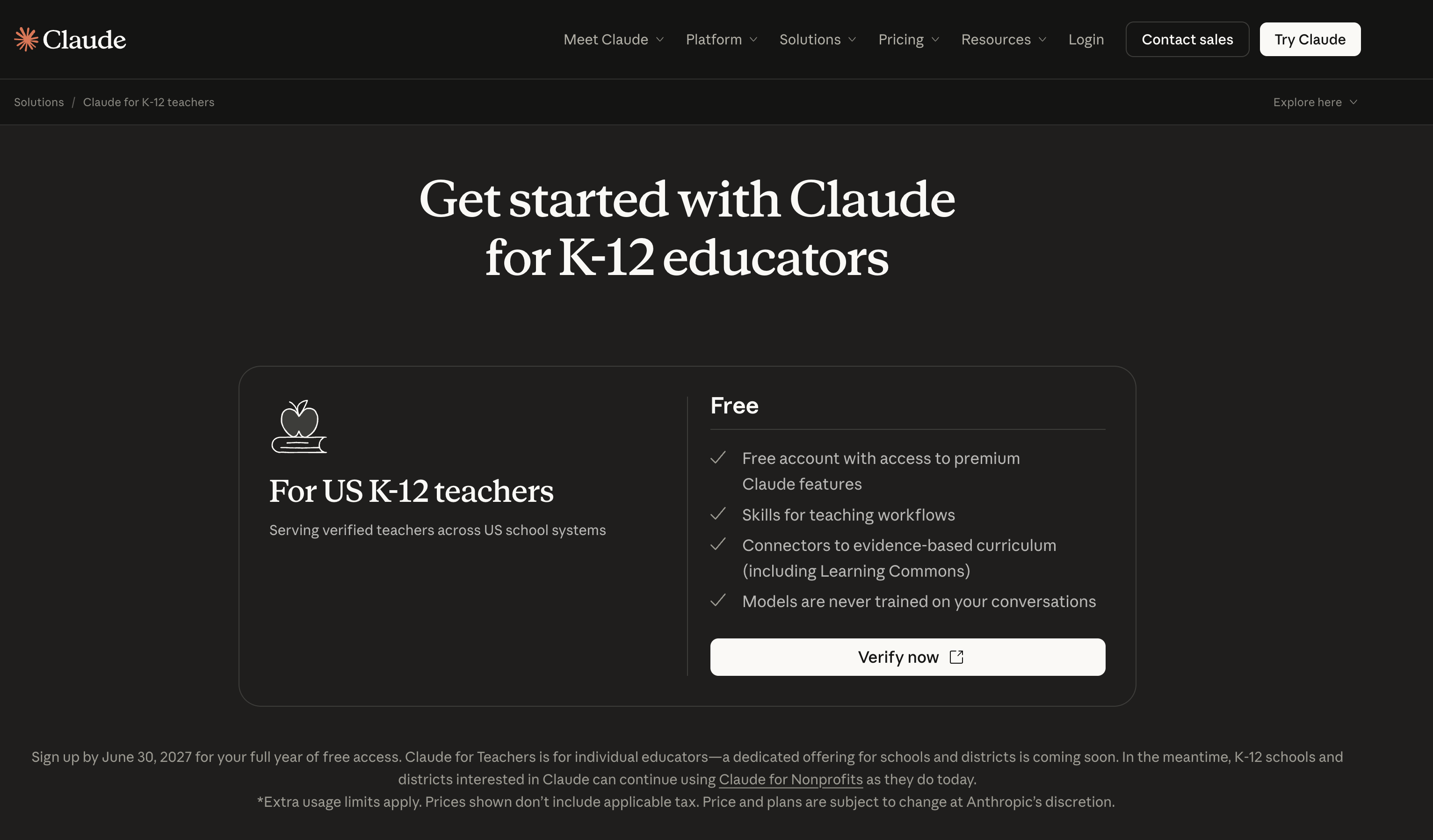
Using AI to code isn’t cheap, nor is it simple, but it is possible to learn quickly. A question we must ask beyond the ‘should I use/ not use AI’ is what does uneven access to powerful AI systems mean throughout education? A high school teacher working in the poorest district in the United States has greater access to premium AI tools, coupled with data protection, than a professor working at some of the wealthier universities. Anthropic recently announced it would be giving away access to Claude Pro to any K12 teacher for one year for free. Both OpenAI and Google had previously made such pledges. Even at the most prestigious research institutions, Higher Education faculty can usually only access one or two data protected AI suites of tools. And the capacity and access of low-tier educational AI plans often pale in comparison with pro plans.
What’s notable here is these offerings all mirror one year deals that each promise premium access to advanced AI features, integrated training, and custom frameworks for K12 teaching standards. In effect, it is one of the most aggressive and substantial pushes we’ve seen from AI developers to completely capture teachers and districts. It also is something higher education cannot afford to ignore.
There is a growing divide among how many K12 districts and college campuses are approaching AI, and teachers are increasingly caught in the middle. While some K12 districts have started mandating teachers use AI tools in their classrooms, no college campus has been so instructive or intrusive to telling its faculty to do so, leaving individual instructors to decide what response to AI in their class is appropriate.
Faculty across K16 need to understand to the fullest extent AI’s capabilities, and that’s not always clear by reading about them. It often comes through deliberate and sustained testing and judgement. I think we can and should develop some deeper, nuanced understanding that accessing and testing premium AI tools doesn’t necessarily mean we’re adopting them wholesale. I have no issue using the technology to create experiences that help my students explore their thinking and the world around them, but I am uninterested in custom chatbots that are advertised to help them learn more efficiently. My goal this fall is helping my students understand why it is important to ensure their engagement with AI is above all intentional. Some might call this nuanced resistance to AI. Others might dub it AI engagement. For myself, I call it practicing AI-awareness.
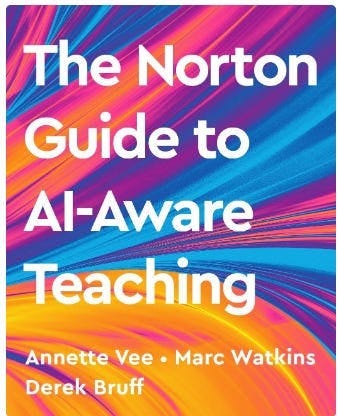
The Norton Guide to AI-Aware Teaching is now available to order as an ebook! Print copies are expected to start shipping on September 24th. Here’s how you can get a copy:
Our publisher Norton is pleased to offer the guide as a free ebook for all instructors currently using a Norton textbook. If that’s you, you’ll receive access from the Norton team when the ebook is available July 1st and can contact your local Norton representative with any questions.
If you would like to order the ebook, you can now do so through Amazon and Barnes & Noble and other retailers.
If you would like to pre-order the paperback version of the book, you can now do so through Norton, Amazon, Barnes & Noble, and likely other retailers. If you go through Norton, be sure to use the code AIFREESHIP at check out to get free shipping!
If you would like to order multiple copies for a campus reading group or some other faculty development effort, Norton has an option for you: On orders of 10 or more print copies, we offer 50% off the list price and free domestic shipping. (Such orders must be on a nonreturnable basis.) To take advantage of this offer, contact Peter Wentz at pwentz@wwnorton.com with subject line “Norton Guide to AI-Aware Teaching.”
Comments
Nothing yet. Say the first thing.
Sign in to join the conversation.