
Government and industry are already responding to the capacity problem.
The U.S. Department of Labor has awarded nearly $162 million through five cooperative agreements to expand Registered Apprenticeships in occupations tied to shipbuilding, defense, emerging technology and American reindustrialization.
Jobs for the Future received $40 million to build apprenticeship pipelines for the AI, semiconductor and nuclear-energy infrastructure sectors.
This week’s numbers are not telling us that staffing is dying.
They are telling us that the traditional staffing model is becoming incomplete.
60% of employers want to hire.
44% cannot fill existing roles.
Temporary staffing is accelerating.
AI-exposed jobs may be rebounding.
Major investment is flowing into the training pipelines required for new infrastructure and industries.
The opportunity is enormous.
But the winners will not simply be the firms with the largest candidate databases or the most recruiters making calls.
They will be the firms that can assemble the right capacity—human and digital—around the work that needs to be completed.
This week, we mapped 14 real staffing workflows into a clearer operating model—from candidate screening and sourcing to timecards, payroll, billing, collections, onboarding and client-system integration.
The common thread was not “use more AI.”
It was much more practical:
Define the work.
Break it into clear duties.
Assign each duty to a human or digital worker.
Put rules and approvals around the sensitive decisions.
Measure completed, checked work.
Increase capacity only after value is proven.
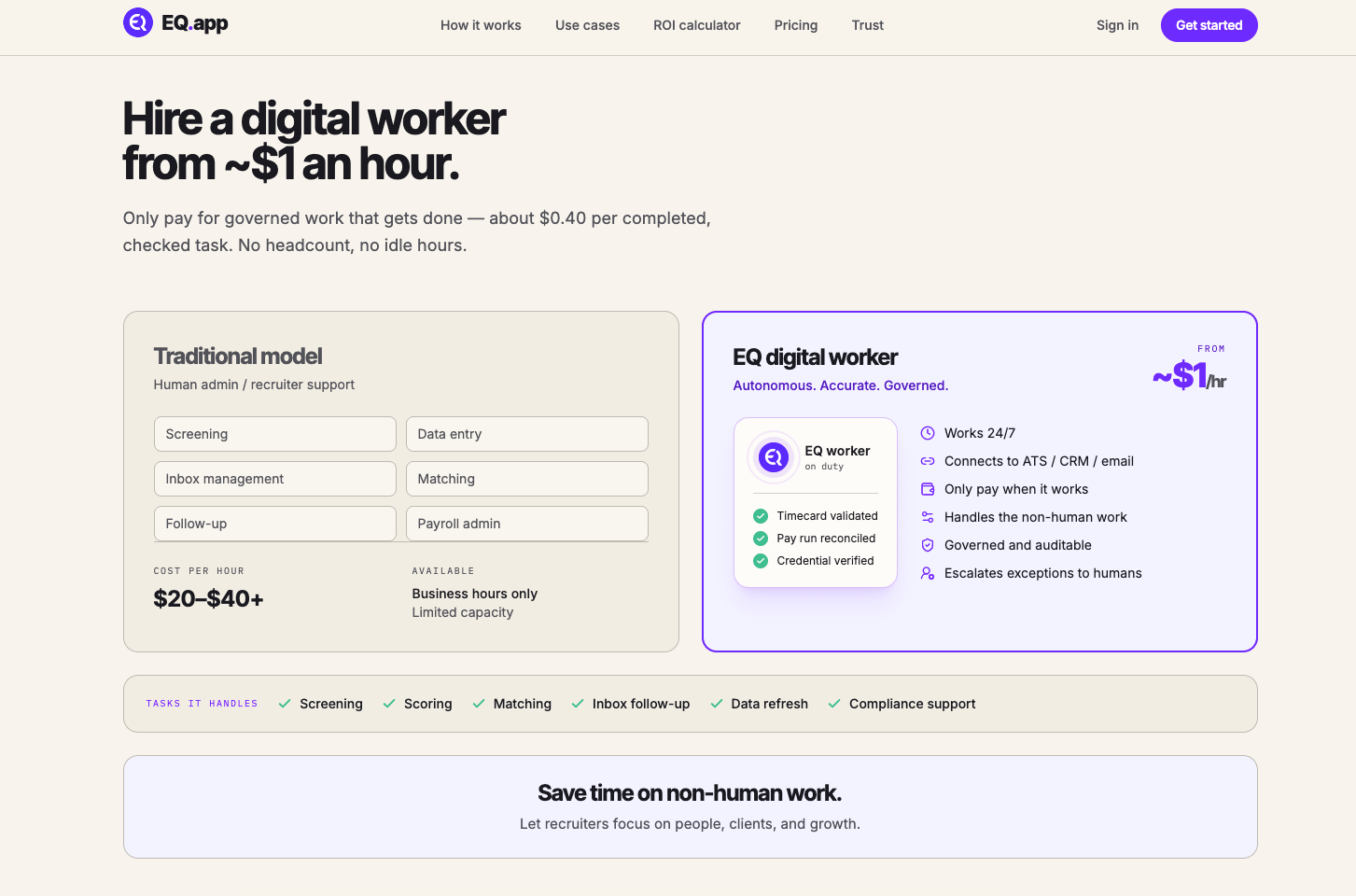
We also spent time clarifying why digital-worker pricing should not look like traditional software pricing.
You are not buying another seat or another tool for recruiters to manage.
Have a great one!
Comments
Nothing yet. Say the first thing.
Sign in to join the conversation.