
An interesting claim from the complex-systems physicist Barbara Drossel on the alleged ability of prayer to affect the weather.
The power of prayer to influence the weather is one of humanity’s oldest religious beliefs and can be found throughout all cultures and historical periods. For example, Jewish communities recited prayers such as Tefillat Geshem, while Christian churches organized rogation processions and public days of prayer during periods of drought or flood.
Of course, for contemporary science, this is little more than superstition. Weather phenomena can already be explained through physical atmospheric processes and predicted, at least over limited time intervals, with considerable accuracy. Why, then, appeal to any form of divine action?
Reading the paper, one realizes that the reference to weather is more of an example and an opportunity to discuss a more general subject: divine intervention. I appreciate the kinds of questions she poses, which engage with the same issues as my own area of philosophical inquiry, but I cannot agree with the conclusions she draws from her line of reasoning.
For those who do not want to read the entire article, I will address her argument by selecting several quotations from the paper.
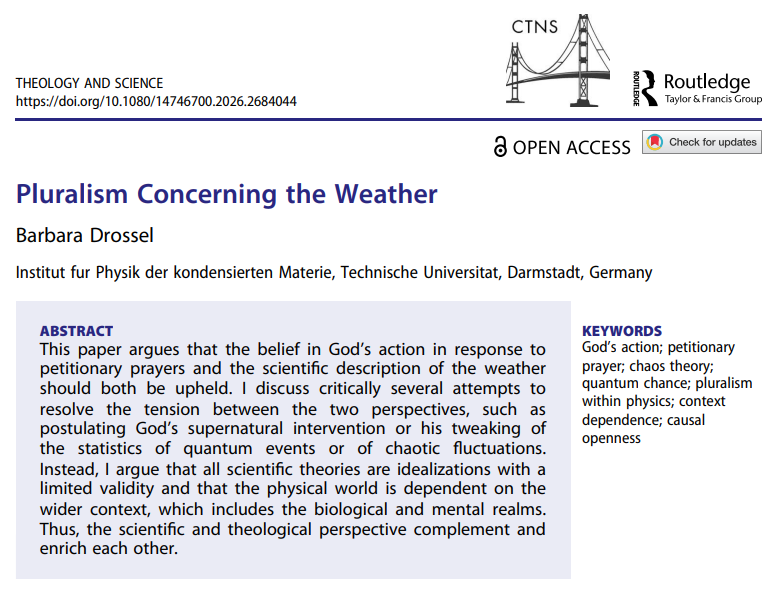
First, here are some introductory passages that set the stage and are self-explanatory.
“This will bring us to a more general discussion concerning the influence of randomness on the weather system, and we will ask if and how God’s influence is conceivable in the face of randomness. From all this follows a more radical and multidisciplinary perspective, which is that of causal openness of the world as described by physics. Scientific explanations capture in principle only parts of the weather as a natural phenomenon. They do not exclude theological explanations, but need to be complemented by them to obtain a more comprehensive view of the weather…”
“My impression is, however, that out of fear of not being taken seriously by scientists many theologians nowadays accept sweeping conclusions that scientists derive from their scientific discoveries (even though these conclusions usually are not science but metaphysics).”
“Again and again I encounter the view that when God answers prayers, he changes the course of nature from what it would have been without divine action in response to these prayers. God’s action in response to petitionary prayers is considered as an additional cause, on top of the natural causes that are part of the physical description of nature.”
Now, on this one…
“Several philosophers, such as Larmer, and von Wachter, propose that God’s action does not violate the laws of nature, even though they consider these laws as (possibly) deterministic and exact. They argue that the time evolution according to the laws of physics applies only after the initial conditions of the considered situation are given, and these initial conditions may also be set by acts of God. However, this implies that there are changes in nature that cannot be described by time evolution according to the laws of physics. So, either these changes deviate from the time evolution predicted on the basis of physics alone, in which case they are rightly labeled as miraculous interventions and vulnerable to the above criticism; or, the laws of physics are not sufficient to predict the course of nature, even in the absence of acts of God, as outlined above. “
The idea I find misplaced is that we introduce a wedge between Nature and God. The so-called “laws of physics” are presented as something other than God, who is then implicitly conceived as a distant figure observing the universe from afar and occasionally intervening when we fail to behave properly. He is imagined as being “up there,” while we are “down here,” as if the two domains could exist independently. It does not occur to us that the laws of nature might themselves be an expression of, and an aspect of, God. Is it conceivable that the laws of physics could ultimately be understood as consistent with, or even expressive of, the will of God?

And, as we will see, there is no need for these laws to deviate from a deterministic time evolution in order to open the door to some heavenly Father intervening in earthly affairs.
“So, if God influenced the weather by very many sufficiently small kicks, this could not be discovered empirically, and the prediction by meteorologists and God's will can be realized at the same time.”
[…]
“But why should God first fix a deterministic dynamics if he later needs to meddle with it? And why should he wish to hide this meddling by not leaving any traces of it?”
Perhaps because He is not only not hiding it but displaying it right in front of us? Sometimes things are so overwhelmingly self-evident that we fail to perceive them precisely because they are in plain sight.
Now, one could argue that God influences the weather by affecting the wave function collapses such that the random molecular motion pushes the larger-scale chaotic dynamics of the atmosphere in the right direction to yield the desired outcomes. Against this view one can bring forward similar arguments as in the previous subsection: random thermal motion of molecules follows statistical laws, and God would need to abide by these statistics when manipulating the wave function collapses if his interference shall not be detectable. For similar reasons as outlined above, I cannot share such a view.
At this point, I believe her argument breaks down. She appears to accept uncritically the standard objection to an immaterial (human or divine) mind—namely, that any such interaction with the physical world would manifest as violations of physical law and/or energy conservation, laws which, particularly in quantum physics, are expressed in statistical terms.
This, however, rests on a misunderstanding of the nature of probabilistic laws. Consider the following sequence or time series: 10101010011001010011. These are 20 digits made of 10 ones and ten zeros. Since they have both 50% probability to appear, we can consider it a “random” sequence. One can permute the same sequence and obtain, say 10111110001010100010. This is a different time series, but still with 50% ones and 50% zeros. A physical law that requires both outcomes to occur with equal probability is not violated. Yet an “agent” can permute a random sequence without changing such probability law, that is, could interact with the world without changing the laws of quantum physics or any law dependent on statistical description with probability functions.
This is one of the more difficult points to recognize, and perhaps to accept, particularly for physicists trained to interpret statistical formulations of physical laws as the most fundamental description of a mechanistic and purposeless dynamics. But once this possibility is admitted, one can appreciate the elegance and explanatory power of the kind of divine intervention it suggests.
When popular science texts speak about chance, they therefore often attach to it a metaphysical meaning, such as “purposeless” and “blind.” But physics by itself can say nothing about purpose or meaning. It can only say that chance event cannot be predicted with certainty based on the present state in combination with the laws of physics.
That’s right. It is a common fallacy to conflate the statistical behavior of a system, we loosely describe as “random,” with a lack of aim, purpose, or agency. An instructive example is an encrypted image: it presents itself as white noise, while nevertheless encoding a message.
“Of course, neither an experimenter nor a man-made measurement device is necessary for such top-down effects from a macroscopic environment on quantum systems. Measurements, where persons set up measuring devices, are only a small subset of events where quantum objects interact with a wider environment, leading to stochastic outcomes.”
[…]
All the discussions about “interpretations of quantum mechanics” or about the “quantum information paradox” are due to the belief that somehow the many-particle Schrödinger equation applies to macroscopic systems that are composed of many atoms, such as the measurement apparatus or, more generally, the environment itself. But if the Schrödinger equation is applied to the whole system consisting of the particle to be measured and the measurement apparatus, the outcome of a measurement is not one of the possible measurement results but all of them at the same time. Those who consider this description as valid have to take recourse to one of those interpretations of quantum mechanics that my mind cannot accept, such as the many-worlds interpretation.”
[…]
“This is absurd in my view and demonstrates that some scientists believe in their theories so strongly that they are willing to accept any conclusion, no matter how irrational it is.”
I agree. The MWI often comes across as a desperate attempt to save appearances, reminiscent of the Ptolemaic system’s proliferation of epicycles and deferents in defense of a geocentric worldview.
“The context dependence of quantum chance illustrates that the behavior of a physical system depends also on its wider environment. This context dependence is not just a feature of quantum events, but it is a pervasive feature of nature. My research as well as my teaching have shown me that processes on meso- and macroscopic scales are not fully determined by microscopic laws, but that there are different laws and different scientific descriptions for different classes of systems.”
[…]
“This effect of the context on a system is also called top-down causation. In a reductionist description, the considerations are limited to the bottom-up effects from the constituents of a system and their governing laws on the properties and behavior of a system. But the opposite influence from the wider context is equally important, and only when taken together, these two points of view yield a more complete picture; this illustrates once more that we need the pluralistic approach advocated by Paul Feyerabend.”
Top-down causation has become fashionable among contemporary philosophers of science because it articulates something fairly obvious while also providing space for what appear to be pseudo-metaphysical claims, which, upon closer examination, nevertheless remain within a broadly physicalist framework. The idea that higher-level structures influence lower-level physical processes is not entirely new. While it has recently been formalized within the physical sciences, similar motifs can be found in a range of other cultural and philosophical contexts, including many Indigenous traditions, where nature and its constituents are not conceived as passive, independent, or isolated mechanistic systems, but rather as a relational field of agents: humans, animals, land, rivers, seas, mountains, the atmosphere, the cosmos, and so on. Causality is typically framed in relational rather than strictly hierarchical terms from “higher” to “lower” levels, though the overall philosophical orientation is not new.
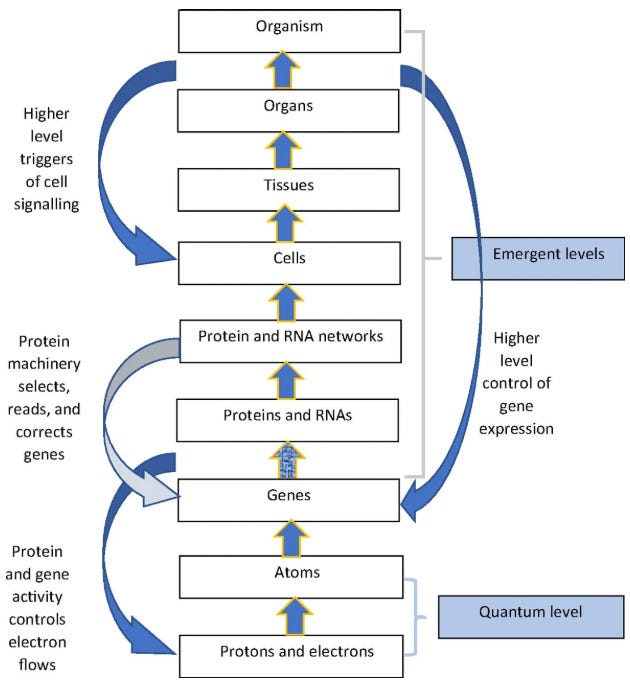
“This context is even not fully known to us. And it is not purely physical. I have mentioned biological influences on the physical landscape that affect the weather, such as beavers building dams; and I have listed a variety of human influences on the weather. These influences are the result of human decisions, wich are non-material, mental processes. Weather is an inseparable part of a larger world that transcends the physical and includes the biological and mental. From this larger world the weather is influenced in many ways. So, the weather is a natural phenomenon that is conducive to scientific pluralism because it necessitates a genuine explanatory pluralism.”
Here I think comes the weakest part of the paper. The argument appears to take a step too far. Drossel simply asserts a metaphysical claim without beginning to provide an argument for it. She posits from the outset that “human decisions are non-material, mental processes,” without offering any account of how this conclusion is reached beyond asking the reader to accept it. A physicalist who does not share this assumption will likely stop reading at this point.
A causal openness to influences from the wider context does not imply any sort of “God’s influence on the material world.” In fact, several scientists who work on the top-down causation philosophical project are naturalists.
“Of course, there remain open questions and new apparent contradictions: How can, even in principle, the nonmaterial realm influence the material realm such that material changes are effected?”
For those interested in seeing why this argument rests on similar fallacies, see here.
“To summarize: The considerations of this paper support the view that the weather systems is not closed, but embedded in a wider context, which includes the biosphere and human civilization.“
Physicists who study atmospheric physics do not deny this and are well aware of it, as they must deal daily with the uncertainties introduced by such broader contextual embedding. However, this is by no means an argument against physical closure, let alone in favor of divine intervention.
“This larger world, in turn, is sustained by God, and he acts in everything that happens and pursues his goals.”
Yes, we may know this to be true, but we cannot assume that others will start from this premise uncritically without providing a coherent argumentative framework.
I had also considered submitting a paper to Routledge’s journal Theology and Science on similar topics, but it is off-limits to independent scholars who are unable to meet the approximately $3,300 article processing charge. Nonetheless, I addressed these in my book “Meaning and Purpose in a Conscious Universe.”
Anyway, however it may be, and despite my critique, I’m one of those who find these attempts to bring nearer physical sciences to metaphysical speculations about divine causation fascinating, not old superstitions. The value of the article is more social than philosophical or scientific. A pluralistic approach in theology can prevent dogmatism and open minds. No matter how naive and stumbling our attempts may be, they can help the human mind to detach from a strictly third-person analytical approach to a more intuitive standpoint that does not deny rationality but luminously complements it.
The subscription to “Letters for a post-material future” is free. However, if you find value in my posts and would like to support my work, you can make a small contribution by buying me one or more coffees, or supporting me through one of my books. Thank you in advance.
Comments
Nothing yet. Say the first thing.
Sign in to join the conversation.