
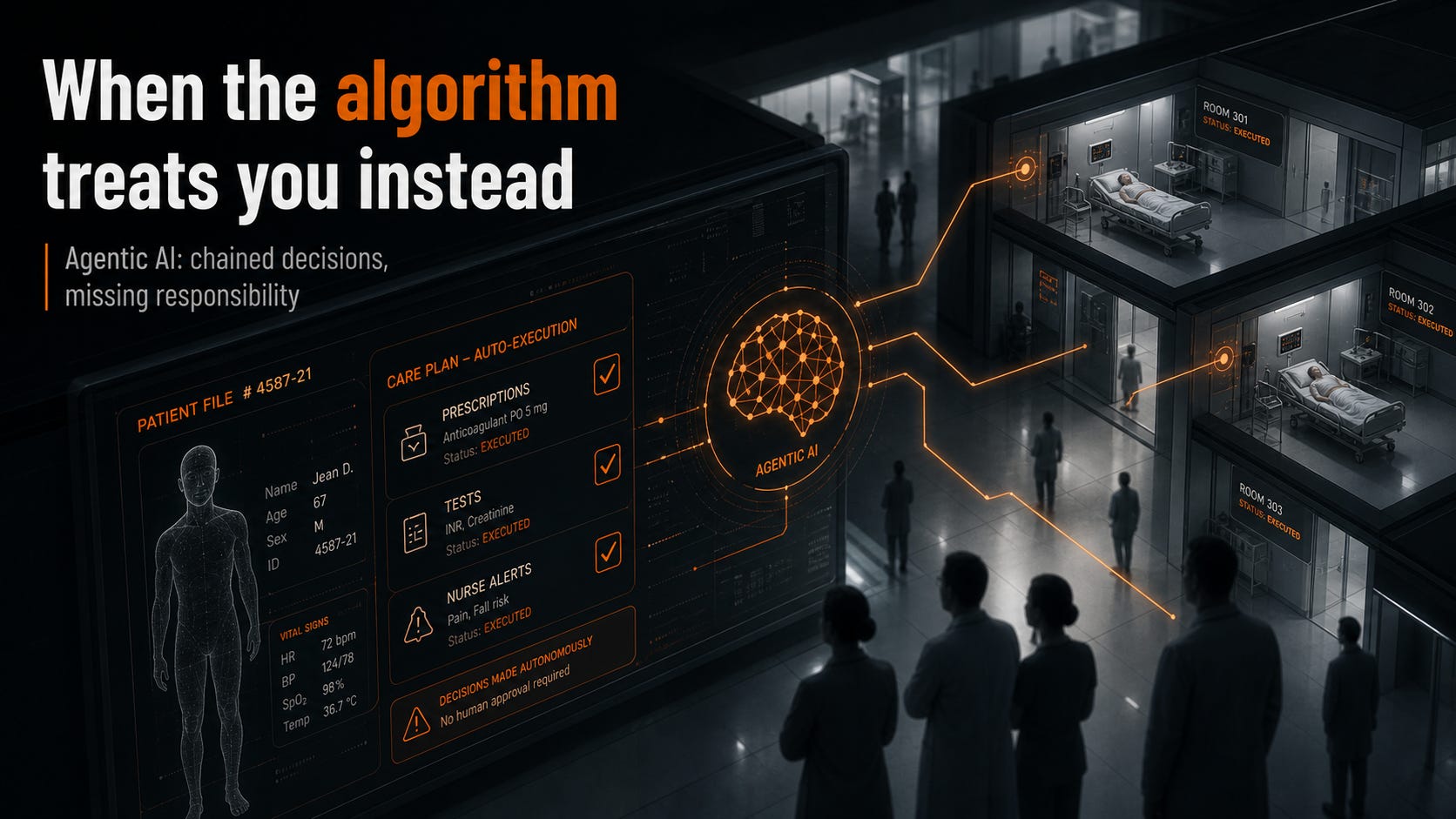
An AI system in a major American hospital network is now managing entire clinical workflows. Not assisting doctors. Replacing steps that used to require a doctor’s judgment. No confirmation required at each decision point. The system sets its own sub-goals, executes them, moves on.
This is what “agentic AI” means. And it’s not coming. It’s here.
I’ve been thinking a lot about what this actually changes, not technically, but ethically.
And I keep arriving at the same uncomfortable place: we’ve built systems capable of consequential decisions, without building the accountability structures to match.
Let me give you three images that won’t leave me alone.
A hospital AI makes a clinical error. A patient is harmed. The doctor didn’t make the call, the system did. The hospital deployed it. The company built it. The regulator approved the category. Who answers?
A military drone, operating within parameters set six months ago by a human commander, identifies and strikes a target. Wrong target. Who is responsible for that death?
An algorithm denies your mortgage application. No explanation you can meaningfully contest. Correlated patterns in data you’ll never see. You lose the house. Who do you call?
Three domains. Three catastrophic outcomes. One architecture. And in each case: a void where accountability should be.
What makes this moment different from previous waves of automation is the autonomy of the decision-making. Earlier software executed instructions. Agentic AI pursues objectives. It plans. It adapts. It acts across multiple steps without a human in the loop at each one.
Gartner projects that 40% of enterprise applications will use autonomous AI agents by the end of 2026. Less than 5% do today. That curve is nearly vertical.
And the infrastructure behind all of this sits in the hands of six companies: OpenAI, Microsoft, Google, Meta, Amazon, Anthropic. Not scrappy underdogs. Giants with enormous economic stakes and the lobbying power to shape the regulations meant to govern them.
Meanwhile, Stanford’s Digital Economy Lab has documented a 16% drop in employment among 22-25 year olds in AI-exposed sectors since 2022. Not a forecast. A measurement.
I’m not writing this to tell you to be afraid. I’m writing it because I think the conversation we’re having about AI is still mostly about capability (what it can do) and not nearly enough about governance, who decides how it’s used, and who answers when it goes wrong.
The question isn’t whether agentic AI will change your industry. It will. The question is whether anyone in your organization, or your government, or your legal system, will be able to say, clearly: “this decision belongs to me, and I take responsibility for it.”
That capacity for accountable judgment may be the most important thing we have to protect right now.
I’d genuinely like to know: in your field, who would answer if an AI agent made a serious mistake today?
Comments
Nothing yet. Say the first thing.
Sign in to join the conversation.