
On March 25, 2025, NATO adopted Palantir’s Maven Smart System at its headquarters in Mons, Belgium.
This software—originally designed to process surveillance video feeds—is now embedded in the Alliance’s intelligence infrastructure.
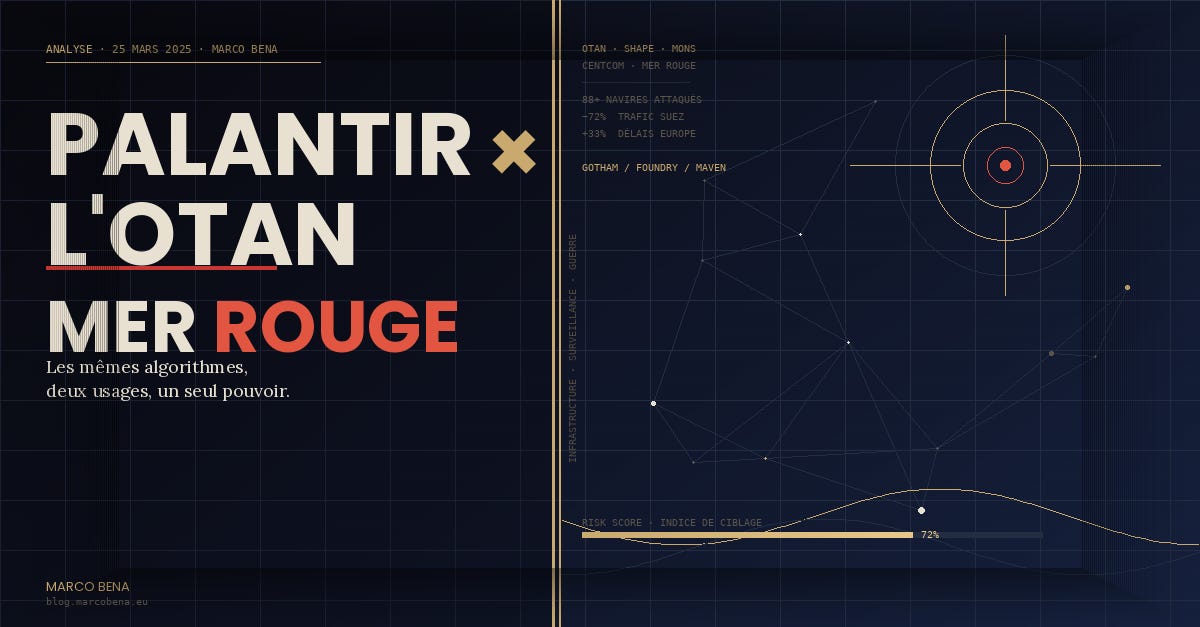
It’s being deployed across CENTCOM operations in the Red Sea, where Houthi attacks have crippled global shipping routes.
Here’s what most people miss: this is the same technology stack that ICE uses to track and deport migrants.
Palantir, founded by Peter Thiel in 2003, built three core platforms: Gotham (law enforcement), Foundry (enterprise), and Maven (military AI).
They share the same DNA: ingest massive datasets, cross-reference sources, output actionable scores. Whether you’re an undocumented worker in Arizona or a suspected combatant in Yemen, you’re just a data point waiting to be classified.
The Red Sea crisis has accelerated this convergence. Since late 2023, over 88 commercial vessels have been attacked by Houthi forces.
Suez Canal traffic dropped 72%. Shipping delays to Europe spiked by 33%. Maven Smart System now analyzes drone footage, satellite imagery, and radar feeds to identify launch sites, track small boats, recommend interceptions.
Here’s the uncomfortable part: Italy has a moratorium on facial recognition to protect civil liberties. Yet as a NATO member, Rome indirectly benefits from Maven-powered intelligence in the Mediterranean and the Red Sea.
The data flows. The algorithms compute. The lines blur.
Who audits these systems? Who defines what makes someone a “target”? Who ensures that an AI trained on migration patterns doesn’t carry those biases into conflict zones?
Right now, no one is asking these questions publicly.
We’ve entered an era where the infrastructure of border control and the machinery of war are becoming indistinguishable.
The same engineers optimize both. The same companies profit from both. The same logic—predict, classify, neutralize—applies to both.
This isn’t a call to reject technology. It’s a call to recognize what we’re building: a world where life-and-death decisions are mediated by proprietary software, where accountability is outsourced to corporate contracts, where the distance between surveillance and violence shrinks to a few lines of code.
The Red Sea isen’t just a strategic chokepoint. It’s a preview of a futur where war happens through dashboards, where targeting is automated, where the distinction between “migrant” and “militant” collapses into a probability score.
And if we don’t pause to interrogate these systems now, we’ll wake up in a world where we’ve delegated our humanity to an algorithm.**
Worth thinking about.
Comments
Nothing yet. Say the first thing.
Sign in to join the conversation.