
“Mostly Books” is a reader-supported publication. Please consider upgrading to a paid subscription or dropping a donation in my tip jar at BuyMeaCoffee.com. Your support is greatly appreciated!
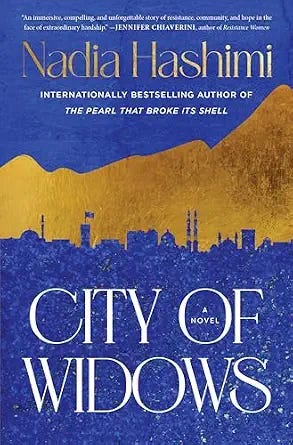
The year is 2021. The U.S. military has just abandoned Afghanistan to the repressive Taliban regime, which gives men total control over women. Marjan and her 11-year-old daughter, Hawa, are trapped in Kabul. Nadia Hashimi’s new novel, City of Widows, captures their fears and Marjan’s determination to find a way out of the city to a place of safety.
“It was a dangerous myth,” Marjan thinks, “this idea that just being Afghan gave a woman some survival superpower, the ability to withstand such brutal oppression. It gave the world permission to turn its back. Afghan women were resilient because people saw only the ones who survived. No one paid attention to the ones who didn’t.”
Having fled an abusive underage marriage to a Afghan warlord, Marjan takes refuge in a series of unsafe homes before finding her feet as a soldier. Hawa lives in an orphanage while Marjan’s unable to care for her and then enters a music academy. Mother and daughter are close, though they both keep painful secrets from the other. Hawa learns from not only Marjan’s courage, but also her caution and her mistakes.
With armed Taliban fighters searching the city for anyone who collaborated with the Americans, Marjan, a member of the Female Tactical Platoon of the Afghan National Security Forces, is desperate to leave the country. She’s equally worried for Hawa, who’s growing up in a world that for women requires constant vigilance.
“Marjan looks at Hawa, uncomplaining even as her breathing has grown heavier on the uphill. She has made a small soldier of her daughter now. A small, beautiful, unwitting soldier.”
Marjan’s colorful friend, Soraya, and Soraya’s beloved aunt, Mina, a respected broadcast journalist, are also in danger. Soraya from her cousin; Mina from the Taliban government.
“Mina has been free to talk about whatever she pleases....but there will be no free speech in a country of mandatory beards. Schools closed for girls. Public executions. Whips lashing at exposed ankles or painted fingernails. It is already hell to be a woman in this country.”
The novel’s structure is sometimes jarring as the narrative unfolds with two timelines, one in August 2021, the other from 2011 to 2017. The 2021 timeframe has greater urgency and a quicker pace. Marjan’s repeated attempts to reach the chaotic Kabul airport, where she must somehow follow the confusing instructions she receives from her American friends, are especially harrowing.
City of Widows shines with authenticity and emotional complexity. A satisfying conclusion avoids a false happily-ever-after ending and insists that the trauma these women experience can never be forgotten.#
Marcie Geffner is a journalist, writer, and book critic in Ventura, California.
City of Widows | Nadia Hashimi | William Morrow | July 28, 2026 | 432 pages
Comments
Nothing yet. Say the first thing.
Sign in to join the conversation.