
The letter was waiting on everyone's desk one morning. Ernst & Young was the appointed receiver, called in to essentially manage a ‘fire sale’. There would be redundancies.
Men in black and dark navy suits wandered around the office with notebooks (the paper ones), questions and unsympathetic glances, probably coming to the conclusion that they were doing a good deed, putting the business out of its misery.
“What did you ACTUALLY do here?” asked one smug-looking accountant, poking his nose into a cardboard box and pulling out a handful of 5 1/4 inch floppy disks. (Don’t you start.)
As it turned out, the receivers managed to sell some of the titles to Maxwell Specialist Magazines (yes, that Maxwell), so a skeleton crew of editorial staff (me included) headed to a new office on Goswell Road, near The Barbican tube station.
It wasn’t easy watching friends being made redundant, especially as they all knew so much more than me about everything. I found myself working as a reporter on Popular Computing Weekly, or PCW as it was also known, a title that had been around since the early 80s. ('Promotion’ to PCW reporter came with no extra money. Just a ‘be grateful you’ve still got a job’ look from the portly tweed publishing director.)
It was a shift in subject matter and style. I no longer had to spend my time wondering “WTF is UNIX?” - PCW (which had an excellent editor at the time, by the way) was consumer-focused and didn’t do UNIX or DOS. It did games consoles, games reviews, and something called hacking (see top lead story below by one of Goswell Road’s finest).
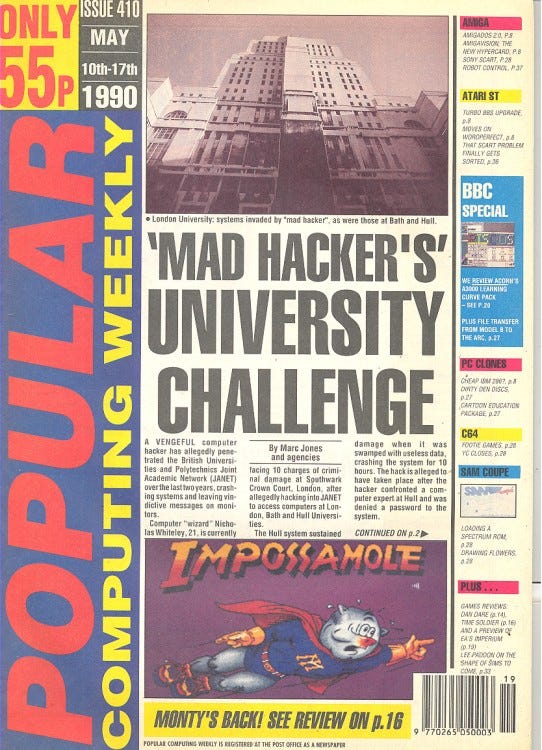
Machines such as the Amiga, a range of consoles first introduced by Commodore in the mid-80s, the Atari ST and the Acorn Archimedes were big news but so was the emergence of a new range of PC clones. Brand names like Tulip, Tiny, Elonex and Mitac were part of a wave of businesses pushing cheaper versions of the IBM PC.
“You don’t get fired for buying IBM,” said someone once, probably from IBM. Really?
Of course, with no internet yet, how could buyers compare PCs?
Tech mags of course, all (actually, not all) run by reputable, knowledgeable tech journalists. Trusted curators of content.
For non-tech nerds like me, we had to carve other niches - like how these things were being used and what impact they were having on people, businesses and the environment. Yes, green stuff. I could write about that.
The environmental impact of the industry was starting to become an issue, with questions increasingly asked about electronic waste and emissions from manufacturing.
This was 1990. Nelson Mandela was free and the USSR had collapsed. And nearly everyone had heard of the ozone layer by then. Those hairsprayed back combs and sickly smelling aerosoled armpits were part of the problem, sending CFCs (bad chemicals) into the atmosphere. That was the narrative at the time. So, as the population moved towards roll-ons and hair gel, the computer industry tended to hide. Who knew that making tech would be bad for the planet?
Intel announced it was banning CFCs a year later and the industry had a short-lived marketing flirtation with ‘going green’. It would be a few years before printer and PC makers would take this really seriously (and even then, did they?).
As I sat in my new office on Goswell Road, home of the Panini stickers people (honestly, there was near Anchorman level tension), it was slowly dawning on me that this was not going to work (especially as I had been denied a pay rise). While writing another prize-winning front page story headlined, PC made of fish and chips, I decided enough was enough.
A few days later I handed in a letter of resignation to the 19th century, red-cheeked, shirt-popping, mill-owner/publisher. I returned to my desk and gathered what little things I had and walked straight out of the door to meet a friend for lunch in Soho. It was all over.
But what I didn’t realise then, was that it was in fact just the end of the beginning - and I’d spend the next four years at Dutch publisher VNU in Broadwick Street. Just like the IT industry in the early 90s, I was about to go corporate.
Next time: Cup of tea? And other code words for going to the boozer
No posts
Comments
Nothing yet. Say the first thing.
Sign in to join the conversation.