
According to the headlines, the American economy is doing fine. Not great, not terrible, but fine. GDP grew 2.0% in Q1 2026. Employment seems stable-ish. Inflation, while still above the Fed’s 2% target, looks like its moderating. The CBO projects continued economic expansion through the end of the year. Consumer spending is holding up, particularly at the upper end. The stock market is near all-time highs. Corporate earnings are strong, especially in tech.
Yet despite this news, most Americans are worried. Consumer confidence is far from ebullient. And the US economy is shed more jobs than it created in July. I’ve spent a career looking past headlines and connecting seemingly irrelevant and disparate dots. And the mosaic I’m putting together is forming a deeply concerning image.
AI Infrastructure: Boom or Bust?
·
Mar 29

In the late 1990s, Lucent Technologies was America’s most widely held stock — a “picks and shovels” play on the internet revolution. The company lent billions to its own customers so they could buy more Lucent equipment. On paper, revenue soared. In reality, Lucent was financing its own demand. When the customers went bust, Lucent nearly followed. The p…
The American economy is being disproportionately carried by one thing: the AI buildout. Five companies (known by those in the business as the “hyperscalers”) plan to spend a combined $700 to $725 billion on AI infrastructure this year alone. That’s more than the annual GDP of most countries, deployed in a single year, by Microsoft, Google, Amazon, Meta, and Nvidia. Global AI spending will likely exceed $500 billion in 2026, according to UBS.
That money is showing up directly in the GDP numbers. In Q1 2026, AI-related capital invesments contributed as much to GDP growth as all of household consumption combined. Think about that…consumption is two-thirds of GDP, and data center and AI construction matched it as a growth driver.
In 2025, Harvard economist Jason Furman analyzed how the economy might look without the AI spending. His findings are chilling. According to the analysis, AI-related investment in software and equipment accounted for 92% of GDP growth during the first half of 2025. Without it, annualized growth was 0.1%. Practically zero. But let’s remember, that was last year. Since then, AI investment has gone vertical.
Two weeks ago, Columbia Business School economist Stijn Van Nieuwerburgh said it plainly: “We’d basically be in a recession right now without data centers.” BCA Research’s Peter Berezin told the Wall Street Journal the same thing: “It’s certainly plausible that the economy would already be in a recession” without the AI boom.
So how does the non-AI portion of the economy look? Sadly, not very healthy. The sectors that employ most Americans are slowing or shrinking. The economy that most people experience is not the economy the headline GDP numbers describe. Sure, if you’re an AI tech executive, you’re probably loving life. But if you’re like most Americans, life is a challenge. I see this every day in the demand for frozen pizza (which seems to be rising steadily), especially when compared to what’s happening at restaurants.
As regular readers know, my primary thesis in forming Goodwell Foods eighteen months ago was that economic weakness would lead people to eat at home more regularly, with frozen pizza as a big beneficiary. As such, I closely monitor developments in the restaurant industry. It shouldn’t surprise anyone that I immediately read the “Consumer Outlook” report that was published by the National Restaurant Association last week. And what I read was not encouraging regarding consumer health. I’ve pasted three charts from the report that think tell the story of the non-AI economy.
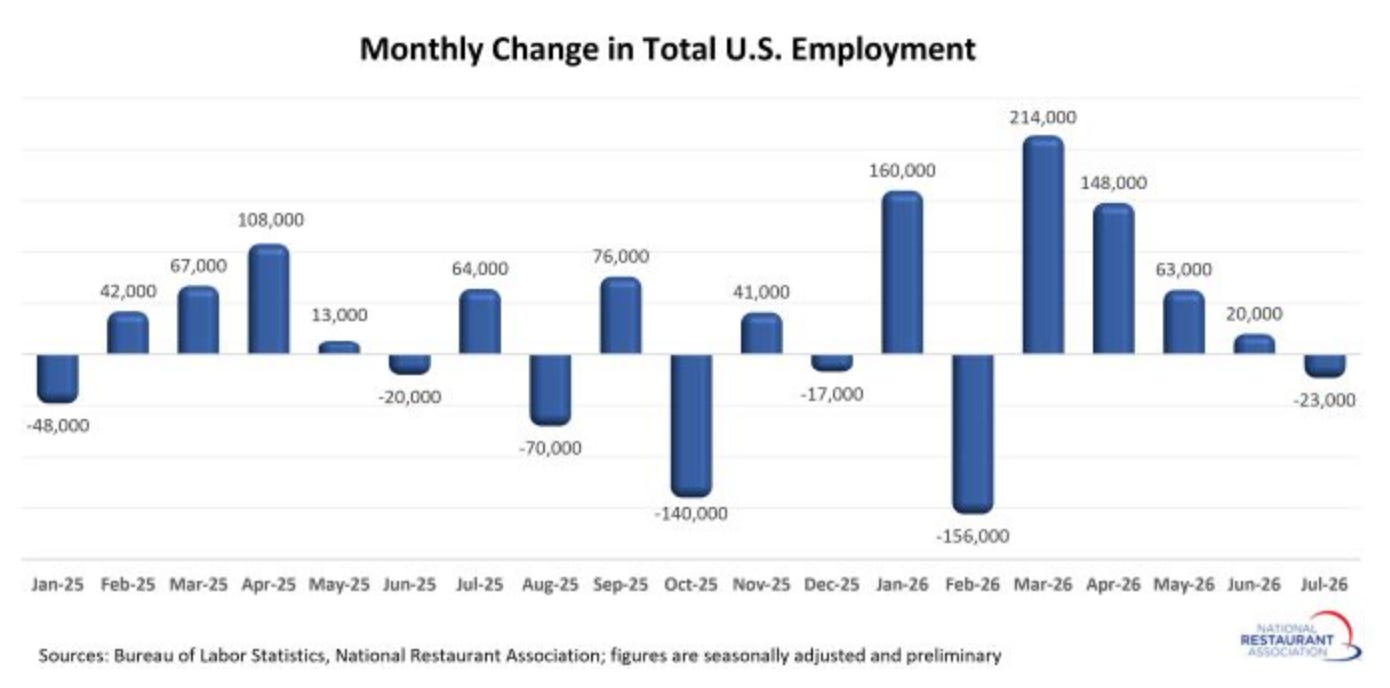
First, US employment trends point to a labor market that is struggling to create meaningful job growth. Remember, this is aggregate data for “Total US Employment” and contains the job growth from the AI buildout. If we excluded construction, energy, and tech jobs related to the AI infrastructure boom, this chart would likely look worse.
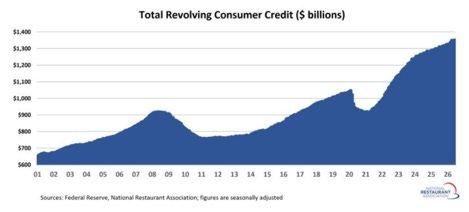
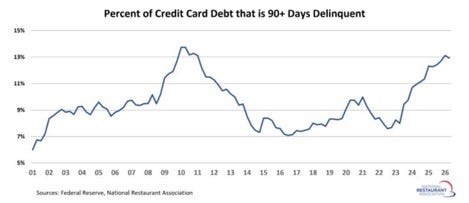
The next two charts show a US consumer that’s feeling stretched. US credit card balances are skyrocketing and are currently well over $1.25 trillion, with delinquency rates also rising rapidly. These are not the signs of healthy consumer likely who is likely to keep spending. They also imply most Americans are living “hand to mouth” and don’t have ready access to funds in the cope with medical or other emergencies.
So what does this all mean? To me, it points to an economic fragility that’s downright scary. At the very highest level, I believe we have a struggling American consumer and five companies spending three-quarters of a trillion dollars a year on a technology bet that hasn’t fully proven its commercial case.
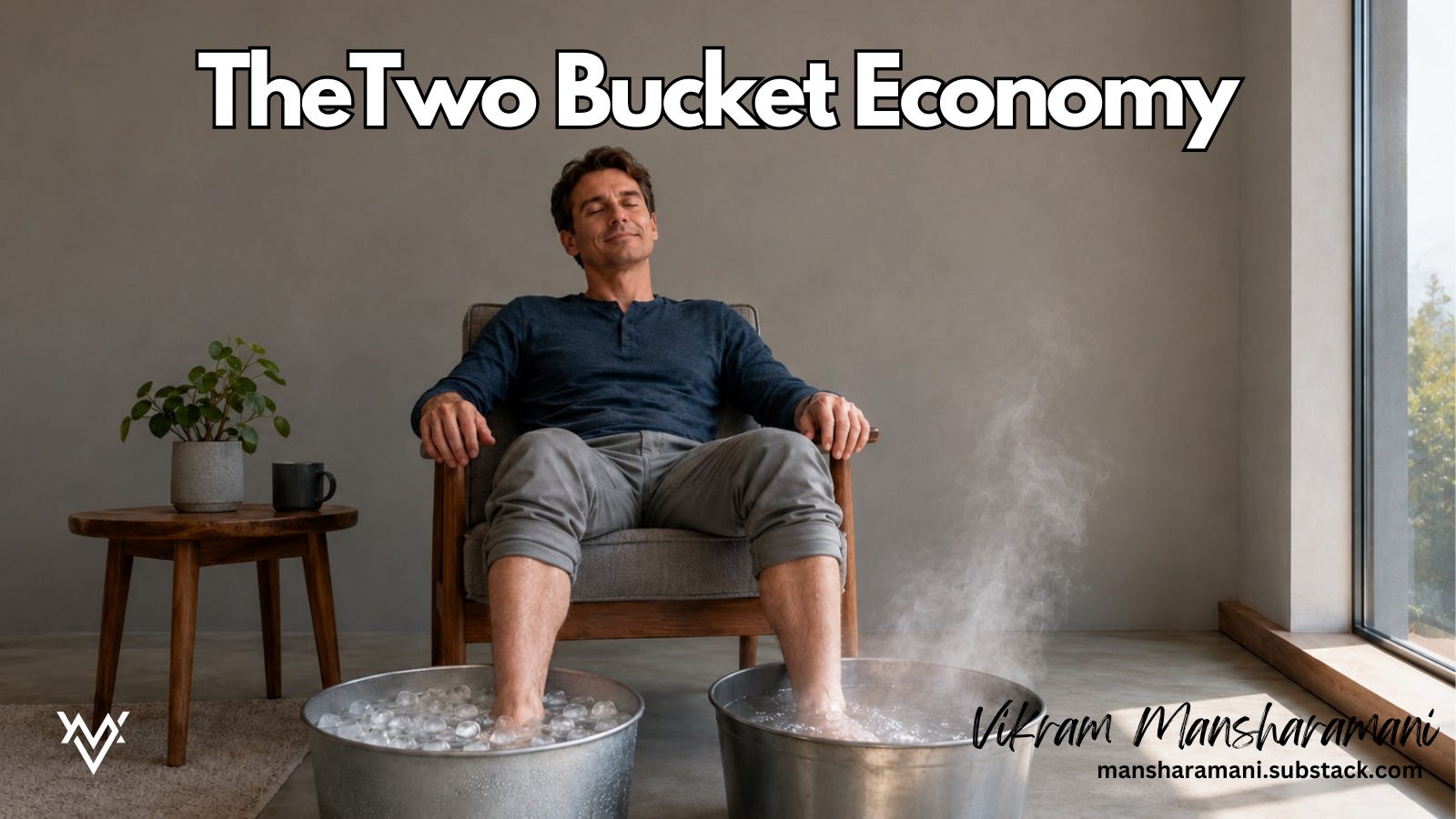
These extremes are getting buried in aggregate statistics. I often make this dynamic clear during speeches I give by suggesting audience members put their left foot in a bucket of boiling water and their right foot in a bucket of ice water. On average, I note, you’d be comfortable.

VIKRAM MANSHARAMANI is an entrepreneur, consultant, scholar, neighbor, husband, father, volunteer, and professional generalist who thinks in multiple-dimensions and looks beyond the short-term. Self-taught to think around corners and connect original dots, he spends his time speaking with global leaders in business, government, academia, and journalism. He’s currently the Chairman and CEO of Goodwell Foods, a manufacturer of private label frozen pizza. LinkedIn has twice listed him as its #1 Top Voice in Money & Finance, and Worthprofiled him as one of the 100 Most Powerful People in Global Finance. Vikram earned a PhD From MIT, has taught at Yale and Harvard, and is the author of three books, The Making of a Generalist: An Independent Thinker Finds Unconventional Success in an Uncertain World, Think for Yourself: Restoring Common Sense in an Age of Experts and Artificial Intelligence and Boombustology: Spotting Financial Bubbles Before They Burst. Vikram lives in Lincoln, New Hampshire with his wife and two children, where they can usually be found hiking or skiing.
Comments
Nothing yet. Say the first thing.
Sign in to join the conversation.