
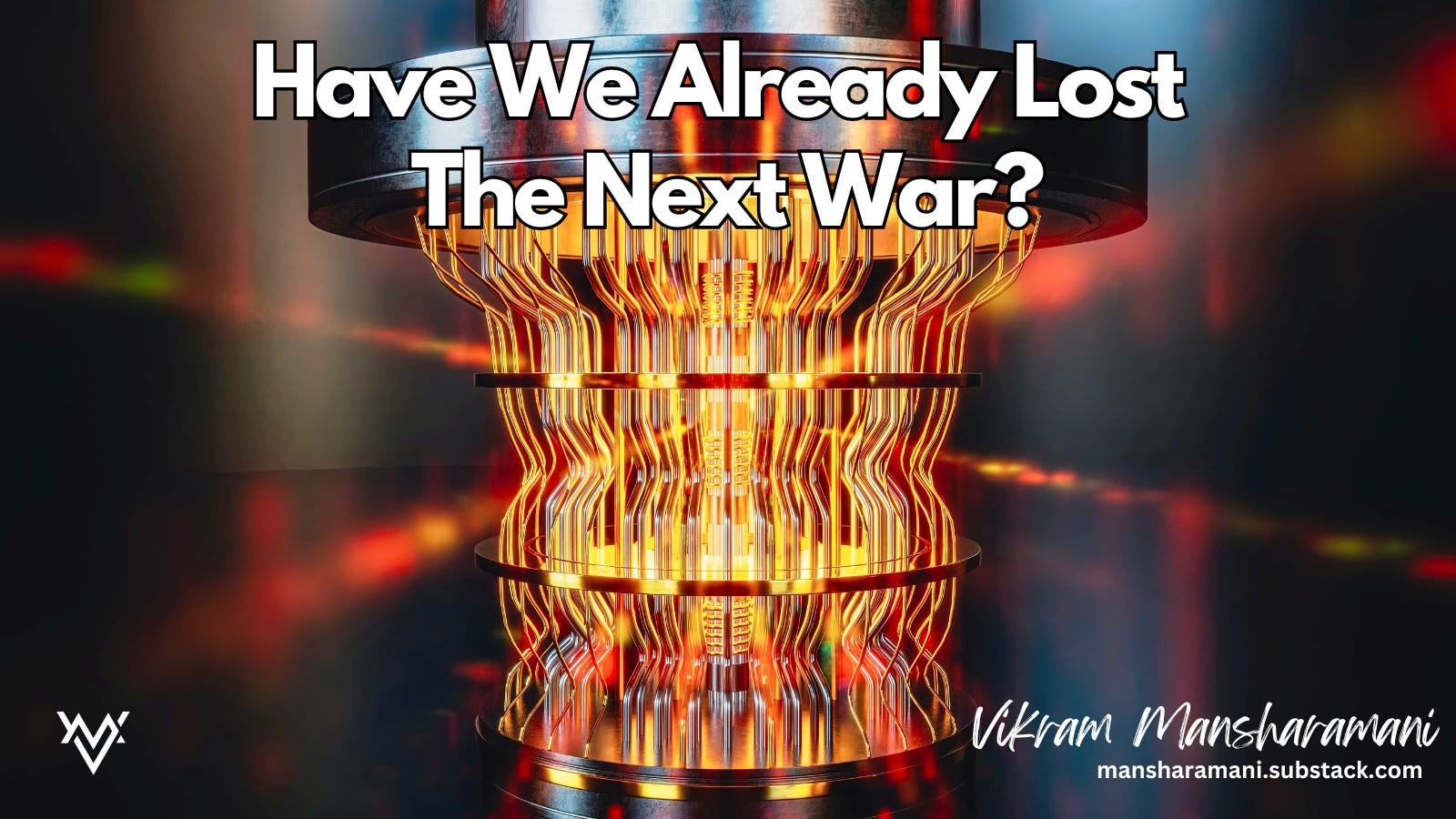
The most dangerous weapon in the world doesn’t exist yet, but the damage it will cause may already be done. The weapon is quantum technology, which has the potential to disrupt almost every form of communication and the protection of secrets, especially when it comes to national security. And the worst part is it’s already too late to stop the damage it will do.
But first, a quick detour into the physics of quantum computing. Every computer you’ve ever used stores information in bits, tiny switches that are either 0 or 1. Every email, every photo, every encrypted military communication, is just a very long string of 0s and 1s that are processed very fast. Quantum computing is not just an incremental improvement in speed, it’s fundamentally different. Instead of bits, it uses qubits, which can be 0, 1, or (and this is the part that makes my brain hurt) both at the same time. A qubit exists in both states simultaneously until you measure it. (This is where Schrödinger’s cat comes from—the cat is both alive and dead until you open the box.) While my PhD physicist friends may say I’m oversimplifying the difference, I’ve come to think of quantum computing as probabilistic and traditional computing as binary.
Why does this matter? Because a classical computer trying to crack an encryption key has to try every possible combination one at a time. But a quantum computer can try many combinations simultaneously. For certain types of problems—such as breaking codes, optimizing logistics, simulating molecular behavior—this approach leads to solutions that are not just determined quicker. Quantum approaches get there exponentially faster. A problem that would take a conventional computer thousands of years might take a quantum computer mere minutes.
The military implications are profound. The Defense Science Board has identified three areas where quantum technology could reshape warfare. The first is quantum sensing. Quantum sensors can navigate using the properties of atoms instead of relying on satellites. You can’t jam the atoms and their properties. You can’t shoot them down. DARPA just awarded IonQ a $28 million contract for optical atomic clocks that provide precision timing in GPS-denied environments. The implications for submarines, hypersonic missiles, and special operations in contested airspace are profound.
The Space Business is Taking Off
·
February 19, 2024
On Thursday February 15, 2024, a SpaceX Falcon 9 rocket successfully launched a private lunar lander in what may prove to be a milestone in the private space industry. If successful, it will be America’s first return to the moon since the 1972 Apollo mission
The second area is quantum computing, which the Pentagon estimates is at least a decade away from battlefield impact but could eventually enable breakthroughs in pattern recognition, target identification, and artificial intelligence. The Department of Defense named “Quantum and Battlefield Information Dominance” as one of its six critical technology areas and allocated $781 million for quantum technologies in FY2025.
The third is quantum communications. In theory, this approach could enable the creation of unhackable channels that use quantum mechanics to detect attempts at interception. China is working on this intensely and has already launched a quantum communications satellite and built a 2,000km quantum network between Beijing and Shanghai.
But here’s what keeps me up at night. The most dangerous quantum threat isn’t in the future. It’s in the past. The threat emerges from a strategy called “Harvest Now, Decrypt Later” and the logic is as simple as it is terrifying. Adversaries, namely China and Russia, are vacuuming up encrypted data right now. Military communications, diplomatic cables, weapons designs, intelligence reports…all of which is encrypted (and therefore unreadable) today. They’re not even trying to crack it. They’re just storing it…and waiting, patiently. Waiting for something known as Q-Day, the day a quantum computer powerful enough to break modern encryption becomes operational. Leading analysts estimate that day is less than a decade away. On Q-Day, everything that was harvested and encrypted becomes readable. Retroactive intelligence of an enormous pile of a country’s most sensitive information. Every secret transmitted over decades, unlocked in one stroke. (If you have 20 minutes, the above video will prove worth your time.)
And, perhaps most disturbingly, you can’t patch breaches that have already happened. The Cyber Threat Alliance puts it bluntly: the damage is done the moment the data is intercepted, not when it’s decrypted. The harvest is the breach. The decryption is just the reveal.
And while you and I may not care about emails sent 10 years ago about dinner reservations or a child’s soccer game, the most sensitive encrypted information (even if dated) in the national security domain is probably still very valuable. Consider these examples:
Nuclear submarine patrol routes. America’s submarines carry nuclear missiles, and their locations are among the most closely guarded secrets in the military. The entire deterrent rests on the assumption that nobody knows where they are. If China decrypts a decade of encrypted Navy communications that include patrol orders, position reports, and maintenance schedules, the CCP will be able to map patterns. Barring a wholesale change in our approach, the subs wouldn’t be as invisible, our second-strike deterrent is compromised. Not because someone hacked a submarine, but because someone read an email from 2018.
Weapons system specifications. Encrypted communications between Lockheed Martin, the Pentagon, and subcontractors might contain the exact radar cross-section of the F-35, the vulnerabilities in its electronic warfare suite, the specific frequencies it uses, the countermeasures it’s designed to defeat. Decrypt those and you can engineer a defense against every American weapons system currently deployed. China is already suspected of having stolen F-35 designs through conventional hacking; its J-31 fighter looks suspiciously familiar. Quantum decryption might enable them to rapidly complete what they already have underway.
War plans for Taiwan. The Pentagon has detailed operational plans for defending Taiwan. Even if those plans get updated, previous versions reveal doctrinal thinking, strategic assumptions, logistics constraints, and institutional habits that don’t change quickly. Knowing the American war-fighting approach for a 2018 conflict tells you a great deal about how America might fight in 2028.
Intelligence sources. Between 2010 and 2012, China identified and killed or imprisoned at least 30 CIA sources inside the Chinese government, one of the worst intelligence disasters in American history. Nobody knows exactly how they were identified. If a harvested encrypted communication from that era names sources who survived the purge and are still active today, those people are going to be killed and American insight into the CCP will deteriorate.
Diplomatic negotiations. Every negotiating the US has had with China over the past decade (on trade, on Taiwan, on North Korea, on Iran, on rare earths, on climate, etc) probably included encrypted cables between the State Department and embassies. Cracking the encryption and reading those cables will reveal America’s red lines, its bluffs, its internal disagreements, and its fallback positions. China would get a glimpse into American thinking, posturing, and the gaps between statements and beliefs.
The Pentagon knows all of this. In June, it published a Post-Quantum Cryptography Strategy calling the quantum future an “existential threat” to military missions and mandating that every DOD system must support quantum-resistant encryption by the end of 2030. President Trump signed two executive orders in June to accelerate the transition and the United States is planning to invest in America’s leading quantum technology companies. But here’s the problem: the strategy is forward-looking. It protects tomorrow’s secrets. It does nothing for the one’s that were captured yesterday.
We tend to think of wars as events that happen in the future…something we prepare for, something we see coming. But the information war may have already been fought, silently, over fiber-optic cables and satellite links, by adversaries who recorded everything and are simply waiting for the key.
The weapon doesn’t exist yet. But the damage may already be done. The question isn’t whether Q-Day is coming. It is. The question is how much of America’s most sensitive information is already sitting in a vault in Beijing, waiting to be read.
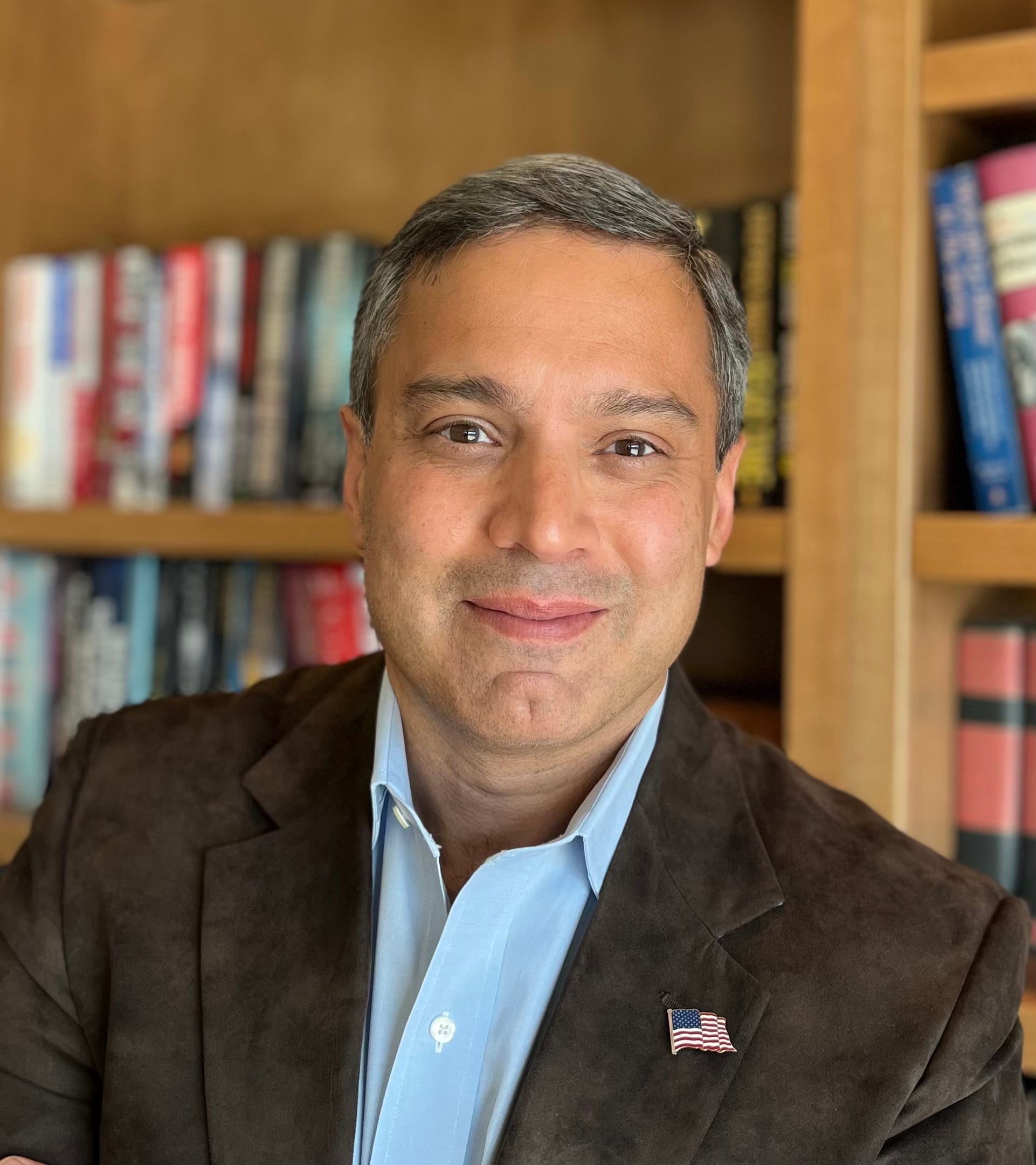
VIKRAM MANSHARAMANI is an entrepreneur, consultant, scholar, neighbor, husband, father, volunteer, and professional generalist who thinks in multiple-dimensions and looks beyond the short-term. Self-taught to think around corners and connect original dots, he spends his time speaking with global leaders in business, government, academia, and journalism. He’s currently the Chairman and CEO of Goodwell Foods, a manufacturer of private label frozen pizza. LinkedIn has twice listed him as its #1 Top Voice in Money & Finance, and Worthprofiled him as one of the 100 Most Powerful People in Global Finance. Vikram earned a PhD From MIT, has taught at Yale and Harvard, and is the author of three books, The Making of a Generalist: An Independent Thinker Finds Unconventional Success in an Uncertain World, Think for Yourself: Restoring Common Sense in an Age of Experts and Artificial Intelligence and Boombustology: Spotting Financial Bubbles Before They Burst. Vikram lives in Lincoln, New Hampshire with his wife and two children, where they can usually be found hiking or skiing.
Comments
Nothing yet. Say the first thing.
Sign in to join the conversation.