
Since 2022 I write about complex biological and socio-technical systems. Click here to easily find all the posts about your topic of interest. Listen to our free podcast on Spotify and Apple.
Some of you have shown interest in knowing more about the four scientists who received the 2026 Dirac Medal, and especially about the ideas for which they were recognized. So I thought it was worth taking a closer look, since their stories also provide an unusually clear view of how far statistical physics has travelled beyond its original domain.
It is a good time for the physics of complex systems.
In 2021, the Nobel Prize in Physics was explicitly awarded “for groundbreaking contributions to our understanding of complex physical systems”: half went jointly to Manabe and Hasselmann for the physical modelling of climate, and the other half to Parisi for the interplay of disorder and fluctuations in physical systems. There was a deep connection behind what initially looked like a split prize: systems can be disordered or chaotic and nevertheless remain predictable at the appropriate level of description.
With Angelo Vulpiani, I discussed some of Parisi’s contributions (read → here), including stochastic resonance and multifractality. There, one of the broader messages was that complexity does not necessarily imply a failure of prediction: it may instead force us to ask which variables, scales and statistical descriptions retain predictive power.
Then came 2024. Hopfield and Hinton received the Nobel Prize in Physics for foundational discoveries and inventions enabling machine learning with artificial neural networks. Hopfield’s associative memory drew directly on the physics of interacting spins, while Hinton’s Boltzmann machine imported statistical-mechanical ideas into learning. We have discussed that too, here:
And now, in 2026, the ICTP Dirac Medal marks the trajectory even more explicitly: Bernard Derrida, Deepak Dhar, Marc Mézard and Haim Sompolinsky have received the medal for pioneering work in statistical mechanics and for extending its concepts into nonequilibrium physics, optimization, theoretical neuroscience and artificial intelligence. To me that’s the history of a conceptual migration.
The ICTP Dirac Medal was established in 1985 in honour of Paul Dirac and is awarded annually on his birthday, 8 August, for significant contributions to theoretical physics. An international committee selects the recipients, and the medal is not awarded to scientists who have already received a Nobel Prize, Fields Medal or Wolf Prize.
For us, the most interesting part of the 2026 selection is that four rather different scientific careers have been grouped around a common idea:
Statistical mechanics can remain useful when the “degrees of freedom”
are no longer ordinary particles
They can be configurations of a disordered material, local instabilities in an avalanche, candidate solutions of a computational problem or patterns of activity in a neural network. They can be much more, indeed, as we know from this space and from the last 20 years of complexity science.
Across those changes of substrate survives a question that statistical physics has always had to confront: what can we still know when there are too many interacting possibilities to follow one by one?
Statistical mechanics was developed to understand systems containing enormous numbers of physical degrees of freedom, because following the microscopic trajectory of each one is generally unfeasible (when not just impossible) and, for many questions, even unnecessary. Instead, one asks which collective variables and probability distributions remain informative.
The four 2026 medallists pushed that strategy into very different territories, and they are connected by the same methodology: complicated spaces of possibilities can sometimes be replaced by statistical descriptions that expose phases, critical points, effective fields, attractors or algorithms.
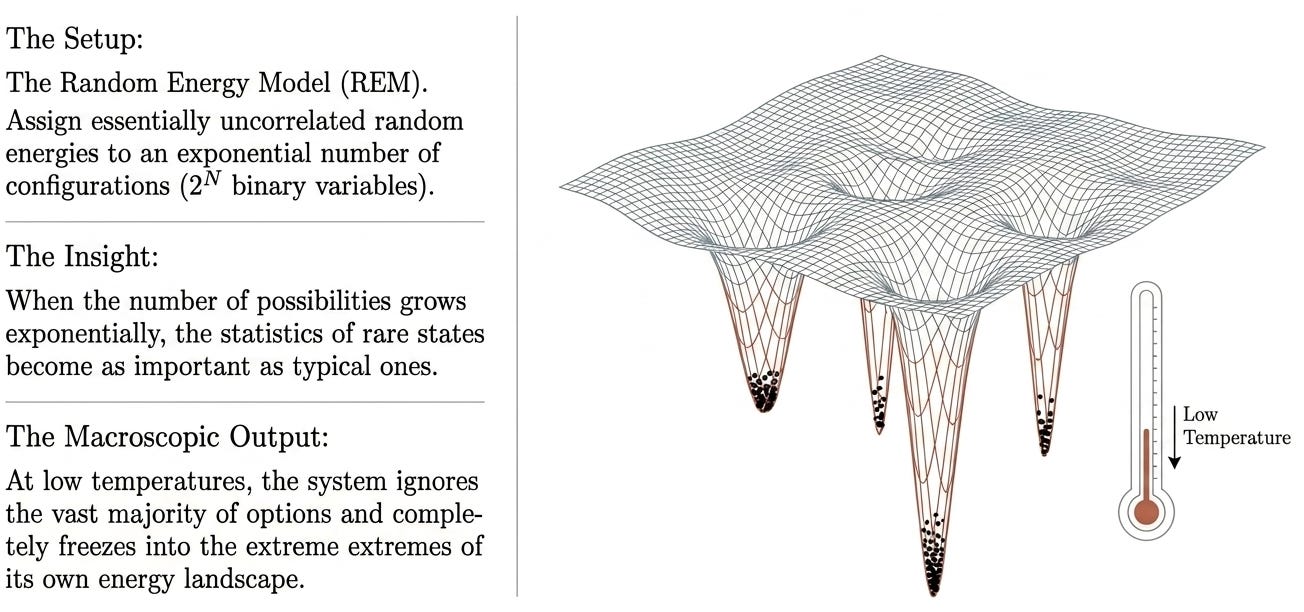
The Random Energy Model, introduced by Bernard Derrida in 1980, is almost “aggressively simple”: take N binary variables — hence 2N configurations — and assign essentially uncorrelated random energies Eα to those configurations. The equilibrium problem can then be summarized by the partition function
\(Z=\sum_{\alpha=1}^{2^N} e^{-\beta E_\alpha}.\)
The point is the competition encoded in Z: there are exponentially many states, but among so many possibilities some have exceptionally low energies. At high temperature, many configurations contribute, whereas below some threshold, the statistical weight becomes dominated by a very small number of unusually favourable states: the system freezes into the extremes of its own energy landscape.
This stripped-down model captured important qualitative features of spin glasses while making the role of the landscape itself transparent. It also anticipated a theme that now appears well beyond condensed matter: when the number of possibilities grows exponentially, the statistics of rare states can become as important as the properties of typical ones1.
Derrida’s contribution to complexity, however, is broader than the REM, but we have not enough space and time, today, to cover everything.
For Deepak Dhar the central object was not a frozen landscape but an avalanche.
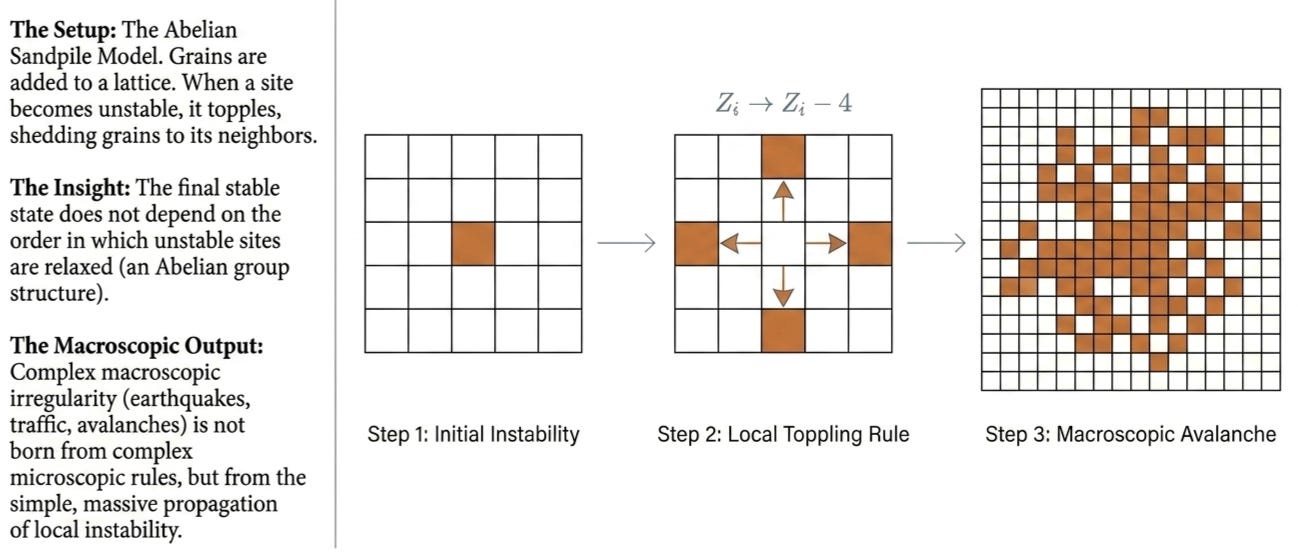
In the Abelian sandpile model, grains are added to sites on a lattice. Using the standard square-lattice convention, when site i becomes unstable it topples:
\(z_i\rightarrow z_i-4,\qquad z_j\rightarrow z_j+1\)
for each of its four neighbours j.
One toppling may stop immediately or trigger a cascade. Bak, Tang and Wiesenfeld had proposed sandpile dynamics as a paradigm of self-organized criticality, while Dhar made an important class of these models analytically tractable. He then recognized that, in the Abelian sandpile, the toppling operators commute: under the appropriate dynamics and boundary conditions, the final stable state does not depend on the order in which unstable sites are relaxed. That observation gives the recurrent configurations an Abelian group structure and unlocks exact results for the critical state.
This is a beautiful complexity result because the macroscopic irregularity is not produced by complicated microscopic rules, but comes from the propagation of local instability through an interacting system.
Sandpile models have inspired descriptions of earthquakes, traffic and other bursty phenomena, but the appearance of avalanches or broad event-size distributions does not by itself establish self-organized criticality, let alone membership in the same universality class. The model gives a mechanism and a mathematical structure to test against reality, not a universal explanation for every system displaying large events2.
With Marc Mézard’s work, the migration from physics to computation became particularly explicit and interesting.
With Parisi and Virasoro, he developed the cavity method as a probabilistic way of describing spin glasses and other disordered systems. The underlying intuition is to remove one variable from a large interacting system, characterize the effective environment left by the others, and then impose consistency when the variable is put back.
On a sparse constraint network, the logic can be represented schematically (and pedagogically) as messages arriving at a variable:
\(P_i(x_i)\propto\prod_{a\in\partial i}\widehat m_{a\to i}(x_i).\)
Each neighbouring constraint a communicates information about which values of xi remain compatible with the rest of the system; the local marginal emerges from combining those messages.
The important step was to recognize that a combinatorial problem can itself possess a statistical-mechanical landscape. In random K-satisfiability, Mézard, Parisi and Zecchina showed that below the SAT–UNSAT threshold there is an intermediate regime in which solutions organize into many metastable clusters, helping explain the onset of algorithmic difficulty. The physical description then suggested a computational strategy: survey propagation turned information about clusters of possible solutions into a practical message-passing algorithm.
→ That is stronger than saying that optimization “looks like” statistical mechanics: the organization of the solution space becomes useful for deciding how to search it.
Haim Sompolinsky helped make neural networks a genuine many-body problem.
With Amit and Gutfreund, he applied spin-glass statistical mechanics to Hopfield-type associative-memory networks, characterizing their stable and metastable states and helping establish a statistical-mechanical theory of associative memory. The connection with the 2024 Nobel Prize is therefore direct, but Sompolinsky’s programme went substantially beyond associative memory.
A particularly influential step came with Crisanti and Sommers in 1988. Let us consider a large network of nonlinear units,
\(\tau\frac{dx_i}{dt} = -x_i+ g\sum_{j=1}^{N}J_{ij}\phi(x_j),\)
where Jij are random couplings and g controls their effective strength. In the large-N limit3, dynamical mean-field theory predicts a transition from a stationary regime to deterministic chaos above a critical gain; the temporal correlations and maximal Lyapunov exponent of that collective state can be calculated.
The shift in viewpoint is important, because instead of trying to predict every neuronal trajectory, one asks which dynamical regime the population occupies and which statistical quantities characterize it.
The same programme has continued into modern questions about representation. With SueYeon Chung and Daniel Lee, Sompolinsky developed a statistical-mechanical theory of how the geometry of perceptual manifolds controls the capacity to classify objects, explicitly connecting biological representation and deep neural networks.
A beautiful path from spin glasses to brains, and from brains back to artificial networks.
Derrida, Dhar, Mézard and Sompolinsky did not study the same systems: a random-energy landscape is not a sandpile, a sandpile is not a satisfiability problem, and a neural circuit is neither of them.
Nevertheless, in each case, microscopic description alone is not the useful endpoint because the number of configurations, events, solutions or trajectories becomes enormous. One therefore looks for another description: energy landscapes and extreme states, recurrent configurations and critical avalanches, cavity fields and clusters of solutions, attractors, dynamical regimes and representational geometries.
This is why the trajectory from the 2021 Nobel to the 2024 Nobel and now the 2026 Dirac Medal is interesting: these recognitions are not equivalent, but together they make increasingly visible an intellectual programme that has been developing for decades.
Statistical physics was built to understand collective behaviour in physical systems, although its concepts turned out to travel because the deeper problem is more general than its material substrate: how to extract reliable macroscopic knowledge from a space of interacting possibilities too large to inspect one by one.
And, perhaps, this is the enduring lesson of these four medals: complexity does not begin when prediction becomes impossible, it begins when following everything is no longer the right way to predict.
→ Please, remind that if you find value in #ComplexityThoughts, you might consider helping it grow by subscribing, or by sharing it with friends, colleagues or on social media. See also this post to learn more about this space.
This is the same core argument on which I have grounded my recent work on the architecture of living systems. I am currently writing a series for the newsletter about it: if you are curious, check the latest one (pointing to the previous ones too) below
It seems a redundant note, but it is not, given the misconceptions appeared in the literature.
Remind that N here is the size of the system, i.e., the number of components.
Comments
Nothing yet. Say the first thing.
Sign in to join the conversation.