
Since 2022 I write about complex biological and socio-technical systems. Click here to easily find all the posts about your topic of interest. Listen to our free podcast on Spotify and Apple.
Can “architecture” be a scientific concept for life and not just a metaphor?
Complexity does not require a central designer: it can emerge when stable subassemblies persist, combine and constrain later change. In network terms, this points to hierarchical modularity: many interactions remain local, while selected interfaces coordinate function across scales.
Based on the more technical arguments developed in my recent paper, this is the fourth step in our attempt to understand whether “architecture” in living systems is a real, measurable concept or just a convenient metaphor. I have introduced the key idea in the previous posts:
where I have outlined how function in living systems emerges from the coupling between logic (what the system does) and circuitry (how it is physically implemented).
In the last chapter, we have shown how loops can support redundancy, feedback control and closure. Their usefulness depends on how far their effects propagate: feedback loop stabilizing one variable can create problems if it couples too many subsystems, whereas a redundant pathway that protects one process becomes expensive if every component must maintain alternatives to every other component.
The same informational and energetic constraints discussed earlier return in architectural form. If genomes cannot encode dense wiring diagrams edge by edge — and if biological connections must be built, regulated, repaired and sometimes removed — then viable architectures must limit how much coordination is required at once.
Hierarchical modularity addresses this problem by concentrating many interactions within partially autonomous subsystems and allowing selected exchanges among them. In this way stable intermediate structures1 can persist and later be (re)combined, reducing the need for the whole system to become functional in just a single step.

In a seminal 1962 paper, Herbert Simon introduced the main point through the famous parable of two watchmakers, Tempus and Hora.
In a nutshell, Tempus builds a watch through one uninterrupted sequence: if interrupted, he loses much of the accumulated work because intermediate configurations have no independent stability. Conversely, Hora first builds stable subassemblies and later combines them: if interrupted, he loses only the current subassembly, while completed components remain available for later construction.
Simon used the parable to explain why complex systems made from stable intermediate structures are more likely to be completed than systems requiring all parts to remain coordinated throughout the entire construction process.
This is extremely important for our series on the architecture of living systems, and we will use it again at a later stage, when we will discuss major evolutionary transitions.
In fact, for biological systems the important is search, not watches: when partial structures persist, later change proceeds from components that already satisfy some constraints. Evolution does not need2 to assemble from scratch an organism, a regulatory network or a metabolic system in a single combinatorial leap.
In his popular — and likely his best — book, Richard Dawkins considers a variation of the parable, adding the evolutionary constraint. Since natural selection has no foresight, but it can be cumulative: viable intermediates can sometimes persist, be modified, duplicated, recombined or repurposed. The process can be idealized as a blind watchmaker.
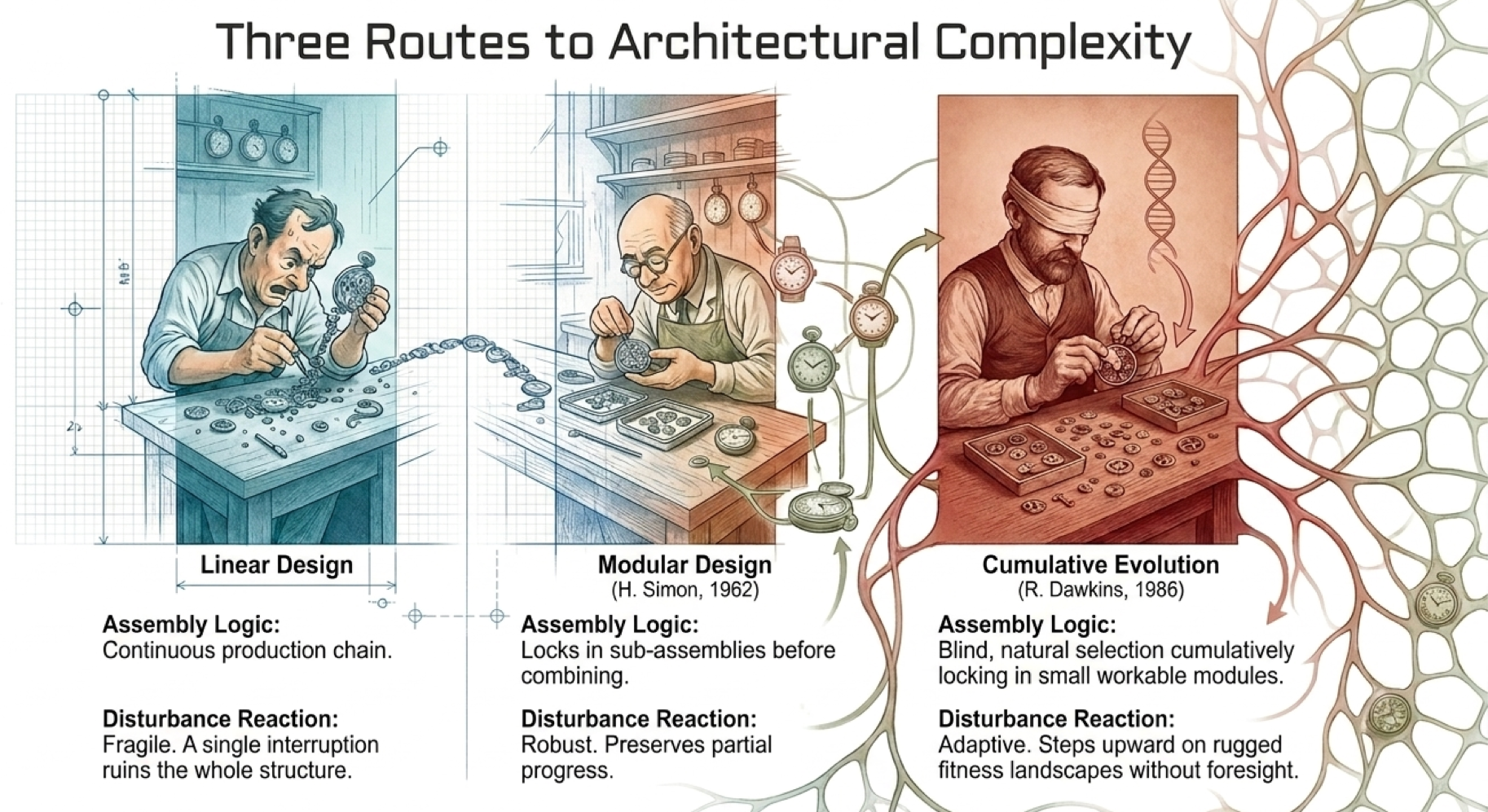
While Simon proposes the architectural argument about stable subassemblies, Dawkins suggests the evolutionary intuition about cumulative change without design. What is the point that I outline in my paper? I connect these ideas to hierarchical modular networks: staged assembly can make certain large architectures more reachable under finite time and resource constraints, whereas unrestricted global assembly can rapidly become combinatorially prohibitive.
What do we mean, here, with “hierarchy”? It often evokes command, with one element controlling those below it, while in terms of complex networks, the relevant structure is nested modularity.
A modular system consists of groups whose internal interactions are denser, stronger or faster than their external interactions. Accordingly, a hierarchically modular system repeats this pattern across scales: small modules combine into larger modules, and those larger modules can become parts of still larger structures.
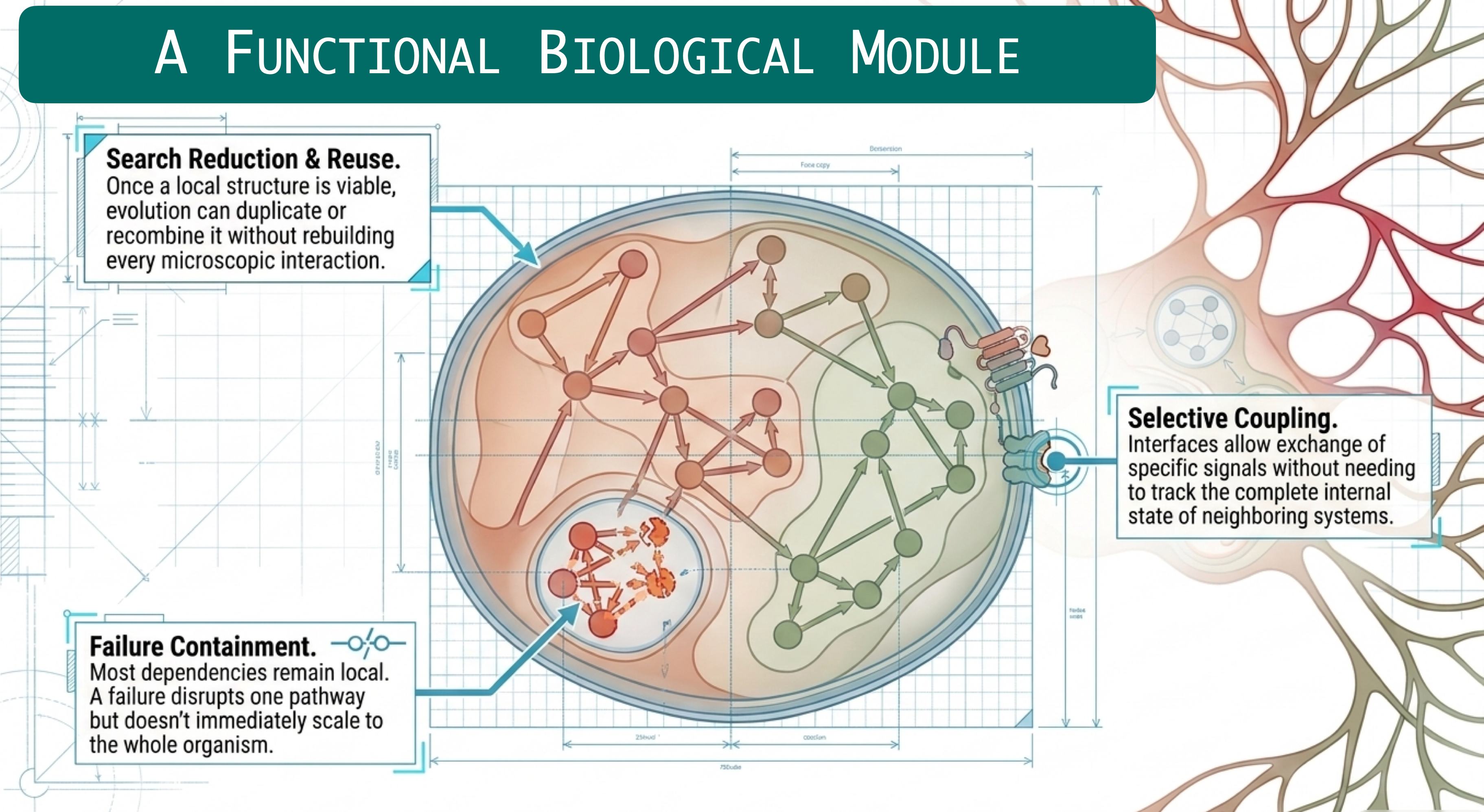
We have a beautiful example of this organization, in biology. A metabolic pathway may sit inside a cellular subsystem, and several interdependent subsystems contribute to the cell as a whole. There is more: interconnections — for instance through biochemical, mechanical or electrochemical signaling — allow cells to exchange relevant information. Adhesion, extracellular matrix organization and mechanical coupling help cells form tissues, which, in turn, organize within an organism. Similar patterns occur in regulatory, neural, ecological and social systems, although the meaning of an edge changes across domains.
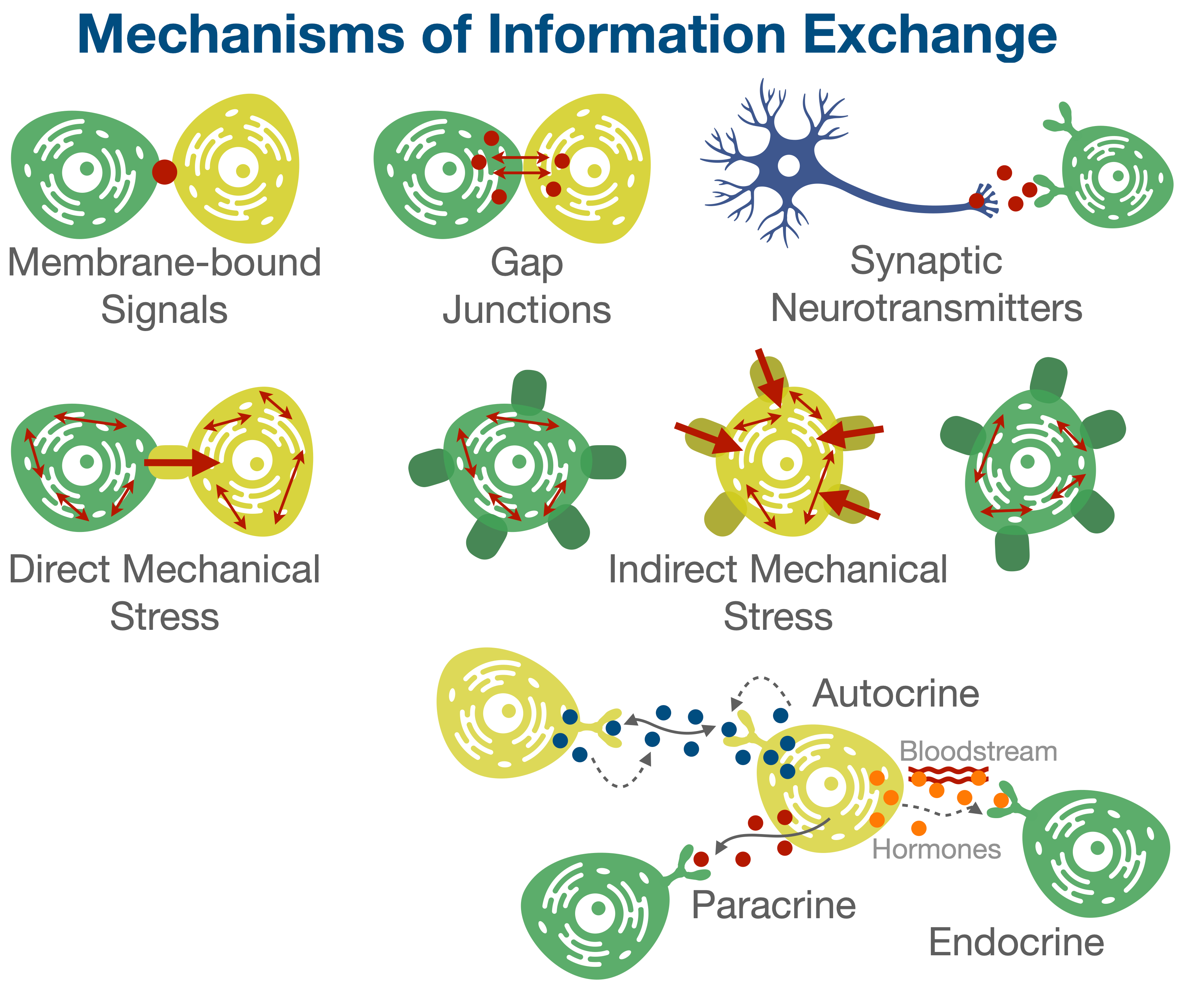
Operationally, hierarchy appears as structured coupling: high connection probability within modules, weaker coupling between modules, and selected interfaces across levels. This makes our claim measurable through edge distributions, nested communities, interaction timescales and perturbation pathways: in practice, through the core tools of network science dynamical systems theory.
However, a methodological caveat is necessary, because hierarchy is inferred from data, models and the choice of resolution. In practice, a protein-interaction network, a metabolic network or a developmental lineage do not encode the same type of relation. Especially in biomolecular networks, apparent modules can depend on how edges are defined, whether ubiquitous currency metabolites are filtered and which resolution scale is privileged by the detection method.
In Simon’s words, the relevant regime is called near-decomposability: interactions are stronger or faster within subsystems than between them, allowing local processes to relax, adapt or change without requiring immediate reorganization of the whole system. As we will see later in this series, this claim is far from being speculative: it can be formalized in mathematical terms using the language of complex networks and dynamical systems theory.
Let us focus for a moment on the qualifier “near”, which carries much of the biological content, because fully independent modules cannot coordinate. On the one hand, a tissue whose cells never exchange signals is not a functional tissue. On the other hand, fully coupled systems have the opposite problem: boundaries weaken, local control becomes expensive and disturbances can travel through too many paths, similarly to what we have discussed in the case of loops.
Near-decomposability describes that intermediate regime where internal coupling is strong enough to maintain local function, cross-module coupling is strong enough to coordinate the larger system, and the separation is strong enough to preserve module boundaries. Your first questions could be: what is “enough”? When is “enough” enough?
There is no universal answer. In specific and simplified models, we can identify regimes where subsystems are effectively independent and regimes where they are so tightly coupled that local autonomy disappears. The biologically interesting region lies between those extremes: enough coupling to coordinate, not so much coupling that every local perturbation becomes global.
This region fits living organization because biological processes operate on different spatial and temporal scales.
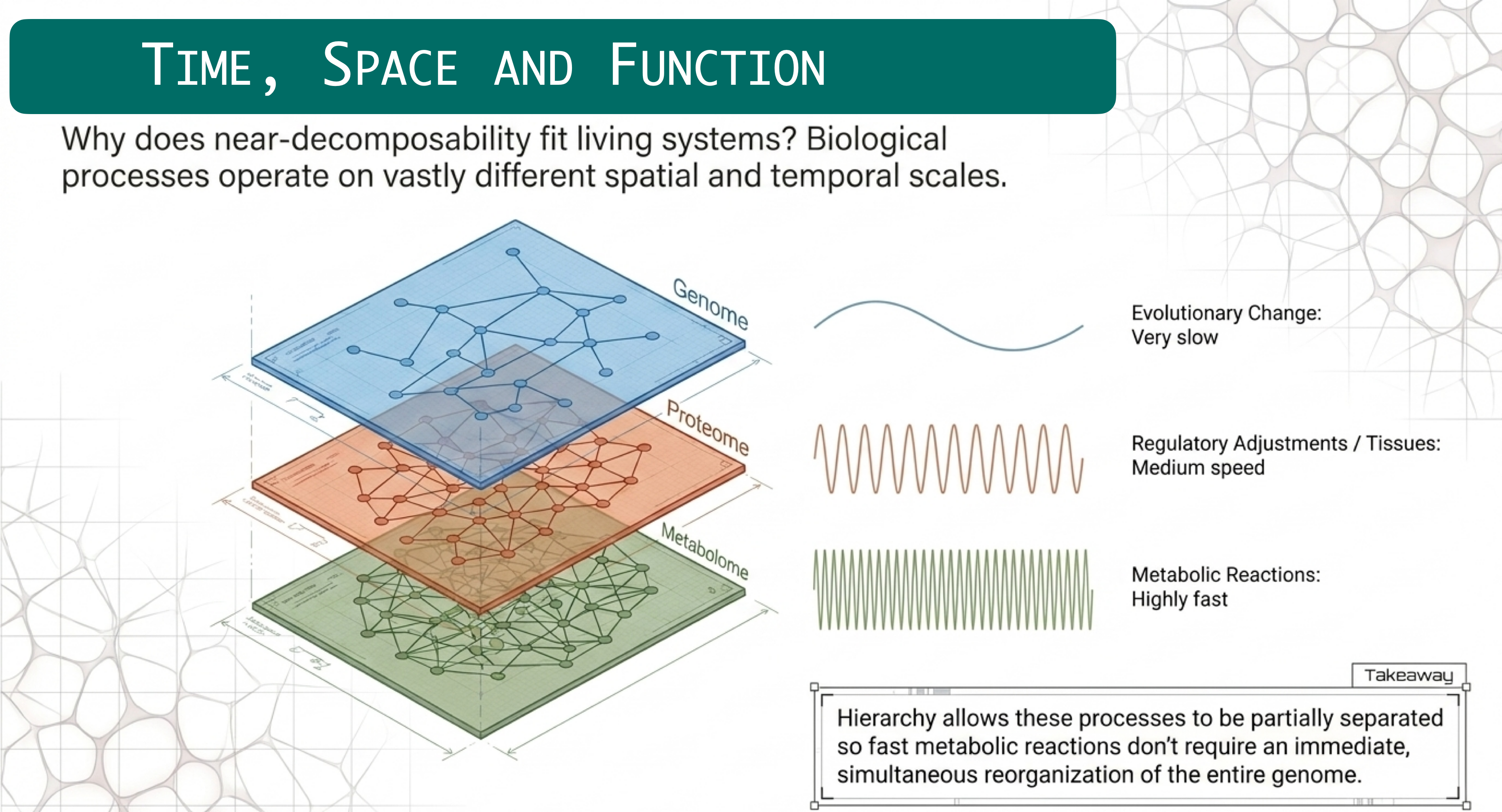
Metabolic reactions are often fast, many regulatory adjustments occur more slowly, tissue remodeling more slowly still and evolutionary change much slower again. Hierarchical organization allows partial separation among these processes while preserving cross-scale influence.
Let us suppose that, to be functional, a network requires many relations to be established simultaneously. As the number of components grows, the number of possible arrangements increases rapidly, while the fraction satisfying all functional constraints may become very small. Astronomically small.
Hierarchical assembly changes the search: small groups form first, with some of them becoming stable enough or functional enough to persist. These groups then become units in a higher-level (blind) search: later change operates on combinations of existing structures rather than on all microscopic components independently. This is extraordinarily important to understand that, while rare, biological organization is possible without design3. How?
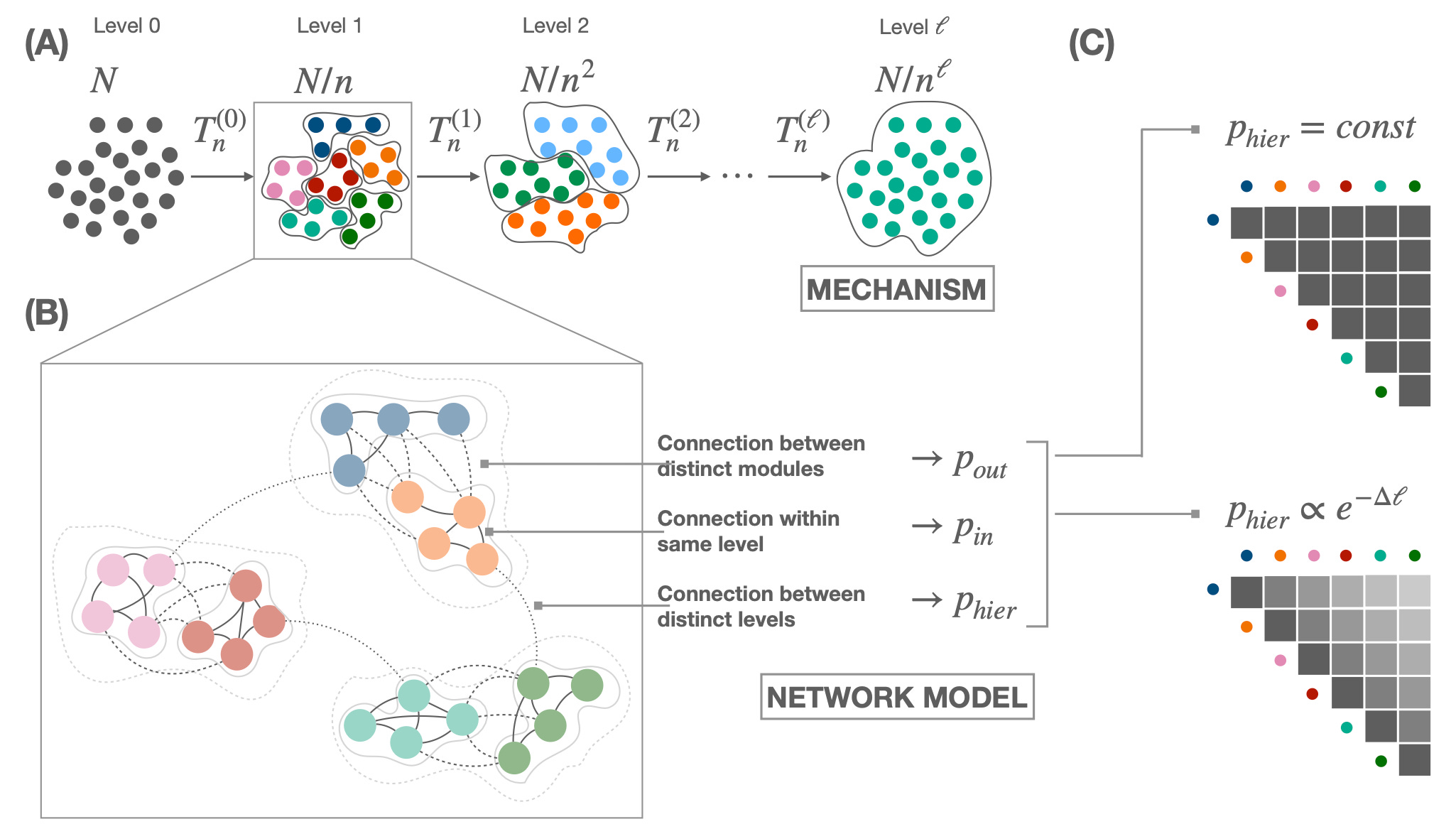
I have shown this through a toy network model freely inspired by Simon, where elementary units aggregate into assemblies, and assemblies aggregate again, producing a hierarchy whose depth depends on repeated staged construction. The model distinguishes connections within modules, connections between modules at the same level, and connections across hierarchical levels.
However, this model should be read as a feasibility argument, since I am not assuming that evolution computes configuration spaces explicitly. The claim is narrower: when large functional dense structures are hard to obtain in one step, staged construction through smaller viable units makes some architectures more reachable.
At this point, your intuition might be correct: the first change is search reduction. A module reduces the number of constraints that must be satisfied simultaneously: once a viable local structure exists, evolution can modify, duplicate or recombine it without rebuilding every microscopic interaction.
The second change is selective coupling: interfaces allow modules to exchange specific signals, metabolites, forces or resources without requiring each subsystem to track the complete internal state of all the others. A cell may respond to selected chemical and mechanical cues without needing access to every molecular event inside neighboring cells.
The third change concerns failure containment and reuse. When most dependencies remain inside modules, some perturbations remain local: a failure may disrupt one pathway or subsystem without immediately scaling to the entire organism. Stable modules can also be used in new contexts, increasing evolvability along some directions. Reuse also constrains later change, because new adaptations must remain compatible with inherited organization.
Remarkably, hierarchy also changes how variation is exposed to selection: if changes are partly localized inside modules, they can alter one function without disrupting all others at once. Wagner and Altenberg formulated this evolvability argument in terms of modular genotype–phenotype maps: complex adaptations become easier to explore when pleiotropic4 effects are concentrated within functional complexes rather than spread uniformly across traits.
However, this does not mean that modularity guarantees innovation. It changes the distribution of accessible variation, where some changes become easier because they remain partly local, while others become harder because inherited modules impose compatibility constraints.
And what about loops?
Hierarchy does not remove loops, it changes their functional and spatial reach. Many cycles remain within modules, where they support metabolic closure, regulatory feedback or alternative routes. Only fewer loops need to span the entire system in order to reduce the probability that a local perturbation enters a system-wide feedback circuit.
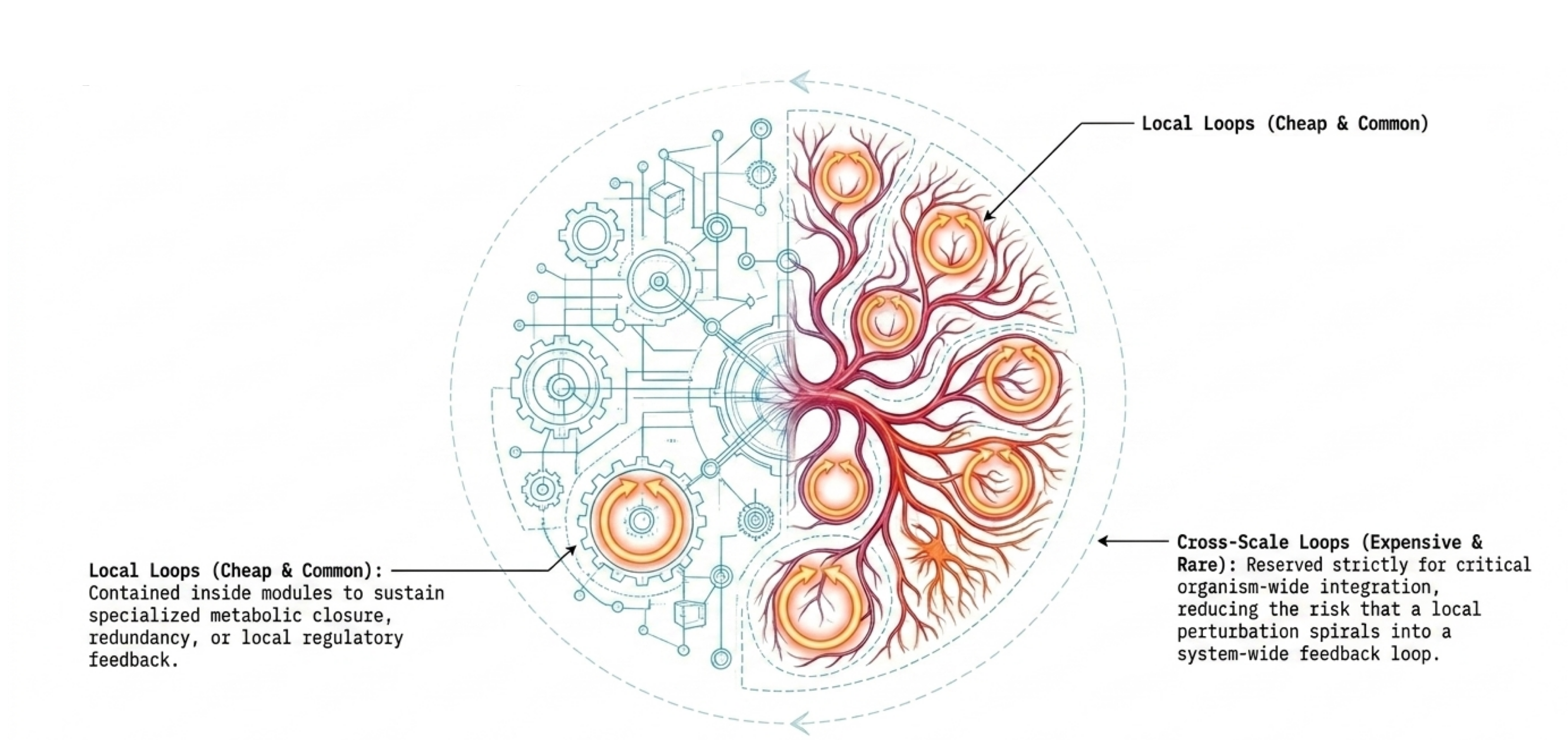
A hierarchical organization can make loops cheaper to maintain when most of their effects remain local, while still allowing cross-scale loops for organism-wide regulation: local loops sustain specialized processes, interfaces coordinate selected outputs, larger loops integrate modules when system-wide regulation is required.
Note that, even if it sounds amazing and almost bullet-proof, this distribution creates vulnerabilities. An interface shared by many modules can become a bottleneck, while a cross-level feedback loop can propagate failure across otherwise separated subsystems.
While hierarchy manages coupling, it does not avoid systemic risk.
Without empirical evidence for hierarchical and modular organization in biological networks, the above argument would remain elegant but incomplete.
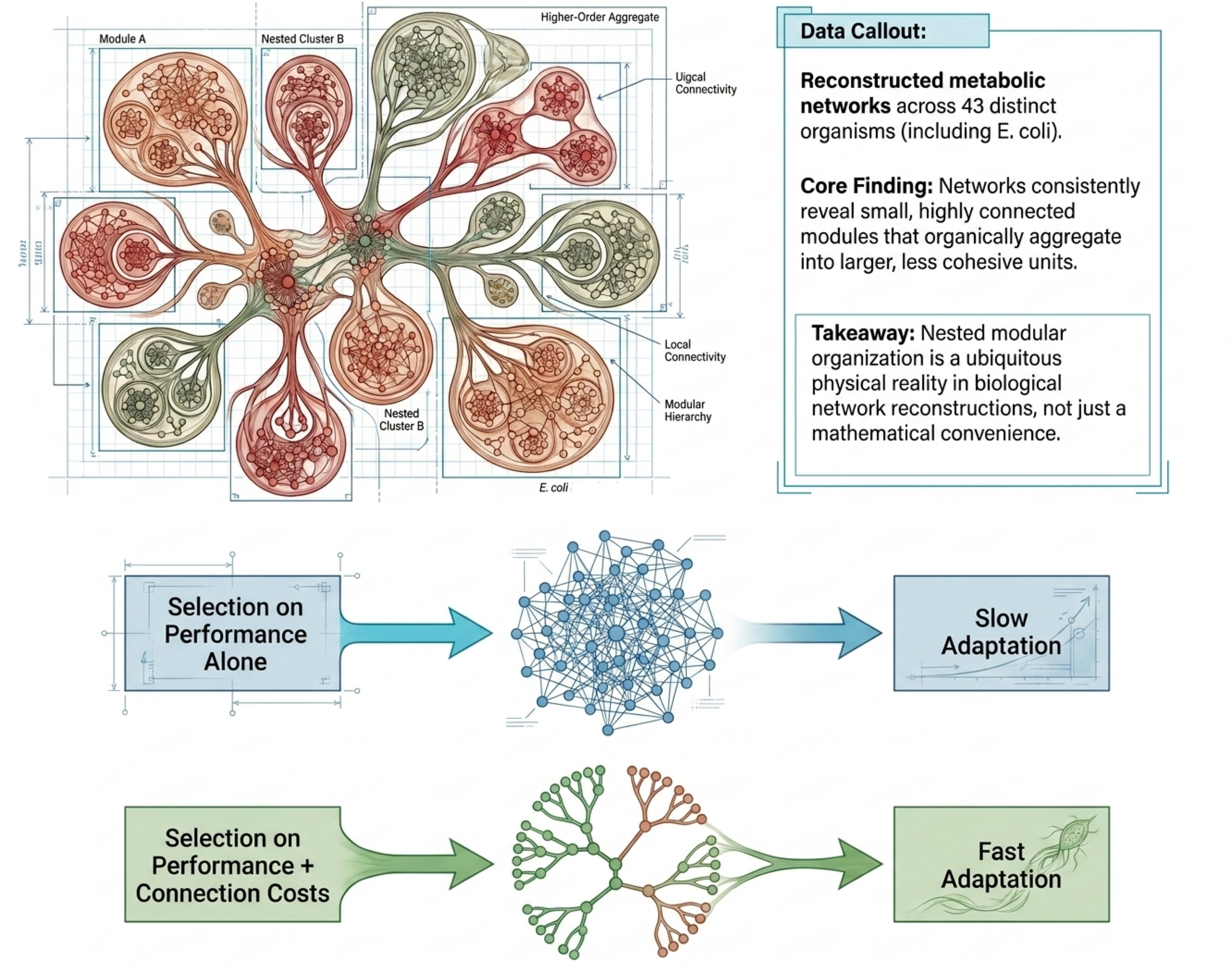
In fact, hierarchical modular organization has been inferred in reconstructed metabolic networks. Ravasz and colleagues reported that metabolic networks from 43 organisms contain small, highly connected modules that combine into larger, less cohesive units. In E. coli, the hierarchy partly overlapped known metabolic functions, supporting the hypothesis that nested modular organization is a recurring pattern in biological network reconstructions5.
The trade-off between robustness and hidden fragility provides a second evidence. Carlson and Doyle’s “highly optimized tolerance” framework explains why systems tuned to withstand common perturbations can become vulnerable to rare or unanticipated ones. Robustness is achieved through structured dependencies, and those dependencies can expose the system to specific failures.
In hierarchical systems, one plausible realization of that trade-off is that modules contain some common local perturbations while interfaces create specific systemic vulnerabilities6.
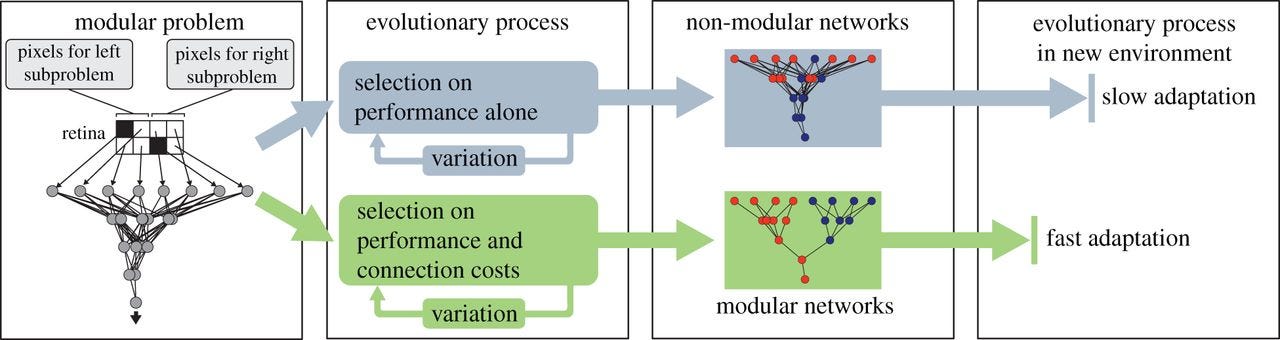
Connection cost provides a third evidence. In evolutionary simulations, Clune, Mouret and Lipson showed that adding a pressure to reduce connection costs can promote modular networks even when modularity itself is not directly selected7. The resulting networks were also more evolvable than networks selected for performance alone.
Summarizing, hierarchy becomes informative only after some questions are answered:
What is being nested? Metabolic reactions, regulatory motifs, cells, tissues, organs, ecological or social groups?
How are levels coupled? Through biochemical signals, mechanical forces, shared resources, information flow, developmental constraints, or ecological dependencies?
Where can failure propagate? Through bottleneck interfaces, shared components, delayed signals, correlated perturbations or historical dependencies that make some rearrangements difficult.
The common rationale is that hierarchy is a way of organizing coupling: a nested structure becomes biologically meaningful when it reduces the number of interactions that must be coordinated simultaneously, while preserving enough exchange for the system to function as a whole.
In this chapter we have seen that hierarchical modularity can (i) make assembly more feasible by preserving intermediate structures; (ii) limit coordination costs by concentrating many interactions inside modules; and (iii) help local loops support redundancy, control and closure without turning every perturbation into a system-wide event.
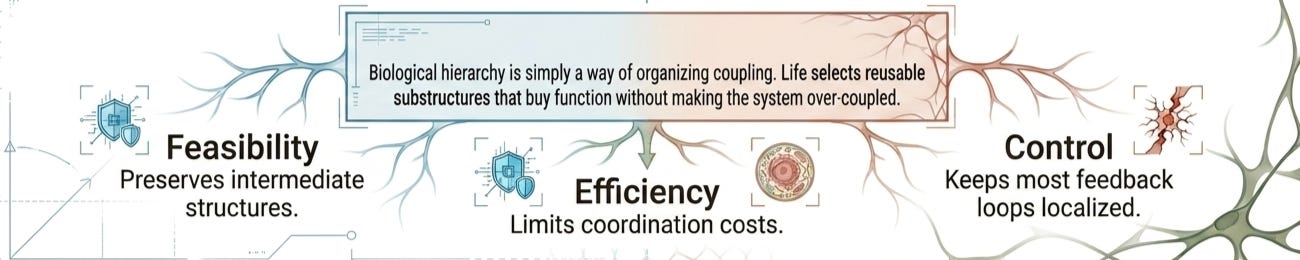
Apparently, life tends to select interfaces and reusable substructures that buy function without making the whole system overcoupled. Therefore, what we observe today is not the result of an ideal design, but of evolutionary histories in which some architectures persisted because they remained viable under changing constraints.
Despite that, hierarchy is not universally optimal: interfaces can become bottlenecks, modules can preserve outdated solutions because later structures depend on them, and a local organization that increases evolvability in one direction can restrict it in another. In a nutshell: hierarchy reduces some costs, but it creates new dependencies.
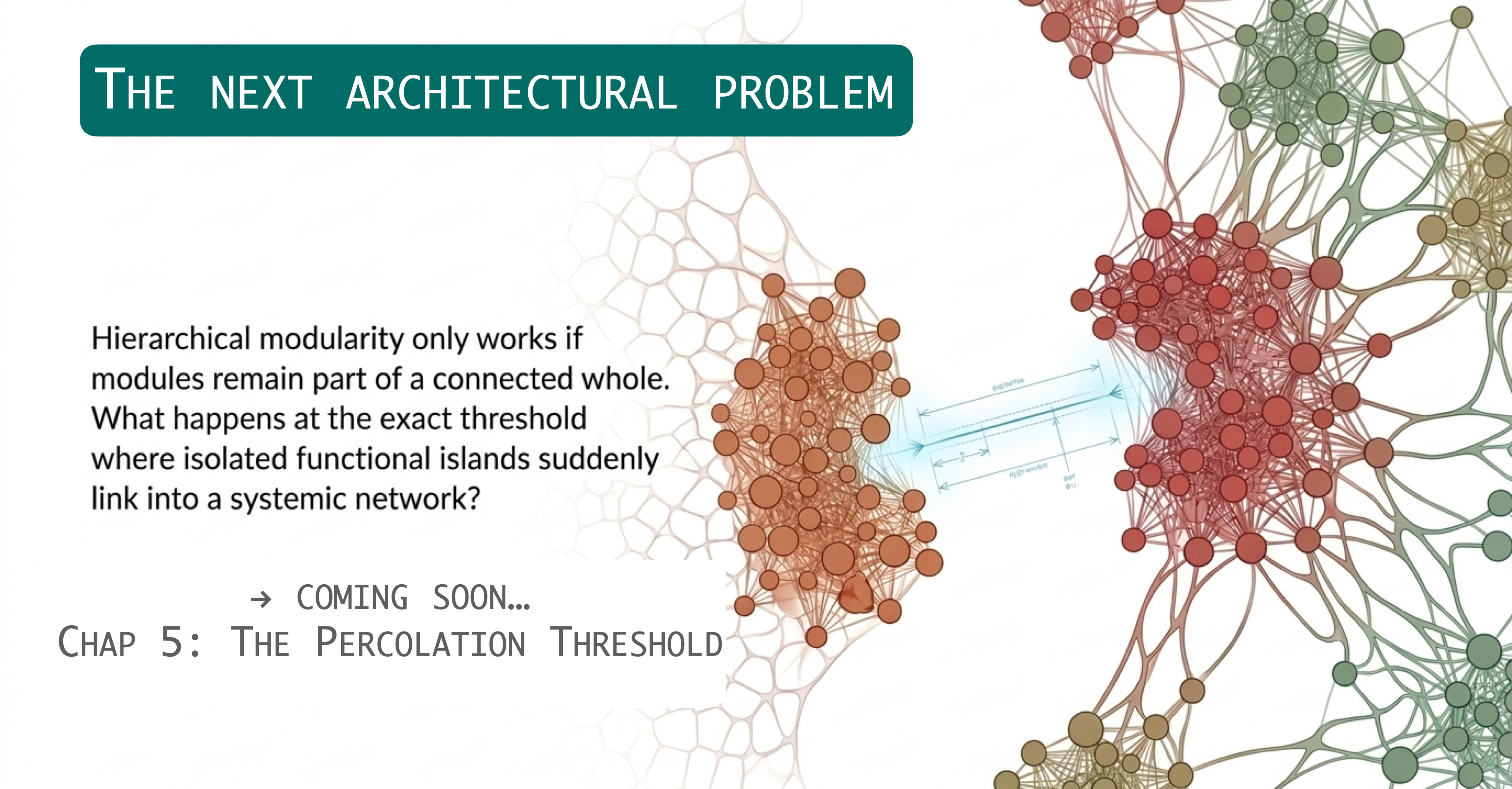
Guess what? This creates the next architectural problem. Hierarchical modularity works only if modules remain part of a connected whole: too little coupling produces isolated functional islands, too much coupling weakens modular boundaries and opens routes for the uncontrolled propagation of disturbances.
In the next chapter we will explore the threshold-like transition between these regimes: percolation, the point at which local structures become part of a network spanning the whole system. It’s getting more exciting, I know.
Here, “stable” is used to mean able to absorb structural and dynamical perturbations.
No, I am not claiming that evolution acts like a human, an entity, or whatever. I am using this expression only for narrative purposes, similar to what others did well before me, such as Jacob.
Roughly speaking, a gene is pleiotropic when changes in that gene influence multiple traits. Those traits may belong to the same functional module, or they may span different parts of the organism
Methodological note: this evidence supports the recurrence of hierarchical modular patterns in reconstructed metabolic networks. It does not necessarily prove that every biological hierarchy arises through the same generative mechanism.
This is an inference from the broader robustness–fragility framework, not a direct result established by Carlson and Doyle.
Original figure and caption from that study:
Comments
Nothing yet. Say the first thing.
Sign in to join the conversation.