
While you have been scrolling through social media feeds, listening to podcasts, and trying to find time for the gym, something invisible has been quietly and steadily accumulating inside of you. I’m talking about microplastics, and they aren’t a joke.
Microplastics are plastic fragments up to 5 millimetres long. They are inescapable. Between 10 and 40 million metric tons are released into the environment annually. By 2040, that figure could double.[2] The question isn’t whether microplastics are in your body. They are. The question is what you’re going to do about it.
Brain tissue samples taken from people who died in 2024 contained roughly 50% more microplastics than tissue taken from people who died in 2016.[1] Eight years. Fifty percent more. Not factory workers. Not miners. Average people.
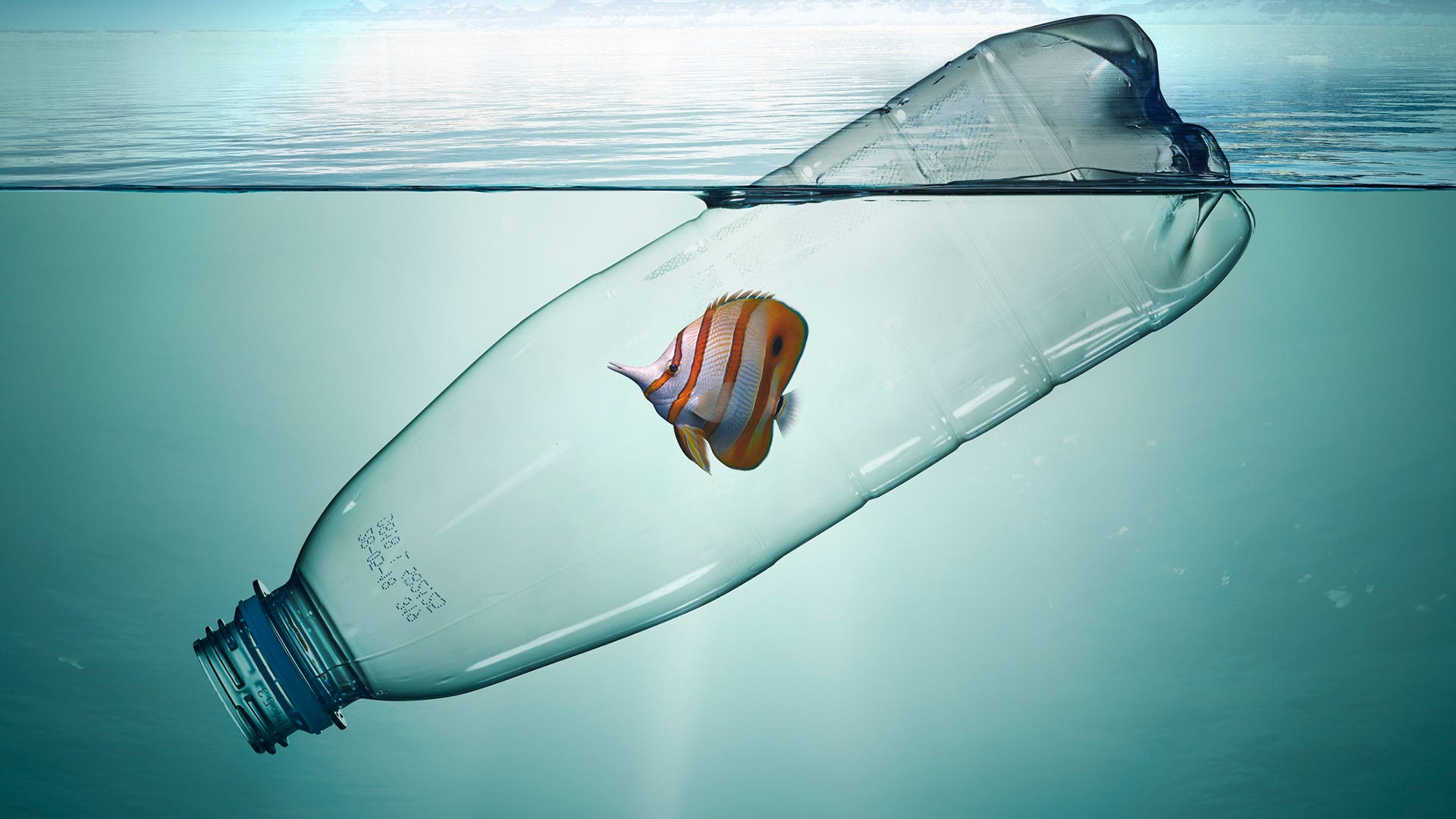
You’ve probably heard the headline: we consume the equivalent of a credit card’s worth of microplastics every week. While that number is significantly overestimated (likely by a factor of 10), more conservative estimates put weekly ingestion closer to 0.1-0.2 grams (roughly the weight of a grain of salt).[3] While scientists duke it out debating the exact weight, the particle count tells a more striking story because nanoplastics, the smallest, most biologically active fragments, weigh almost nothing but cause the most damage.
The biggest microplastic polluters are not the obvious ones. The largest dump of microplastics into the environment comes from paint (40% of paint ends up in the environment), followed by tire shedding (tires shed 10-16% of their weight over their lifetime), and then from the production and use of synthetic textiles (~estimated 35% of ocean-bound primary microplastics).[4] This highlights the need for systemic infrastructure, product design, and policy changes at the macro level to achieve significant change.
How much am I ingesting?
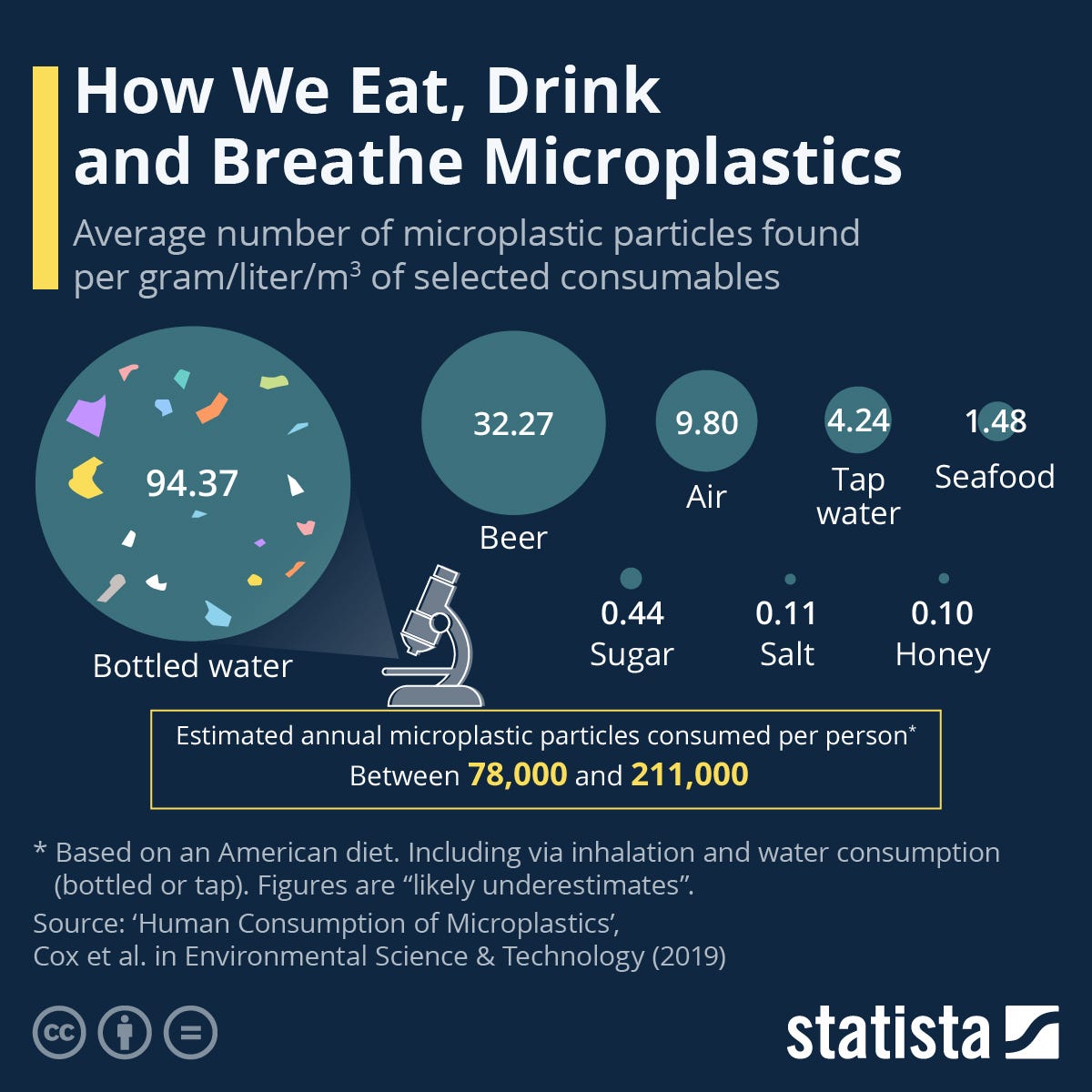
Depending on your habits and where you live, you are ingesting anywhere between 78,000 and 211,000 microplastic particles per year.[5] Drink bottled water regularly? Add another 90,000 particles per year compared to tap drinkers. That’s one lifestyle change I made after listening to a talk by Dr. Peter Lin at last year’s PRIMED conference. Switching from bottled to tap water is the single most measurable daily change you can make to cut your consumption. [6]
Thanks for reading Prescribing Awareness! This post is public so feel free to share it.
Microplastics drive chronic, low-grade inflammation by activating cytokines like interleukin-6 and TNF-α. They generate oxidative stress and damage cell membranes and your DNA. They have been linked to increased cancer risk, impairment of fertility, and contribute to metabolic and gut disruption.
A landmark study in the New England Journal of Medicine found that patients who had detectable microplastic particles in their carotid artery plaque had a 4.5-fold higher risk of heart attack, stroke, or death within three years compared to patients with minimal exposure. [7] Similarly, brain tissue concentrations in people with dementia have been reported to be 2 to 10 times higher than in those without. [8]
Unlike bacteria, microplastics cannot be killed, metabolized, or eliminated by your immune system. They’ve been found in blood, lungs, liver, kidneys, brain tissue, placentas, breast milk, and arterial plaque. The only strategy is to stop putting more in and support what your body can naturally excrete before particles embed deeper.[9]
Most people, when they hear “microplastics,” think of plastic water bottles and stop there. The impact of these chemicals stretches much further.
Between 1960 and 1970, industry, government policy, consumer psychology, and petrochemical ambition collided. We built a civilization around a material we cannot degrade. The exposure is everywhere.
Think about the lint trap in your dryer. Every time you open it, you are staring at a pile of microplastic fibres shed from synthetic clothing. I know I used to. Now I clean it with gloves, hold my breath and dispose of it immediately.
Think about the thermal receipt you grabbed at the pharmacy or coffee shop. Thermal paper is coated with BPA, a plastic endocrine disruptor that can absorb into your skin. Whenever possible, I ask for an email receipt, and I always wash my hands after coming into contact with receipts I do touch.
Think about the cutting board on your kitchen counter. If it’s plastic and scratched, every slice of food picks up polymer fragments. We’ve replaced ours with a glass one, but wood or bamboo are other options.
Think about your dishwasher. The combination of heat, moisture, and plastic is exactly the condition that accelerates polymer leaching. The resultant microplastics coat the interior surfaces of whatever you wash alongside them. We have switched to mainly glass/aluminum lunch containers, and we hand-wash any plastic containers we still have.
Think about how you heat leftovers. We use parchment paper as a barrier between food and any surface we’re unsure about.
Think about your tea ritual. Many commercial tea bags are sealed with plastic polymers. A single plastic tea bag steeped in boiling water can release millions of microplastic particles into your cup. Gone are the Tetely tea bags for chai. We have switched to loose-leaf tea and a stainless steel infuser. [10]
Your gut is the best elimination route for ingested particles. Fibre supports your gut barrier, preventing toxins from crossing into the blood, and it keeps things moving. Studies show 30-40grams per day increases stool bulk, reduces transit time, and can bind to some toxins.[11] I recently got the ‘My Fitness Pal’ APP to track my macros, and you can track your daily intake of fibre with the free plan yourself.
What surprised me most about microplastic elimination was the research on plasma and blood donation. PFAS chemicals, which often travel with microplastics, are found in blood. When high-exposure groups donated plasma regularly, their PFAS levels dropped by roughly 30-40% over a year.[12] Whole blood donation produced smaller but still meaningful reductions. Microplastics and nanoplastics bind to proteins in your blood. By donating blood, you remove a portion of the contaminated fluid and replace it with clean fluid from your own body.
As a society, we have normalized consuming processed food for forty years and are now watching a chronic disease epidemic play out in real time. Microplastics may be the next chapter of this story, only they are quieter, slower, and harder to trace.
It’s not all doom and gloom. Scientists at the University of Tokyo have developed a supramolecular plastic that dissolves completely in seawater within 2–3 hours. With less than 9% of plastic currently recycled and pollution projected to triple by 2040, replacing even 20–25% of plastics in use could make a meaningful impact on our environment. Although it’s still in development, it’s a start.
Realistically, only systemic change can solve this problem. But there are things you can control. Switching to filtered tap water, replacing your cutting boards, and donating blood twice a year will minimize exposure while you wait for the world to catch up.

There are a few spots still available for our upcoming Somatic Breathwork Journey on Friday, February 27th, at Goji Yoga Studio. Check out registration details HERE.
Manjit Hansra is the founder of Rx for Renewal. Through keynote speaking, 1:1 coaching, and curated retreats, I share evidence-based tools to help professionals prevent and manage burnout. Check my offerings HERE and book a complimentary call to improve your mental fitness HERE.
Comments
Nothing yet. Say the first thing.
Sign in to join the conversation.