
Last week I started doing events and interviews for my new memoir “A Room in Bombay.” Just like with previous books, one question I’m still invariably getting asked is “How does being a mathematician inform your writing?”
At the most foundational level, the fact that I started writing arose directly from being a mathematician. There’s so much pressure in academia to do just your day job that I wanted to rebel, strike out in a direction completely perpendicular to math. So, a couple of years after starting as an assistant professor, I penned a two-page story called “Unfulfilled Expectations.” None of the characters in the story fit the bill, so folks who read it would wonder just whose expectations had remained unfulfilled.
Gotcha – it was you, dear reader to whom the title referred. How’s that for a mathematical twist?
In those early days I was very taken with the idea that characters in a story are like variables in a mathematical theory. You let them loose to see where they went, what they did – much like you tried to figure out what values the unknowns x or y could take, how they might behave. Once you figured this out, you ended up with a story in the case of characters and a theorem in the case of variables.
Unfortunately, I carried this analogy too far. If characters were indeed equivalent to unknowns, then perhaps they should be left as blank as possible, I reasoned, so that readers could fill in their own preferred details. A great idea in math, but a terrible one for writing, as I found out soon enough. Because stories thrive on details, with characters coming alive in readers’ minds only if they are limned in sufficient depth.
As time went on, my writing became less precocious. I wrote only a story every year or two but benefited greatly from joining writing groups. They assured me my early efforts – aye, the same ones that remained unsubmitted because I couldn’t decide between the Atlantic and New Yorker – were, well, not very good. It was quite gruesome – like passing my babies around to have everyone tell me how ugly they were – but also very necessary.
In the mid-1990s I started a novel which quickly ground to a standstill. By now I was suffering massive writer’s block. My short stories had been rejected by dozens of literary journals, but my math research was going well. Shouldn’t I cut my losses and start concentrating only on mathematics? Succumb to the message that had become even shriller over time: do only one thing, so you can do it well?
I decided to give the writing one final try. I enrolled in a class taught by Michael Cunningham at the Fine Arts Work Center in Provincetown. To my surprise, he absolutely loved the three chapters I showed him. Michael was the first to ever call me a writer – not a dabbler or hobbyist, but a “real writer.” This was a cosmic revelation – I’d never thought of myself as anything but a mathematician. “You have to do whatever it takes to complete this,” he told me.
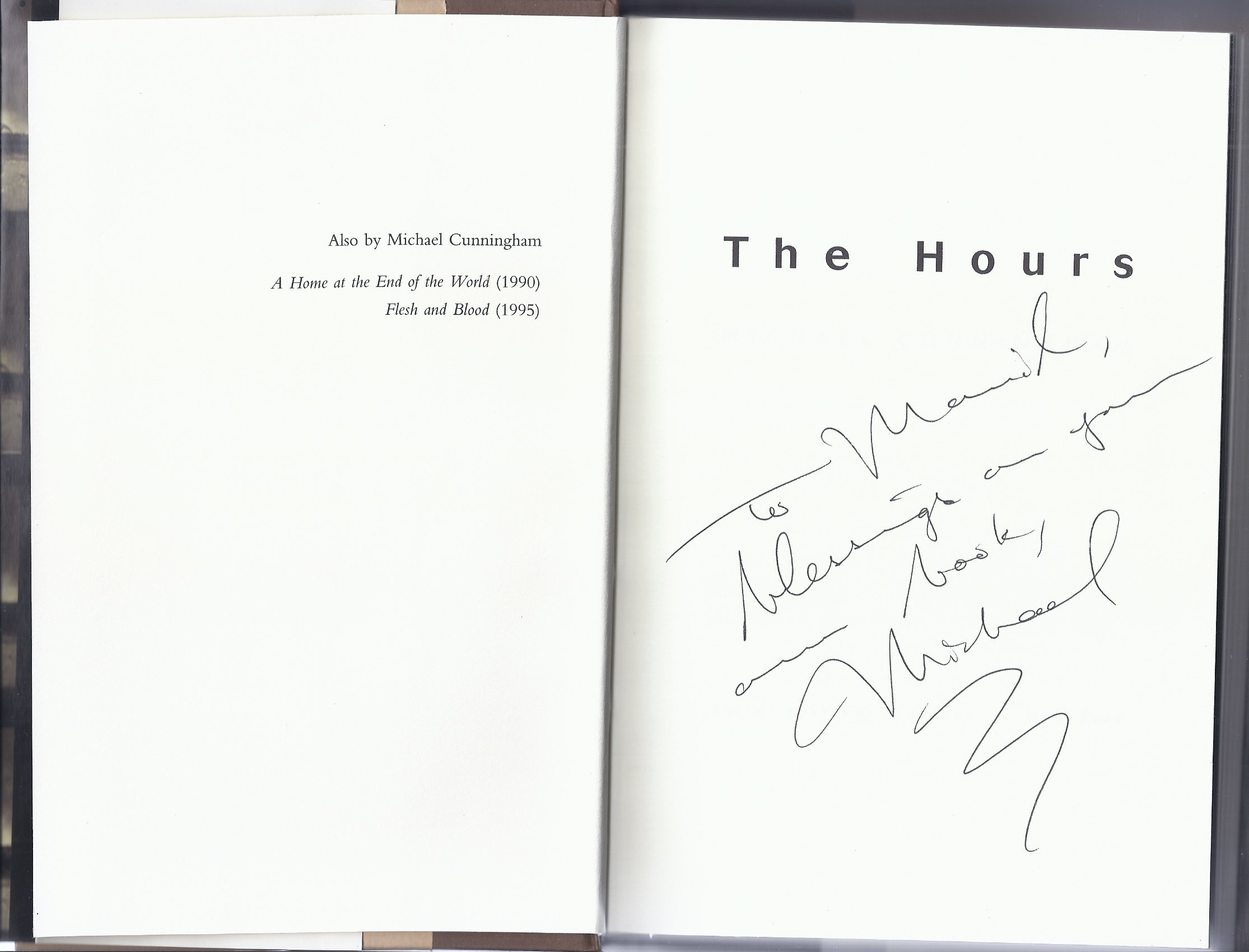
OK, if Michael Cunningham, who’d shortly go on to win the Pulitzer, had given me this directive, I better follow it. I spent part of the next summer at a writing retreat where I did not allow myself to do even a bit of math. My colleagues asked me what I’d been doing, and I replied I’d been writing a book. “A calculus textbook. Didn’t finish it, so next summer, I’ll have to go again.”
Finally, in 2000, I was done, and my debut novel, “The Death of Vishnu” was being readied for a Jan 2001 pub date. I attended a conference on the mathematics of “elastic shells” in Berkeley that spring, where by now, several of my colleagues had heard about my literary adventure. So they had me give a reading during one of the lunch hours. It went well – nobody stood up to denounce me for spending less than 100% of my time on math. My only regret: being too chicken to read them one of the racier parts.
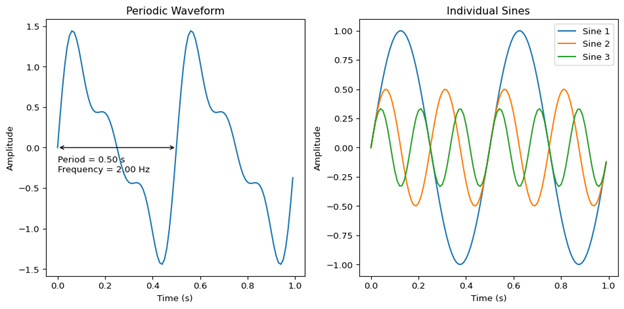
It was after my reading that Professor Juhani Pitkaranta, a colleague from Finland, made me ponder the connection between math and writing a little deeper. “Writing a story is like creating a Fourier series,” he commented. “You just need to choose the right basis functions.”
I know, I know, jargon alert! But quite easy to explain. You’ve probably seen sounds being represented by waveforms in audio components (as in the left-hand picture below). The right-hand picture shows how such waveforms can be decomposed into simpler constituents (in this case, three of them). These constituents are called basis functions, and their combination, which yields the waveform, is called a Fourier series. Many processes in math can be analyzed by figuring out what the “building block” basis functions are, since once you have those, you can combine them in different ways to obtain an endless array of compositions.
Professor P was alluding precisely to this kind of idea of “finding the building blocks and using them to compose.” His speculation was that in fiction, one has several core ingredients (love, mystery, murder, hero, heroine, villain, etc.) and one can use them in different ways to build various plots. As any writer will be quick to tell you, it’s not that laughably easy. There’s much more that goes on in a novel, so Professor P’s notion is a vast oversimplification.
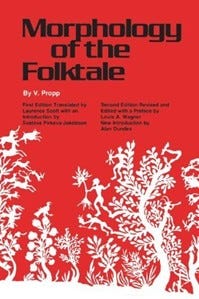
And yet, this idea has been seriously analyzed – not for literary novels, but for a much more basic form of fiction: Russian folk tales. Some of you might be already familiar with the Russian scholar Vladmir Propp, who, in 1928, published his seminal work, “Morphology of the Folk Tale.” In this, he analyzed 100 folk tales and showed that they are all built out of the same 31 plot components (such as “The hero leaves home,” “An interdiction is addressed to the hero,” “The interdiction is violated,” and so on). Not all of these might be used in a particular tale, but when they are, they occur in the same order. Moreover, Propp showed that all the characters could be reduced to seven archetypes (hero, princess, villain, etc.).
Propp’s ideas became quite influential after his work was translated into English in 1958. By then, Joseph Campbell’s complementary 1949 work, “The Hero With a Thousand Faces,” had also received a lot of attention. Campbell showed that the monomyth of “The Hero’s Journey,” where the hero goes through a selection of 17 narrative stages, is common to a host of literary works. This framework is often quoted by Hollywood screenwriters as being the basis of any successful movie (with George Lucas kicking off the trend by attributing some of the success of “Star Wars” to Campbell’s ideas). “Every story is a quest story,” is a popular adage that’s grown out of such considerations.
Now all this happened well before the AI era. So a chilling question for our times is, how have these ideas been integrated into Large Language Models (LLMs) like ChatGPT, Claude and Gemini? How close is AI to finding a larger and more comprehensive set of building blocks that could generate not just Russian folk tales or Hollywood scripts, but all stories? In other words, are we close to making fiction just a matter of generating, as Professor Pitkaranta would put it, a Fourier series?
For certain genres, like romance novels, recent reports indicate we’re already there – the field is on the cusp of being taken over by AI. Literary fiction, which thrives on being unpredictable and going down unexpected passageways, will be harder for LLMs to nail – though individual writers may increasingly use them as assistants. The problem is that even if many authors pledge to scrupulously eschew AI, readers will increasingly need to wade through a lot of AI-generated slop choking the marketplace.
But let me wrest you back from the AI precipice (it’s amazing how, no matter what we discuss these days, we’re always so close to it). Personally, I’ve never felt the “basis function” idea to be relevant to any of my books, and I doubt it ever will. Like many authors, I have a horror of being formulaic – that would defeat the purpose of why I took up writing in the first place.
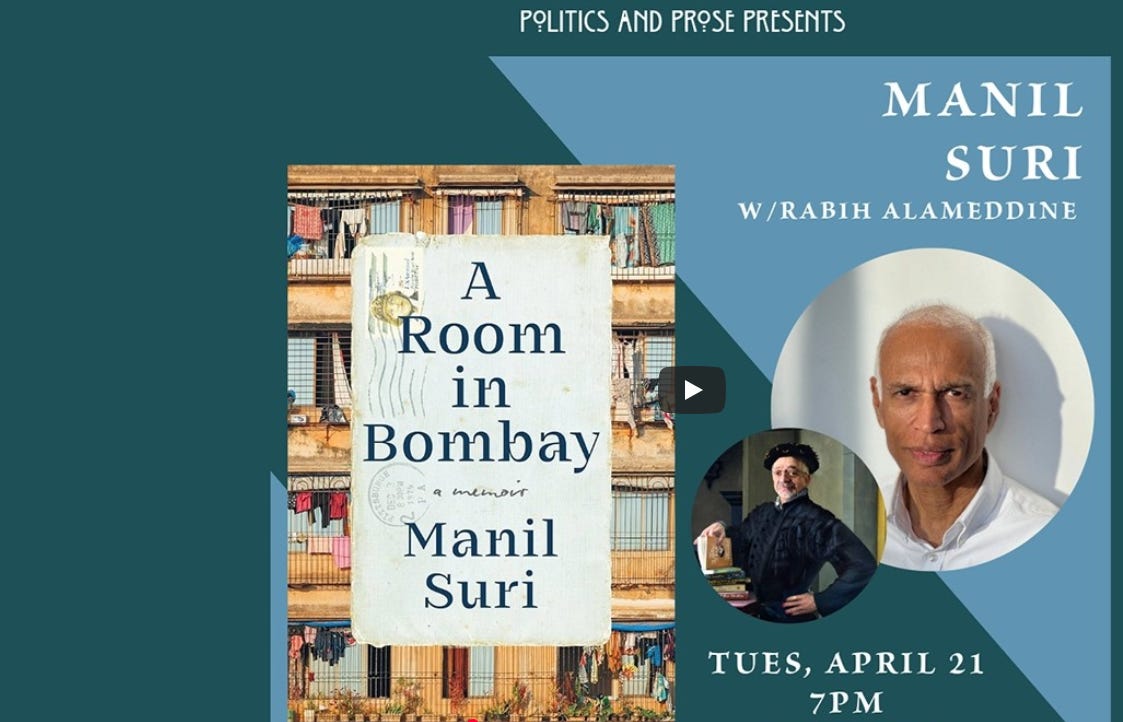
As for how math figures into my writing, I do have a couple of other ways this has happened – but let me save them for a future column. For now, let me leave you with this video – it’s the reading I gave at Politics and Prose on April 21 to launch “A Room in Bombay.” And yes, the question of math figuring in my writing does come up – though some of what I say is different from the answer I’ve discussed here.
Comments
Nothing yet. Say the first thing.
Sign in to join the conversation.