
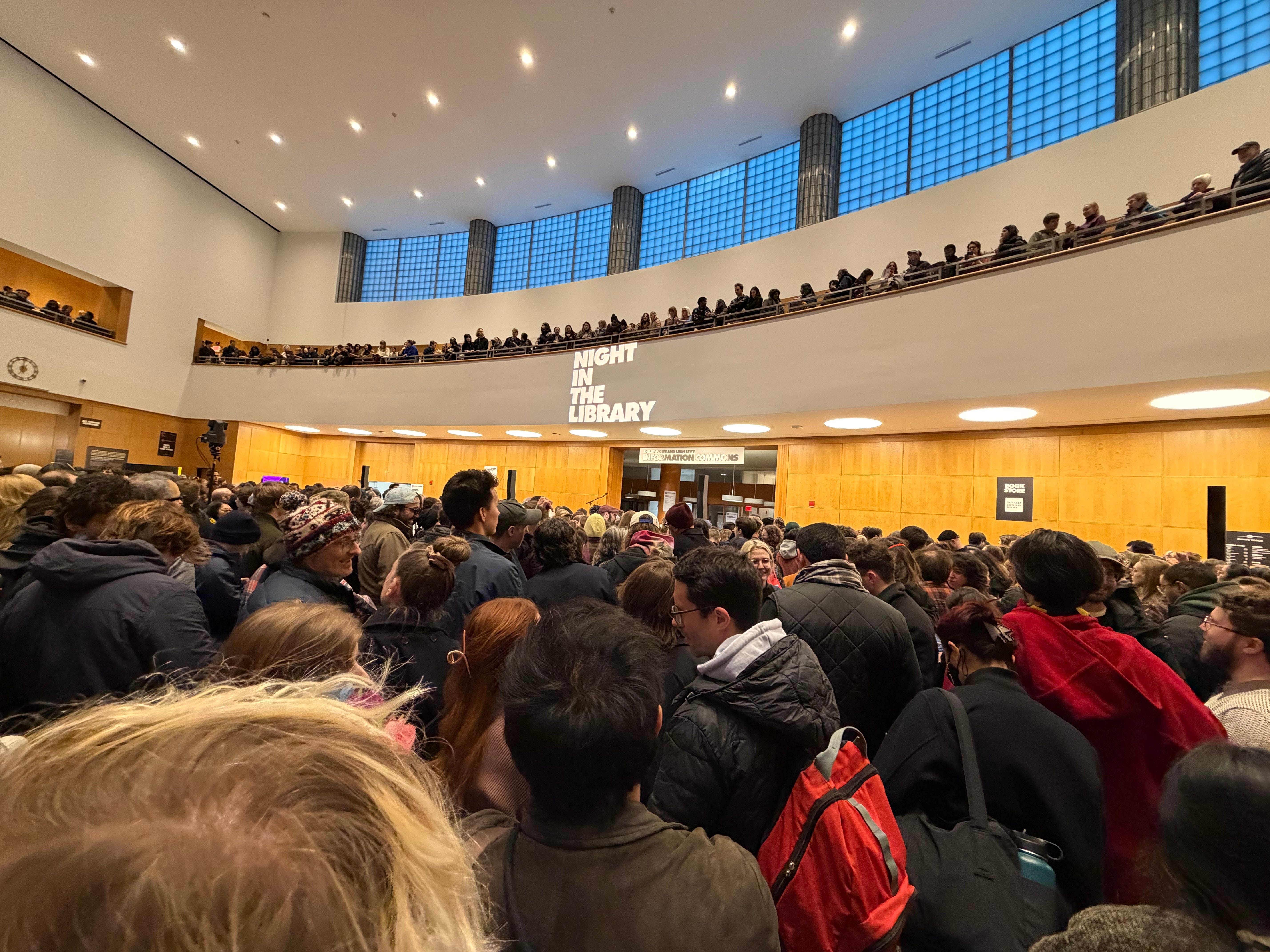
On March 14, 2026, this is what the central branch of Brooklyn Public Library looked like inside. It was their annual “Night in the Library” free event, and over 8500 people attended. The evening started soon after 7 pm with a keynote by the great German film director Werner Herzog and lasted until past 3 in the morning. It was their most well-attended such “Night” ever – more so than 2022’s “The Philosophy of Hip-Hop” and 2025’s “The Philosophy of the Sublime” (the latter, in comparison, drew 4900 folks).
So what was the topic this time? Surely something so sexy that neither Herzog nor the masses could resist being drawn in. Something so compelling that people were willing to queue all the way to the Brooklyn Museum for admission. To take a guess, focus on the date when the event occurred: 3/14. Or just look at the picture below.
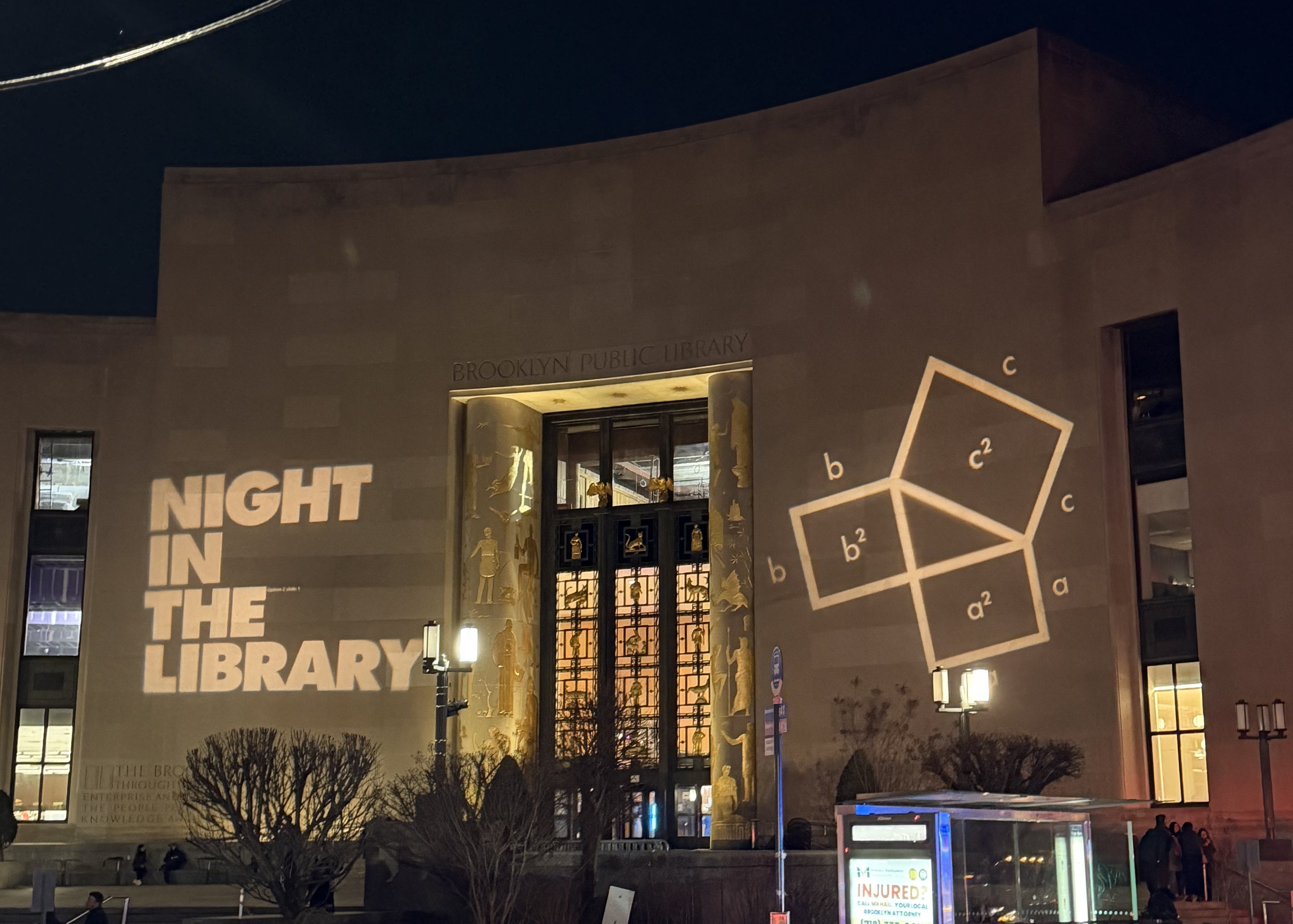
Yes, that’s the Pythagorean Theorem. And the event was held on 3/14, which is Pi Day. (It went on until exactly 3:14 am the next morning.) The topic? “The Philosophy of Mathematics.”
Mathematics? Yes, mathematics.
I know that might be hard for some to believe. Surely math is on the wrong side of the cultural divide, surely it appeals only to specialized audiences (nerds, if you want to be rude), surely with all the angst and frustration math causes, few would want to go to such an event willingly. As for Mr. Herzog, how could you? You’re an artist, a filmmaker, a man of letters – you shouldn’t be mucking around with something so dry, so emotionless, so stark and daunting. Why would you position yourself as a math emissary, enthuse about the beauty of the subject, take up cudgels for the other side?
One answer? To get thunderous applause – the audience loved his talk. Just like they loved sessions on mathematical myths and secrets, on what math has to say about space and time, on how tap dance can unlock the secrets of numbers or how to compose poetry from the digits of pi. There were up to nine parallel sessions going on at any time – so the library churned with waves of eager attendees going from event to event.
In my experience, such attendance is typical for accessible, well-publicized, public talks on math. There’s a real curiosity out there – not about the paper-and-pencil calculations of arithmetic and algebra – but about the realm of mathematical ideas and meaning and connections. As long as speakers keep their talks interesting, free of jargon, and at an understandable level – qualifications that can admittedly be a challenge sometimes – they can expect a pretty appreciative audience.
The problem is that organizers of cultural events often do not realize this – believing, instead, that anything mathematical will scare audiences away. Math doesn’t have a strong enough profile in the popular arena; it has a hard time competing with such surefire alternatives as art or literature or even physics. I’ve personally noticed this “gatekeeper” problem at US book festivals (not UK or Indian ones) – when was the last time you saw a festival author take the stage to talk about a book on math?
This is what makes the “Philosophy of Mathematics” event so cutting edge. Kudos to Brooklyn Public Library for taking what must have seemed like an enormous risk, and having it pay off so decisively. Praise is also due to the Simons Foundation for sponsoring the night as part of their Infinite Sums initiative to foster more math engagement nationally. Incidentally, their Infinite Sums T-shirts rock – I hope they market or distribute them widely to spread the message (should they want to send me one as swag, I wear a medium).
I personally didn’t get a chance to see too many events, since I was giving two talks myself. The 8 pm one was about math being philosophically driven by one of two main goals: The search for solutions to practical problems versus the search for beauty. The famous British mathematician G.H. Hardy, in his 1940 classic “A Mathematician’s Apology” (written near the end of his career), came down emphatically on the side of beauty, calling the more useful parts of math “dull,” and lacking “aesthetic value.” He particularly vaunted the “uselessness” of abstract mathematics – a position that hasn’t held up well over the decades, since even his own work has found extensive applications in practical problems.
In my talk, I looked back at my own career in applied math to find examples of both usefulness and beauty to share with the audience (yes, useful math can be beautiful). Squeezed in was a short tutorial about my field of finite element analysis – which, though few may have heard about it, is as ubiquitous in engineering as microplastics (but in a good way). I say “squeezed in” because they only gave me 20 minutes – the time limit for all presentations at the event. This is a bracing exercise, especially for mathematicians – it forces one to get down to the essentials and convey ideas rather than any technical stuff.
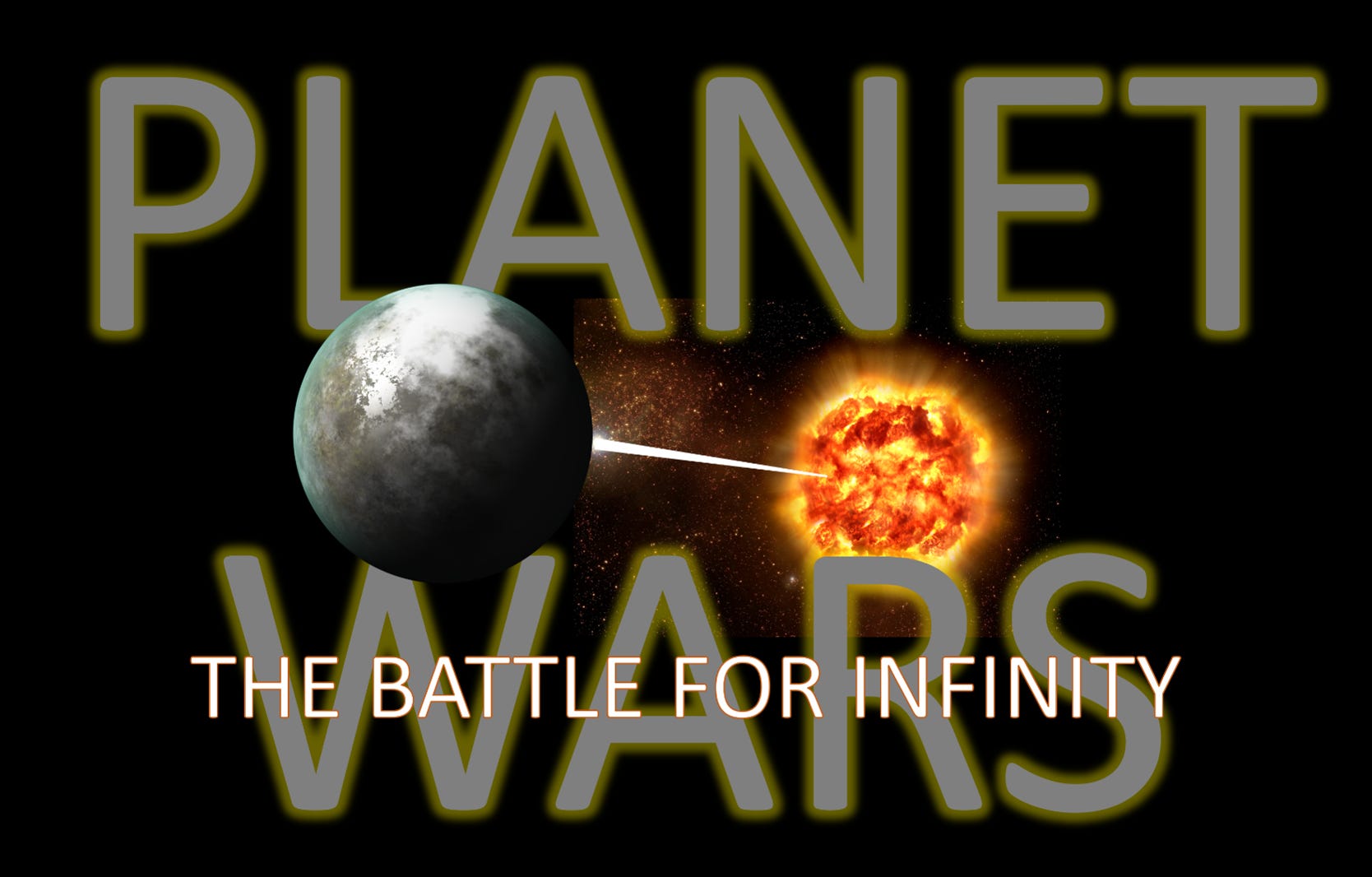
The 20-minute limit seemed even more daunting for my 10 pm talk, for which I made the poster above. This talk laid out some of Georg Cantor’s remarkable discoveries about infinity coming in different sizes. I decided to relate this as a bedtime fable – which was risky, especially at that time of night, since the audience needed to follow along, not doze off. Fortunately, it went over well; people remained alert and asked many questions afterwards. (If you’re curious about this fable, check out Chapters 32-34 of The Big Bang of Numbers.)
The coolest aspect of this talk was a guy in the front row who seemed to anticipate several of the mathematical steps in Cantor’s arguments. “Ah, someone in the first row has seen this before, so knows the answer,” I exclaimed to the crowd. “A professional math person, no doubt.” But chatting to him afterwards, I learned he was not a professional mathematician – hadn’t studied it since high school, in fact – but still felt an affinity for the subject. I encouraged him to reconnect with his inner mathematician, and he said he definitely will.
In fact, I daresay everyone in attendance that night couldn’t help but feel – to some extent or another – an ambient warmth, coming from a shared appreciation of math. The beauty of the festival was that it boldly explored so many different and innovative ways to spark such appreciation.
Year of Mathematics (YOM): The Brooklyn Library festival as well as Infinite Sums are all part of a nationwide initiative to treat 2026 as a special year of mathematics in the US. If you’re interested, there are many opportunities available to participate – check out the Simons Foundation and YOM websites.
Comments
Nothing yet. Say the first thing.
Sign in to join the conversation.