
April 13, 2016
Your brief time in the limelight should be purposeful and impactful—whether telling a story, interviewing for a job, or pitching an investor—Less is More is sage advice, and increasingly necessary because the attention span of any audience is limited by ceaseless inbounds and distractions.
“The Community Manifestao: on politics and economics” is a reader-supported publication. To receive new posts and support my work, consider becoming a free or paid subscriber. Or just read on below and enjoy.
Certainly attributable to my training in journalism, I still live by and impose deadlines in business, and one strategy I've found invaluable is to start every exercise with the 5Ws. The order may differ, but every opportunity for communicating (and understanding others' communiqués) starts with asking WHY, WHO, WHAT, WHERE, and I’ll start this post with WHEN: like when an opinion is attributed, it’s one step closer to fact. For pitching investors, Guy Kawasaki famously gave us the 10/20/30 Rule. For communicating to any potential investor, I recommend starting with the 5Ws.
So, it struck me as I filtered my morning barrage of inbound information on all things Crowdfunding, that due to the debut of “Regulation Crowdfunding” next month (May 2016), it is highly likely that a flood of retail investors will be entering the pre-IPO securities marketplace for the first time, and many first time entrepreneurs will be learning about the expectations of potentially hundreds and thousands of shareholders and stakeholders.
Reflecting its very name, “Regulation" Crowdfunding (the SEC's name for its rules surrounding Title III of the 2012 JOBS Act that introduced Crowd-based financing into our investment marketplace) will hold entrepreneurs of all stripes accountable, thus raising the need to relentlessly audit and edit the messages emitting from one's organization, from sales evangelist to compliance officer. So, in coordinating these efforts I recommend any gatekeeper to employ the 5Ws both in authoring and reviewing.
Some of you may be well-versed in Twitter-size messaging, and Tweets do teach discipline—like TV commercials and film trailers demonstrate, you only have a few moments before your audience flies away. But remember, not only will viewers vote with their attention to your message (and with shares, hearts and likes), but will critically grade your proposition and then volunteer that grade with the world instantly, and visible forever, and often without your agreement of consent. Reputations that may have taken a lifetime to earn, will be entirely vulnerable to (and hopefully survivable from) disinterest and disregard, much less dislike in the new marketplace of ideas and opinions about them. So, be diligent, because while the crowd may hold a ton of promise in many forms of support, it’s also merciless in voicing its now louder, lasting (and potentially lacerating) opinion.
On a movie set there is usually a professional, often closely aligned with Legal Counsel, dedicated to making sure every scene complies with details from ones before it, and with the script—they call that person a Continuity Supervisor. Advertisements, as well as sales presentations, are also scripted. Equally, a business plan, now visible and accountable to a large crowd of investors (and a world of opinionated thumb-liking interlopers) can be seen as a script, too. I should expect we’ll see a similar attention paid to this role in new companies funded by the Crowd, maybe call them “Accountability Officers”?
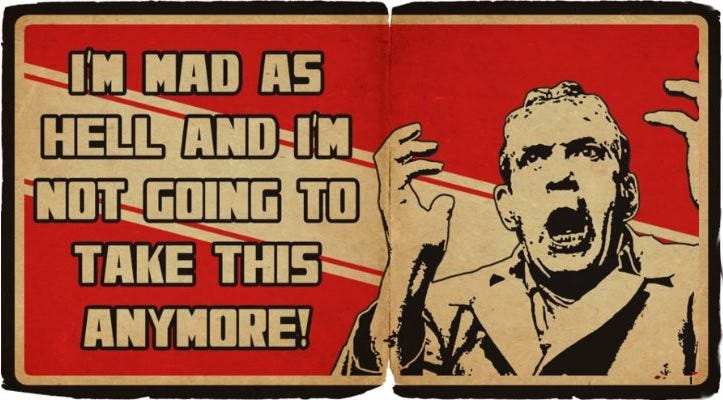
So, as long as we’re conscripted into creating shorter and shorter sound-bytes, as Jeff Daniels flawlessly lamented in one of the top scenes ever seen on the small screen (while channeling Peter Finch’s seminal, posthumous Oscar-winning rant in the 1976 film “Network”, and that still brings me to tears. Both clips below), do what reporters do—start (and stay) with the 5Ws…or hire a Continuity Officer to do it for you. Enjoy the show(s)…these are two of my favorite scenes of all time.
“The Community Manifestao: on politics and economics” is a reader-supported publication. To receive new posts and support my work, consider becoming a free or paid subscriber.
Comments
Nothing yet. Say the first thing.
Sign in to join the conversation.